
The State of the Staffing Industry in 2026

The staffing industry does not stand still. Consolidation, technology shifts, and changing workforce expectations have reshaped the market significantly over the past three years, and the pace is accelerating. Whether you work at a major agency, run your own firm, or are considering a move within the industry, understanding where things stand helps you make better career decisions.
This is not a report written for agency executives or PE investors. This is an overview of the staffing industry written for the people who actually do the work, recruiters. We are looking at market size, segment performance, technology adoption, M&A activity, and workforce trends, all filtered through the lens of what it means for your desk, your commission, and your career.
Market Size and Growth
The US staffing industry generated approximately $213 billion in revenue in 2025, according to Staffing Industry Analysts. That figure represents a modest recovery from the post-pandemic correction, with the industry growing at roughly 3-4% annually after a sharp dip in 2023.
To put that number in context: the sector employs over 2 million temporary and contract workers on any given day in the US alone. It touches virtually every sector of the economy. And it supports hundreds of thousands of recruiters, account managers, and operational staff at agencies of all sizes.
How Big Is the Staffing Industry Globally?
The global staffing market exceeds $500 billion in annual revenue, with the US, Japan, and the UK representing the three largest markets. Europe collectively accounts for roughly 30% of global staffing revenue, driven by strong markets in the UK, Germany, France, and the Netherlands.
The staffing industry market size has grown at a compound annual rate of approximately 5% over the past decade, though growth rates vary significantly by segment and geography. The fastest-growing segments are technology staffing and healthcare staffing, both benefiting from structural talent shortages that show no signs of resolving.
Segment Performance
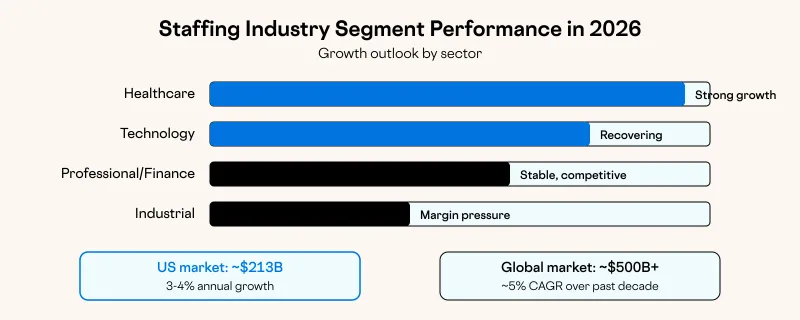
Not all segments are performing equally. Here is where the demand is strongest and weakest in 2026.
Healthcare Staffing: Still the Growth Engine
Healthcare staffing continues to outperform every other segment. The nursing shortage, an aging population, and increasing demand for allied health professionals have created sustained, structural demand. According to the Bureau of Labor Statistics, healthcare occupations are projected to grow 13% through 2032, much faster than the average for all occupations.
For recruiters, this means healthcare recruiter roles remain among the most plentiful and well-compensated in the staffing industry. Travel nursing has stabilised after the pandemic-era spike, but permanent healthcare placement demand remains extremely strong.
Technology Staffing: Evolving, Not Declining
Reports of technology staffing's decline have been exaggerated. While the FAANG hiring freezes of 2023-2024 created a temporary slowdown, the broader tech staffing market has recovered. Demand for cybersecurity, AI/ML, cloud infrastructure, and data engineering talent is particularly robust.
What has changed is the nature of tech staffing. More clients are hiring contractors and freelancers for project-based work rather than permanent roles. This shift favours agencies with strong contract staffing operations. Technical recruiter roles remain in high demand, though the skill set required has expanded to include understanding of AI tools and platforms.
Industrial and Light Industrial: Steady but Squeezed
The industrial staffing segment, warehouse, manufacturing, logistics, remains the largest by volume. However, margins are under pressure from automation, rising minimum wages, and increased competition. This segment is increasingly dominated by the largest staffing companies, which can compete on scale and technology.
For recruiters, industrial staffing offers high-volume placement opportunities but typically lower per-placement fees. The segment is most attractive for recruiters who enjoy the pace and do not mind lower margins offset by higher volume.
Professional and Financial Staffing: Premium but Competitive
Accounting, finance, and professional services staffing remains a premium segment with strong fees and stable demand. The challenge is competition. This is one of the most established segments in the staffing industry, and the major players (Robert Half, Hays, Michael Page) have deep client relationships that are difficult to displace.
For new agency owners or recruiters evaluating niches, professional staffing is viable but requires strong existing relationships to break in.
M&A Activity and Consolidation
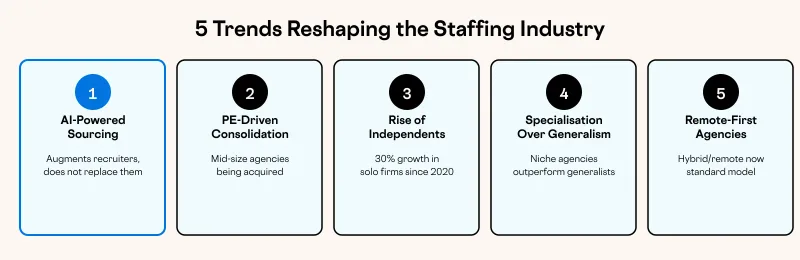
Private equity has fundamentally changed the staffing industry landscape. Over the past five years, PE firms have acquired hundreds of mid-size staffing agencies, driven by the industry's attractive margins, recurring revenue from contract staffing, and fragmented market structure.
What Consolidation Means for Recruiters
When your agency gets acquired, several things can change:
- Commission structures may be standardised across the combined entity, sometimes to your benefit, sometimes not
- Technology platforms will likely migrate, disrupting workflows
- Management layers may be added, reducing the direct access to leadership that many mid-size agencies offer
- Culture often shifts toward the acquiring entity's norms, which can be a significant change if a PE firm is driving operational efficiency
The practical takeaway: if you work at a mid-size agency, understand your firm's ownership structure and likelihood of being acquired. PE-backed agencies are often being groomed for a further sale, which creates uncertainty. Independently owned agencies may offer more stability, or they may eventually sell too.
Notable Consolidation Trends
The largest staffing companies continue to grow through acquisition, not just organic growth. Randstad, Adecco (now The Adecco Group), and ManpowerGroup have all made significant acquisitions in the past two years, particularly in technology and healthcare staffing.
Meanwhile, a wave of "platform" acquisitions has created new mid-market players. PE firms buy a strong agency, then bolt on smaller acquisitions in adjacent niches or geographies, building combined entities with $100M-$500M in revenue within a few years.
Technology Trends Reshaping the Staffing Industry
Technology is the single biggest force changing how the sector operates. Three trends matter most for recruiters in 2026.
AI-Powered Sourcing and Matching
AI tools can now source candidates, screen resumes, and match profiles to job specifications faster than any human. This does not replace the recruiter: relationship management, negotiation, and nuanced candidate assessment remain fundamentally human skills. But it does change the job. Recruiters who learn to work with AI tools are significantly more productive than those who resist them.
Agencies that invest in recruitment technology give their recruiters a tangible productivity advantage. Those that lag behind are asking their people to compete with one hand tied behind their back.
ATS and CRM Consolidation
The staffing tech market is consolidating. Bullhorn remains dominant in the agency ATS space, but competitors like Loxo, Vincere, and Manatal are gaining ground with modern, AI-native platforms. The trend is toward all-in-one platforms that combine ATS, CRM, sourcing, and outreach in a single tool.
For recruiters, this consolidation is largely positive. Better tools mean less time on admin and more time on the activities that generate revenue.
Remote Work Infrastructure
The recruitment sector itself has gone significantly remote. Pre-pandemic, most agency recruiters worked from an office. Now, a substantial percentage work in hybrid or fully remote models. This shift has created new opportunities for recruiters in lower-cost markets to work for agencies based in expensive cities, and it has enabled the rise of home-based recruiting businesses.
Workforce Trends Affecting Recruiters
The Talent Shortage in Recruiting
It sounds ironic, but the sector has its own talent shortage. Recruiter turnover rates remain well above average, and agencies consistently struggle to hire and retain quality billers. According to industry surveys, average agency recruiter tenure is approximately 18-24 months.
This creates opportunity for experienced recruiters. If you can bill consistently, you have more leverage than ever, whether that means negotiating better commission at your current agency, moving to a better agency, or going independent.
The Rise of Independent Recruiters
More recruiters are going independent than at any point in the industry's history. Low-cost technology, remote work normalisation, and favourable market conditions have made solo recruiting businesses genuinely viable. The number of recruiting firms with fewer than 5 employees has grown by an estimated 30% since 2020.
If you are considering this path, our guide on how to start a recruiting business covers the full process.
Specialisation Over Generalisation
The market continues to reward specialist recruiters over generalists. Agencies focused on a single niche consistently outperform generalist firms on margin, fill rates, and recruiter satisfaction. The trend toward specialisation is accelerating as clients increasingly demand recruiters who genuinely understand their talent market.
What This Means for Your Career
The state of the staffing industry in 2026 creates several strategic implications for your career:
If you are at a large agency: Your firm is likely growing through acquisition. Understand the integration plan and how it affects your desk, commission, and career path. Large agencies offer stability but are increasingly driven by PE efficiency metrics.
If you are at a mid-size agency: You may be an acquisition target. This is not necessarily bad: being acquired can bring better technology, more clients, and career opportunities. But it can also bring culture clashes and commission restructuring. Know your options.
If you are considering going independent: The market conditions are favourable. Technology costs have dropped, remote work is normalised, and clients are increasingly willing to work with specialist independents. But competition from other independents is growing too.
If you are evaluating which sector to specialise in: Healthcare and cybersecurity staffing offer the strongest structural demand. Technology staffing is recovering. Industrial staffing is high-volume but margin-pressured. Professional services staffing is stable but competitive.
Browse recruiter jobs across the staffing industry, or explore recruiting companies to see which firms are actively hiring in your niche.
FAQ
How big is the staffing industry in the US?
The US staffing industry generated approximately $213 billion in revenue in 2025, making it one of the largest service industries in the country. The sector employs over 2 million temporary and contract workers daily and supports hundreds of thousands of internal agency staff. Growth is projected at 3-4% annually through 2028, driven primarily by healthcare and technology staffing segments.
Is the staffing industry growing or shrinking?
The staffing industry is growing, though the pace varies by segment. Healthcare staffing and technology staffing are growing faster than the overall market. Industrial staffing is growing slowly with margin pressure. Globally, the market has grown at roughly 5% annually over the past decade. The overall trajectory is positive, but individual segments and geographies tell very different stories.
What are the biggest staffing industry trends in 2026?
The five most significant staffing industry trends are: (1) AI adoption in sourcing and candidate matching, (2) continued PE-driven consolidation and M&A activity, (3) the rise of independent and home-based recruiting firms, (4) increasing specialisation over generalisation, and (5) permanent remote and hybrid work models within agencies. Each of these trends directly affects recruiter compensation, career options, and day-to-day work.
Is the staffing industry a good career in 2026?
Yes, particularly for recruiters who specialise and adapt to technology changes. Recruiter demand remains strong across most segments, and the talent shortage within the sector itself means experienced billers have significant negotiating power. Commission-based earnings continue to offer above-average income potential for consistent performers. The industry also offers multiple career paths, agency, in-house, independent, management, giving recruiters flexibility in how they build their careers.
How does PE ownership affect staffing agencies?
Private equity ownership typically brings increased operational efficiency, technology investment, and growth pressure. For recruiters, this can mean better tools and bigger client books, but also standardised commission structures, more reporting requirements, and cultural changes. The impact varies significantly by PE firm and management team. Some PE-backed agencies maintain strong recruiter cultures; others prioritise margin optimisation in ways that reduce recruiter satisfaction.