
How to Start a Recruiting Business: From Zero to Revenue

Figuring out how to start a recruiting business begins with a simple realization: you have been billing for someone else long enough. The commission split stings every month, and you know you could build something on your own. The question is not whether you can recruit. You have already proven that. The question is whether you can run a business while recruiting.
The decision to start a recruiting business is one of the most natural entrepreneurial moves in the staffing industry. The barrier to entry is relatively low compared to other businesses, the margins are strong, and you already have the core skill. But "low barrier to entry" does not mean "easy." Roughly half of new recruiting businesses fail within three years, usually not because the founder cannot recruit, but because they underestimate the business side.
This guide walks you through every step of how to start a recruiting business, from legal formation to your first placement and beyond. No generic business advice. This is written for recruiters who know the industry and want the specifics.
Decide Your Model Before Anything Else
Before you file paperwork or buy a domain, anyone learning how to start a recruiting business needs to answer the fundamental question: what kind of recruiting business are you building?
Contingency vs Retained vs RPO
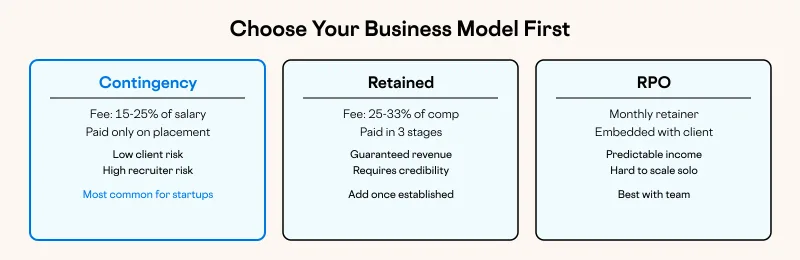
When you start a recruiting business, your fee model shapes everything. Your cash flow, your client relationships, and your risk profile.
Contingency is where most new recruiting businesses start. You only get paid when you make a placement. The advantage is that clients have zero upfront risk, making it easier to win business. The disadvantage is that you can invest significant time in a search and earn nothing if the client fills the role internally or through another agency.
Retained search means the client pays you in stages (typically a third upfront, a third at shortlist, a third at placement). The advantage is guaranteed revenue and committed clients. The disadvantage is that clients expect a premium service, and you need credibility and track record to sell retained engagements.
RPO (Recruitment Process Outsourcing) means embedding within a client to manage some or all of their hiring. The advantage is predictable monthly revenue. The disadvantage is that you are essentially trading your time for a fixed fee, and scaling requires hiring.
Most people who start a recruiting business begin with contingency placements, build a track record, and layer in retained work or RPO engagements as credibility grows.
Pick Your Niche
The single biggest mistake when you start a recruiting business is going too broad. "We recruit for everyone" means you compete with everyone. Niche down hard.
Choose a sector or function where you have:
- Existing relationships with candidates and hiring managers
- Deep knowledge of the talent landscape, compensation benchmarks, and hiring patterns
- A network you can activate immediately
- Genuine interest: you will be living in this space for years
Strong niches when you start a recruiting business include healthcare staffing (sustained demand, high margins), technology (high fees, large candidate pool), and professional services (accounting, legal, finance).
If you are not sure where to focus, look at your billing history. Where did your best placements come from? Which sector did you enjoy working most? Start there.
Legal and Financial Setup
Business Entity
When you start a recruiting business, form an LLC at minimum. An LLC protects your personal assets from business liabilities and provides tax flexibility. In most states, you can form an LLC online for under $500.
If you plan to bring on partners or seek investment, consider an S-Corp election for tax advantages on self-employment taxes. Consult an accountant before choosing: the right structure depends on your projected revenue and state tax rules.
Insurance
You need at minimum:
- Professional liability (E&O) insurance: Covers claims that your services caused financial harm to a client. Essential for any recruiting firm. Expect $1,000-$3,000 annually.
- General liability insurance: Covers basic business risks. Required by many clients before they will sign your terms.
- Workers' compensation: Required in most states if you have employees, and some clients require it even for contract staffing.
If you plan to offer contract or temp staffing (W-2 employees on your payroll), your insurance requirements increase significantly. Consider this before deciding whether to include contract staffing in your model.
Business Bank Account and Finances
Open a dedicated business bank account immediately. Do not mix personal and business finances. You will need:
- A business checking account
- A business credit card (for tech subscriptions, LinkedIn recruiter licence, marketing)
- An invoicing system (FreshBooks, QuickBooks, or similar)
- A reserve fund covering 6 months of operating expenses
That last point is critical. Most new recruiting businesses take 3-6 months to generate their first placement fee. If you are running contingency, you might be working for 90 days before any revenue comes in. You need enough runway to survive that gap.
According to the Small Business Administration, undercapitalisation is one of the top reasons small businesses fail. For a recruiting firm, plan for $15,000-$30,000 in startup costs and 6 months of living expenses as your safety net.
Build Your Tech Stack
Your technology decisions will either make you efficient or slow you down. Here is the minimum viable tech stack when you start a recruiting business:
Essential Tools
- ATS/CRM: Bullhorn, Loxo, or Recruit CRM are popular choices for small agencies. Expect $50-$200/month per user. Your ATS is your business, do not skimp here.
- LinkedIn Recruiter: Non-negotiable for most niches. Budget $800-$1,200/month for a Recruiter licence. LinkedIn Recruiter Lite ($170/month) can work initially, but you will outgrow it quickly.
- Email and communication: Google Workspace or Microsoft 365. Professional email on your domain is essential for credibility.
- Sourcing tools: Depending on your niche, SeekOut, Hiretual (now hireEZ), or Apollo for candidate sourcing beyond LinkedIn. Budget $100-$300/month.
- VoIP phone system: A professional phone number with call recording. RingCentral, Dialpad, or Grasshopper. Budget $30-$50/month.
- Accounting: QuickBooks or Xero for invoicing, expense tracking, and basic financial reporting. $30-$70/month.
Nice-to-Have Tools
- Video interviewing: Zoom Pro ($13/month) for client and candidate calls
- E-signature: DocuSign or PandaDoc for contracts and terms of business
- Website: A simple, professional site on WordPress or Squarespace. Budget $500-$2,000 for initial setup
Total tech stack cost to start a recruiting business as a solo operator: roughly $1,500-$2,500/month. That sounds steep, but these tools directly generate revenue. An experienced recruiter with the right tech stack can out-bill a team of three working with spreadsheets and personal LinkedIn.
Win Your First Clients
This is where most people who start a recruiting business struggle. You know how to source candidates and fill roles. But building a client book from zero requires a different skill set: business development.
Leverage Your Existing Network
Your first clients should come from relationships you already have. Former hiring managers, colleagues who moved to the client side, and professional contacts in your niche.
Make a list of every hiring manager you have successfully worked with. Reach out personally: not with a mass email, but with a genuine conversation about your new venture. Most recruiters find that their first 2-3 clients come from this list.
Client Acquisition Strategy
Once you have exhausted warm contacts, you need a systematic approach to new business development:
- Target account list: Identify 50-100 companies in your niche that regularly hire for the roles you place. Research their current hiring activity, agency usage, and decision-makers.
- Outreach cadence: Structured outreach combining LinkedIn messages, emails, and phone calls. Aim for 20-30 new prospect touchpoints per week while you are building the book.
- Content marketing: Share market insights, salary data, and hiring trends in your niche. This positions you as a specialist and generates inbound interest. LinkedIn posts and a simple blog are enough to start.
- Referrals: Every successful placement is an opportunity for a referral. Ask systematically: "Who else in your network is hiring for similar roles?"
Terms of Business
Get your commercial terms right from the start:
- Standard contingency fee: 15-25% of first-year salary, depending on your niche and seniority level. For specialist or hard-to-fill roles, 20-25% is standard. Do not undercut yourself to win business.
- Payment terms: Net 30 is standard. Push for Net 15 if you can. Include late payment penalties in your terms.
- Guarantee period: Typically 60-90 days. A candidate who leaves within this period means you refund a portion of the fee or provide a replacement.
- Exclusivity: Where possible, negotiate exclusive or preferred-supplier arrangements. Exclusivity drastically increases your fill rate and reduces wasted effort.
Have a solicitor or business attorney review your terms of business before sending them to clients. A few hundred dollars in legal fees now can save you thousands in disputes later.
Realistic Timeline to Revenue
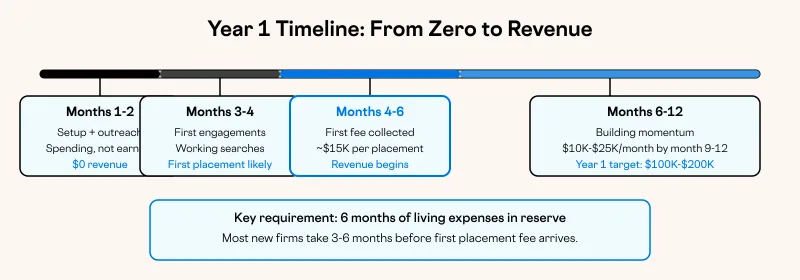
Here is what the first 12 months typically look like when you start a recruiting business:
Months 1-2: Business setup, tech stack, and initial outreach. You are spending money, not making it. Focus on building your pipeline of clients and candidates.
Months 3-4: First client engagements. You are actively working searches. If you came from agency with a warm network, your first placement may land here.
Months 4-6: First placement fee collected. For a mid-level professional placement at 20% of a $75,000 salary, that is $15,000. One placement covers several months of operating costs.
Months 6-12: Building momentum. Most successful new recruiting businesses are billing $10,000-$25,000/month by month 9-12. Some hit this earlier; some take longer. The key variable is how quickly you build a repeat-client base.
Year 1 revenue target: $100,000-$200,000 in placement fees is a realistic target when you start a recruiting business as an experienced recruiter going solo. Your net profit after expenses will be significantly higher than what you were earning as a percentage of billings at an agency.
Is starting a staffing agency profitable? The short answer is yes, if you can bill consistently. According to Staffing Industry Analysts, the average gross margin on permanent placements is 18-25%, and the average gross margin on contract staffing is 25-35%. A solo operator with low overhead can take home 60-70% of revenue as profit.
Scale or Stay Solo
Once your recruiting business is billing consistently, you face the growth decision. Do you hire recruiters and build a team, or stay solo and maximise personal income?
Staying solo means higher margins, less overhead, and complete control. Top solo recruiters in specialist niches bill $300,000-$500,000 annually. The ceiling is your personal capacity.
Building a team means lower margins per recruiter but higher total revenue. You transition from billing to managing, and not every great recruiter is a great manager. Hiring your first recruiter is the biggest risk you will take, a bad hire in a two-person firm is catastrophic.
If you decide to scale, your first hire should be someone you have worked with before. Proven billers with a track record you can verify. Write a proper recruitment agency business plan before scaling, and make sure the numbers support the investment.
For an alternative path, read our guide on working as a freelance recruiter: it is a middle ground between agency employment and full business ownership.
Common Mistakes to Avoid
Having worked with and spoken to dozens of recruiters who learned how to start a recruiting business the hard way, these are the mistakes that come up repeatedly:
- Going too broad: Niche down. You are competing against agencies with hundreds of recruiters. Your advantage is specialist expertise, not scale.
- Underpricing your fees: Do not discount to win business. Clients who choose the cheapest agency are not the clients you want. Your fees reflect your value.
- Ignoring cash flow: Revenue is not cash. A placement in March might not generate a payment until May or June. Manage your cash flow religiously.
- Neglecting business development when busy: The moment you stop prospecting because you are busy filling roles is the moment your pipeline dries up three months later. Always be developing.
- Not getting terms in writing: Verbal agreements lead to disputes. Every client engagement needs signed terms of business before you start a search.
- Trying to do everything yourself: Outsource bookkeeping, legal, and admin early. Your time should be spent on two things: billing and business development.
What to Do Next
Learning how to start a recruiting business is a significant career move, and it is not for everyone. If you are still at an agency and evaluating your options, start by reviewing the best staffing agencies to work for. It might be that a better agency, not your own agency, is the right next step.
If you are committed to going independent but want to keep overhead minimal, our guide on how to start a recruitment company from home covers the lean-startup approach specifically.
Ready to list your first roles? Post recruiter jobs on Recruiter Roles and reach the professionals who are actively looking.
FAQ
How much does it cost to start a recruiting business?
When you start a recruiting business, plan for $15,000-$30,000 in startup costs covering business formation, insurance, technology subscriptions, and initial marketing. On top of that, keep 6 months of personal living expenses in reserve. The biggest ongoing cost is LinkedIn Recruiter ($800-$1,200/month) and your ATS ($50-$200/month). You can start a recruiting business from home to significantly reduce overhead, no office lease required.
Is starting a staffing agency profitable?
Yes, when you start a recruiting business you enter one of the most profitable small business categories. Gross margins on permanent placements are typically 18-25%, and solo operators with low overhead can take home 60-70% of revenue as profit. An experienced recruiter billing $200,000 in their first year can realistically net $120,000-$140,000 after expenses. The key is consistent billing and disciplined cost management.
How long does it take to get your first client?
If you have an existing network of hiring managers from your agency career, your first client can come within weeks. Most new recruiting businesses secure their first client engagement within 1-3 months of launch. The first placement fee typically arrives 3-6 months after starting, depending on your niche's hiring cycle and the seniority of roles you fill.
Do I need an office to start a recruiting business?
No. Many people who start a recruiting business operate entirely from home. Clients care about your results, not your office address. A professional phone system, video conferencing setup, and a quiet workspace are all you need. If you meet clients in person, co-working spaces with bookable meeting rooms are a cost-effective alternative to a full office lease.
What legal structure should I use to start a recruiting business?
An LLC is the most common and practical choice when you start a recruiting business. It provides personal liability protection with minimal administrative burden. If you expect to earn over $80,000-$100,000 in net profit, consider an S-Corp election for tax savings on self-employment taxes. Always consult an accountant who understands your state's tax rules before making this decision.
Should I start with permanent placements or contract staffing?
Start with permanent placements unless you have specific experience in contract staffing. Permanent placements generate larger one-time fees with less administrative overhead. Contract staffing (placing W-2 employees on your payroll) requires additional insurance, payroll processing, and working capital to cover the gap between paying contractors and collecting from clients. Add contract staffing once your permanent placement business generates consistent cash flow.