
How to Win Your First Retained Search Client

Almost nobody wins retained search clients cold. You win the first one by converting a contingent client who already rates your delivery, then asking for the conditions you need to keep delivering at that level. That conversation takes ten minutes, happens after a placement rather than before one, and turns on a single question: do you want this service, or the cheapest version of it?
Here is the sequence that works, the words that carry it, and the four objections you will hear.
Key takeaways
- Convert, don't cold-pitch. Every recruiter quoted here won their first retainer from an existing client.
- Sell the method, not the model. Clients pay up front for mapping, assessment, and reporting.
- Offer a choice of two structures, never a yes-or-no on one.
- Never fold to contingency in the same conversation. Folding costs the credibility that made the ask work.
The recruiter quotes below come from our library of 228 interviews, all from one show, The Elite Recruiter. Treat them as informed practitioner opinion, not an industry survey.
Start with a client who already trusts your delivery
The clean route into retained search is not a new logo. It is an account where you have filled roles, the hiring manager takes your calls, and the relationship survives a difficult conversation.
Nicolas Greppo described the mechanics on Starting a Recruitment Business. He ran contingent assignments using retained methodology from the start: direct approach, comprehensive market mapping, an hour-long briefing up front. Then he made the ask. "Look, do you like the service that I deliver? Yes. Okay. For me to be able to continue to deliver this service, these are the conditions I need to put in place." He was blunt about the cost: "I lost a few ones, but most of the clients I had started to work with had just converted from contingent to retained after 12, maybe maximum 18 months."
Two things worth copying. He delivered the retained standard before he charged for it, so the ask had evidence behind it. And he accepted attrition. Some clients left. That is the price.
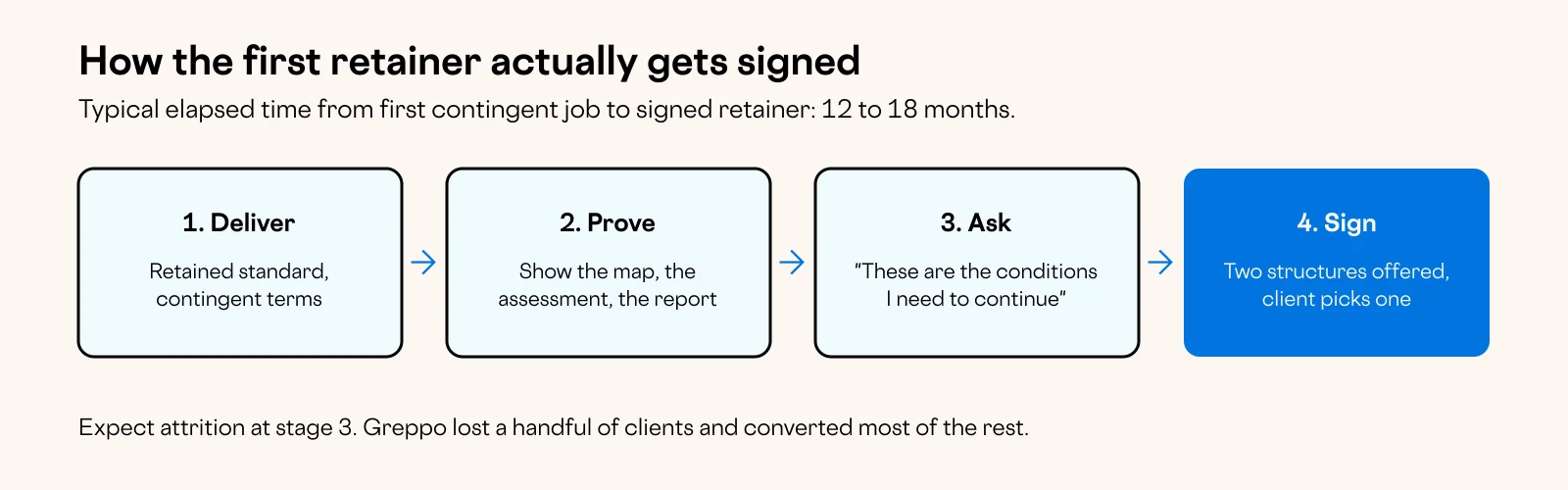
What you sell at stage three is work the client can see before a candidate appears: an hour-long briefing, a written document that sells the role rather than describing it, defined competencies and a defined way of assessing them, and agreed parameters covering geography, target companies, and off-limits firms. Each is a deliverable you can name on a call without using the word "retained".
The conversation, roughly word for word
Adapt the language, keep the order.
- Open on their result, not your model. "We've filled three roles for you this year. Before we start the next one I want to change how we work on it, and I think you'll get a better outcome."
- Name the constraint honestly. "When I'm working your role alongside four other firms, I'm optimizing for speed. I send you what I can reach fastest. That's fine for a sales hire. It's the wrong process for this one."
- Describe the alternative as work. "On an engaged basis I map your whole market, approach the people who aren't looking, assess against competencies we agree, and send you a written progress report every two weeks. You see the map whether or not you hire from it."
- Ask plainly. "To commit that time I need the search exclusively and an engagement fee up front, credited against the total."
- Give them a choice of two. Not yes or no. Either "$7,500 engagement against a 28% fee" or "straight contingency at 33%". David Bradley's firm leads with exactly that pairing on The Elite Recruiter roundtable, for a behavioural reason: "The client likes to have choice, and sometimes they'll default just to one or the other."
Then stop talking. The most common failure at step five is filling the silence with a discount.
The four objections and what to say
The table pairs each objection with the answer working recruiters use. The right-hand column is the reasoning, so you can rebuild the answer in your own words rather than reciting it.
| Objection | Response | Why it works |
|---|---|---|
| "We don't pay before we hire." | "Understood. Then let's do it contingent at 33% and I'll work it the way contingent gets worked. The engaged version is 28% and a different process. Both are real options." | Refuses the false choice between your terms and no deal, without dropping the price. |
| "What if you don't find anyone?" | "Then you have a mapped market, a documented assessment of everyone in it, and a fee that stops at the end of the term. You'd have none of that from a contingent search that also failed." | Reframes the retainer as buying information, which is what it buys. |
| "Another firm will do it on contingency." | "They will, and they should. If speed is what this role needs, use them. This role isn't that." | Concedes the point that is true and holds the one that matters. |
| "Can you reduce the fee?" | "I can change the structure. I can't change the rate." | Keeps the negotiation on payment timing rather than percentage. |
On that last one, Jon Brooks made the arithmetic point on Mastering Pricing Strategies for Elite Recruiters that most recruiters miss in the moment: "Lots of people I see dropping from 20 to 15, for example, and that's a quarter of their fee, but it doesn't sound like it's a quarter of the fee. So some consultants can get tricked into thinking, oh yeah, it's not too bad, I only gave away 5%. You didn't."
Structure the first one so it is easy to say yes to
Your first retainer does not have to be a full three-stage engagement. Two lighter structures come up repeatedly, and both lower the client's perceived risk without lowering your rate.
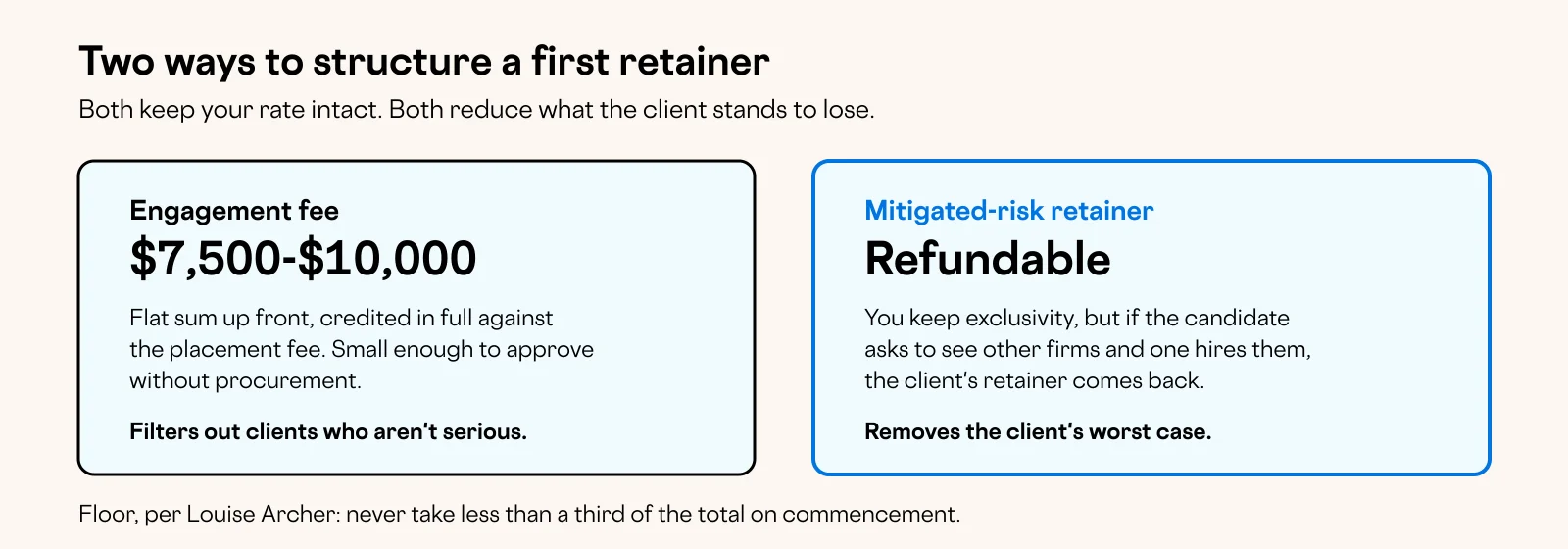
Scott Love described the second one on his Elite Recruiter session: "You are retaining me on this search, but if the candidate requests that I send him or her to other organizations I am free to do that, but I will tell you that. And if those organizations hire this person, then I have the option to give you back your retainer."
Louise Archer's rule sets the floor. On The Art of Retained Search she said her guidance "after years of getting it wrong and experimenting with different things is that you don't take less than a third on commencement." Anything thinner, in her experience, fails to create the commitment the retainer exists to create.
What you owe them once they sign
The fastest way to lose a retained client is to run the search exactly as you ran the contingent ones. Agree four things before the invoice goes out: a reporting cadence, the market map itself screen-shared, a defined term (commonly 120 days), and off-limits firms in writing.
Frequently asked questions
What is a retained search?
A retained search is an assignment where the client pays in instalments across the search rather than on the hire. The recruiter works the role exclusively and is paid for the process, not the outcome. The standard structure is a third on engagement, a third on shortlist, a third on start.
What is a retained search firm?
A firm that takes assignments on this basis by default rather than as an exception. Most work at executive level, run few searches at a time, and compete on market coverage rather than speed. Plenty of generalist agencies run retained assignments without calling themselves retained search firms.
How do you sell retained search?
By selling the method rather than the model. Describe the briefing, the market map, the assessment framework, and the reporting, then explain that committing that time requires exclusivity and payment up front. Ask an existing client, not a stranger, and offer two structures rather than one.
What are the 5 C's of recruitment?
There is no industry-standard definition, so be sceptical of anyone presenting one as settled. The version quoted most often is capability, commitment, culture fit, compensation, and communication. It is a memory aid for structuring a briefing, nothing more.
How long does it take to convert a client to retained?
Greppo's experience was 12 to 18 months, having delivered to the retained standard throughout. Recruiters who compress that usually find the client has no evidence on which to justify paying up front.
What if the client says no?
Work the role contingent, deliberately and openly, and revisit after the next placement. What you must not do is offer the retainer and then immediately accept contingency at the same fee, because that tells the client the conditions were never real.
Winning retained search clients is a delivery problem before it is a sales problem. Run one search to the retained standard on contingent terms, show the client the work they never usually see, then ask for the conditions that make it repeatable. The clients who say no were buying speed all along, which is worth knowing.
If you want a firm where retained work is the default, browse current executive search jobs and agency recruiter roles, or research a firm in our directory of 2,397 recruiting and staffing firms. For the fee mechanics, see retained versus contingency search and our guide to recruiter commission structures.