
Retained Search Agreements: What to Put in Writing

A retained search agreement needs nine things in writing: the fee basis, the payment schedule, the exclusivity setting, the term, the deliverables, the guarantee, off-limits firms, the cancellation terms, and who pays on an internal or referred candidate. Everything else is boilerplate. Those nine are where the money and the arguments live, and most disputes trace back to one of them being vague.
Below is what each clause should say, what to push back on, and an annotated skeleton you can take to a lawyer.
Key takeaways
- Define the fee base explicitly. "First-year compensation" means nothing until you list what is in it.
- Exclusivity has four settings, not two. Pick one deliberately and write it down.
- Name off-limits companies at signature, not at shortlist.
- A guarantee should be a replacement search, not a refund, unless you are being paid for the extra risk.
- State who gets paid if the client hires an internal or referred candidate. This is the single most common gap.
Two disclosures. The recruiter quotes here come from our library of 228 interviews, all from one show, The Elite Recruiter, so treat them as practitioner opinion rather than an industry survey. And this is a commercial guide, not legal advice. Have a lawyer in your jurisdiction review anything you intend to sign.
What a retained search agreement has to cover
The table below lists the nine clauses and the failure mode each one prevents. If your current template is missing a row, that row is where your next argument with a client will happen.
| Clause | What it fixes | Common mistake |
|---|---|---|
| Fee basis | What the percentage is applied to | Saying "compensation" without defining it |
| Payment schedule | When each instalment is invoiced and due | Tying stage two to "shortlist" without defining shortlist |
| Exclusivity | Who else may work the role | Assuming exclusivity because it is retained |
| Term | When the engagement ends | No end date, so the obligation runs forever |
| Deliverables | What the client gets between payments | No reporting cadence, so silence looks like inactivity |
| Guarantee | What happens if the hire leaves early | Offering a cash refund by default |
| Off-limits | Which companies you will not source from | Agreeing verbally, discovering the conflict at shortlist |
| Cancellation | What is owed if the client stops the search | Retainer refundable, so it commits nobody |
| Source of hire | Payment on internal or referred candidates | Silence, which the client reads in their favor |
Fee basis and payment schedule
The percentage matters less than what it is calculated on. Write the base out in full: base salary, target bonus or commission at plan, signing bonus, and any guaranteed allowance. If equity is excluded, say so. If the fee is calculated on the offer and the candidate renegotiates upward before start, say which figure governs.
On the schedule itself, Scott Love laid out the standard and its variants on his Elite Recruiter session: "A third of the fee is paid up front. Once we present two to four finalists, the next third is paid. And once the candidate accepts, the final third is paid." Where a client wants more evidence of progress before the last payment, he shifts it: "You might end up with a third up front, a third once the candidate accepts, and the final third once the candidate shows up."
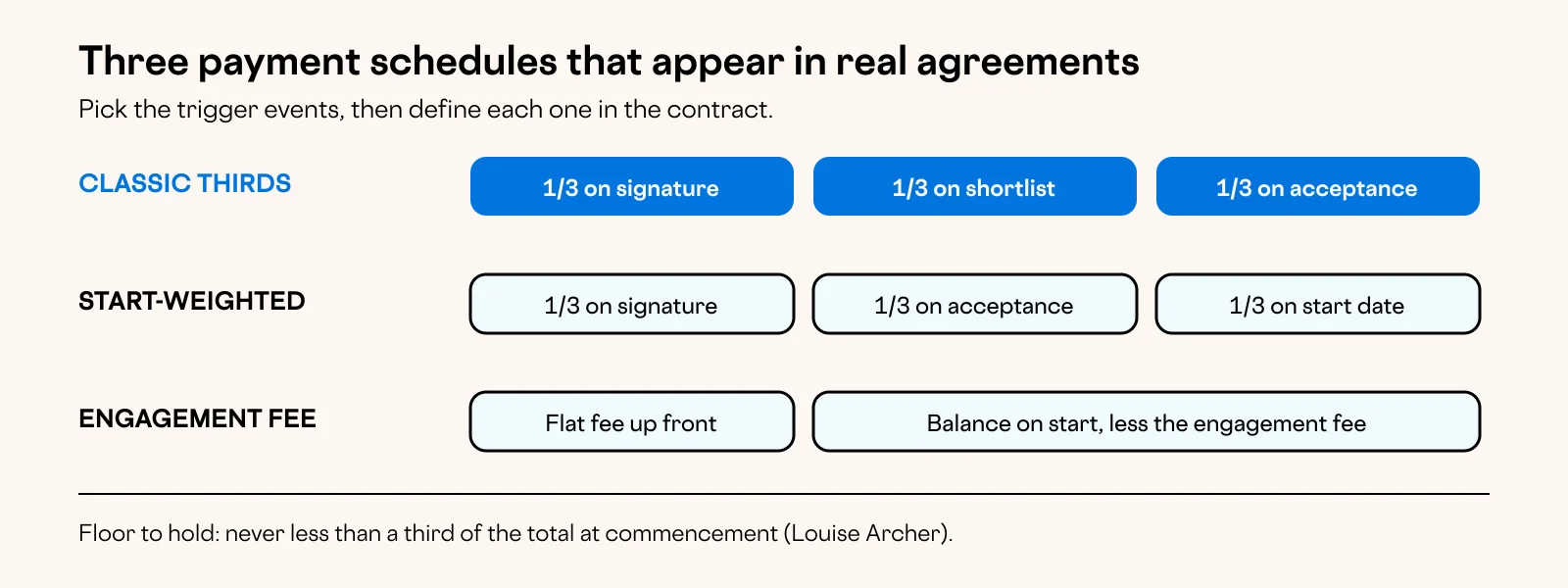
The lighter structure is a flat engagement fee credited against the balance. David Bradley's firm, speaking on The Elite Recruiter roundtable, uses $7,500: "It's a contingency deposit and that's non-refundable, but it goes against the fee at the end of the process." They pair it with a rate concession, offering 33% straight contingency or 28% with the deposit.
Louise Archer sets the floor for anything you call retained. On The Art of Retained Search: "You don't take less than a third on commencement. That's my rule for myself now. But if it's a lower-level project I'm happy with two thirds on completion." Her reasoning is not greed. Below that threshold the client is not committed, which was the entire point of the payment.
Exclusivity has more than two settings
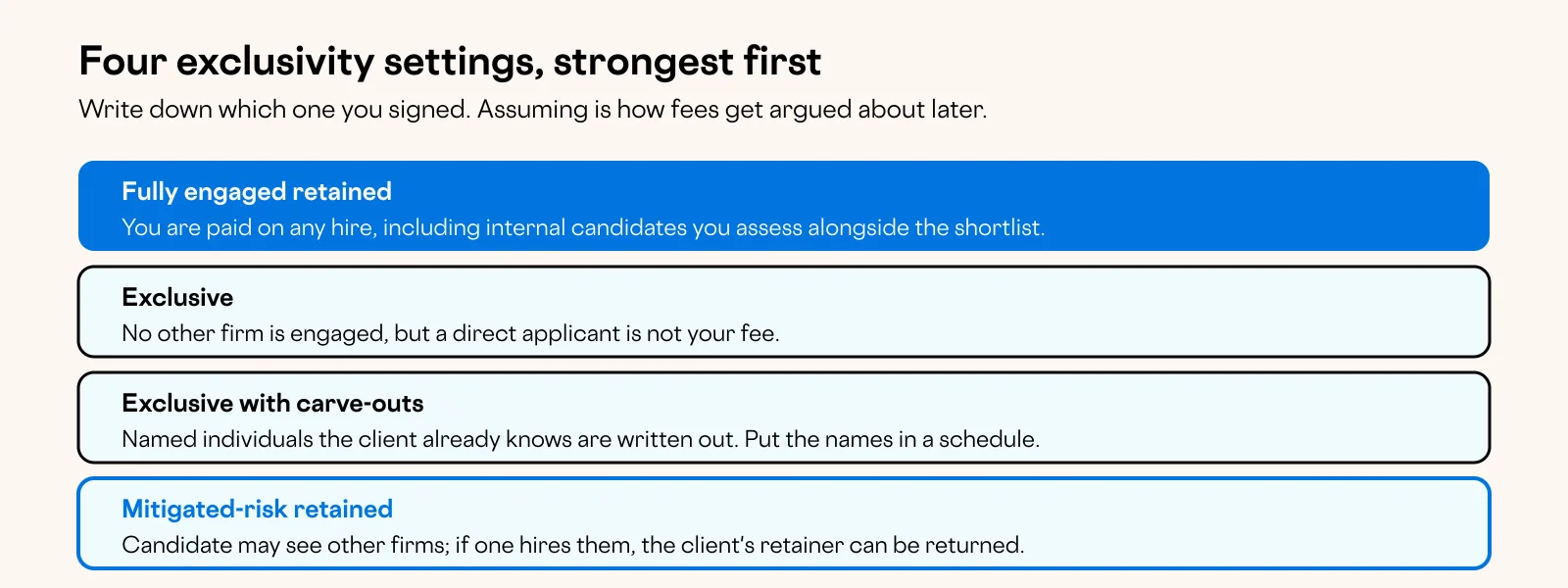
Most templates treat exclusivity as on or off. In practice there are four settings, and Love describes all of them.
- Fully engaged retained. You are the only source. You are paid on whoever is hired, including internal candidates the client wants assessed alongside your shortlist. As Love puts it, "everybody has a fair shot at the opportunity and we would facilitate all of that."
- Exclusive. No other search firm is engaged, but if a candidate approaches the client directly, you are not paid on that hire.
- Exclusive with carve-outs. Exclusive, but with named individuals the client was already speaking to written out of the agreement. Get those names in a schedule, not in an email.
- Mitigated-risk retained. Love's own variant: "You are retaining me on this search, but if the candidate requests that I send him or her to other organizations I am free to do that, but I will tell you that. And if those organizations hire this person, then I have the option to give you back your retainer."
The fourth is worth understanding even if you never use it. It exists because in some markets candidates refuse to look at a single opportunity, and an agreement that pretends otherwise gets broken quietly rather than renegotiated.
Term, extension, and the unfilled search
A retained search agreement without an end date is an open obligation. Love's benchmark: "Usually in a retained search there might be like a 120-day period where you're working on that search. At the end of 120 days the contract ends. Hopefully you filled it by then."
Three things to settle alongside the term:
- What happens at expiry. Default should be that the engagement simply ends and no further fee is due either way.
- Extension terms. If the client wants more time, is it free, or does it trigger a further instalment? Decide before you are 110 days in and emotionally invested.
- Cancellation. Bradley's firm keeps the deposit if the client changes course: "If they fill from another source or they change course, they cancel the search, then we collect the $7,500." That is what makes the deposit meaningful.
The guarantee clause
Clients ask for a guarantee and recruiters usually concede one without thinking about its structure. There are two versions and they are not equivalent.
A replacement guarantee says that if the hire leaves within a defined window, you run the search again at no additional fee. A refund guarantee says you return money. The first costs you time. The second costs you cash you have already recognized and probably already paid commission on.
On retained work the refund version is particularly hard to justify, because the client, not you, controlled the selection decision and the onboarding. If a client insists on a refund clause, price it. Also carve out the obvious exclusions in writing: redundancy, a material change to the role, and departure caused by the client's own conduct.
A retained search agreement, annotated
What follows is a plain-language skeleton with a negotiation note against each clause. It is a starting structure to take to a lawyer, not a document to sign as written.
- Parties and scope. "Consultant is engaged to conduct a search for the role of [title], reporting to [name], based in [location]." Note: name the role and the reporting line. A search agreement written against a department rather than a role invites scope creep.
- Fee. "The fee is [X]% of the candidate's first-year cash compensation, defined as base salary plus target bonus and any signing bonus or guaranteed allowance, excluding equity." Note: this is the sentence clients most often try to shorten. Do not let them.
- Payment schedule. "One third payable on execution; one third on presentation of a shortlist of no fewer than three assessed candidates; one third on the candidate's acceptance of a written offer. Invoices payable within [14] days." Note: define shortlist by number and by "assessed", or stage two becomes a negotiation.
- Exclusivity. "Client engages Consultant exclusively. Consultant's fee is payable on any candidate hired into the role during the term, including internal candidates and direct applicants, save for those listed in Schedule A." Note: Schedule A is the carve-out list. Insist it is complete at signature.
- Term. "This engagement runs for 120 days from execution and terminates automatically thereafter unless extended in writing." Note: automatic termination protects you as much as the client.
- Deliverables. "Consultant will deliver a written briefing document, a market map, and a written progress report every [two] weeks." Note: these are what the client is buying between instalments. Naming them makes stage-two payment easy to collect.
- Off-limits. "Consultant will not approach employees of the companies listed in Schedule B for the duration of the engagement." Note: define the duration. An indefinite off-limits list on a 120-day search is a hidden non-compete.
- Guarantee. "If the placed candidate leaves within [90] days other than by reason of redundancy, material change to the role, or Client conduct, Consultant will conduct one replacement search at no further fee." Note: replacement, not refund. Keep the exclusions.
- Cancellation. "If Client terminates the search before completion, instalments already invoiced remain payable and are non-refundable." Note: without this sentence the retainer is a deposit, and a deposit commits nobody.
- Confidentiality and data. "Candidate information is provided for the purpose of this search only." Note: standard, and worth having when a client circulates your shortlist to a sister company.
Frequently asked questions
How much does a retained search cost?
The recruiters in our interview library quote 25% to 33% of first-year pay, with the retained rate often set a few points below the same firm's contingency rate in exchange for money up front. The first instalment is commonly a third of the total, or a flat engagement fee in the $7,500 to $10,000 range. Confirm what the percentage is calculated on before you compare two quotes.
Is there a standard retained search agreement template?
No. There is no industry-standard form, and templates circulating online are usually a specific firm's terms rather than a neutral document. The nine clauses above are the substance; the wording around them should be drafted for your jurisdiction. Trade associations offer member templates, which are a reasonable starting point if you are already a member.
Can a client cancel a retained search?
Yes, unless your agreement says otherwise, which is why the cancellation clause matters. A well-drafted agreement makes instalments already invoiced non-refundable and lets the client walk away from future ones. That is a fair settlement: they stop paying for work that stops, and you keep payment for work already done.
What does SLA mean in recruiting?
Service level agreement. In recruiting it usually refers to agreed response times between recruiter and hiring manager: time to submit a shortlist, time to return interview feedback, time to decision. On a retained search these belong in the deliverables clause, and the client's obligations should be in there too. Feedback turnaround is the most common cause of a stalled search.
What is an ATS versus a CRM?
An applicant tracking system (ATS) manages candidates against live roles: applications, stages, and offers. A recruitment CRM manages client and prospect relationships: contacts, activity, and pipeline. Most agency platforms now bundle both, but they answer different questions. Your retained search agreement lives in the CRM side, alongside the fee terms it sets.
What should you not tell a headhunter?
As a candidate: your current salary before you know the range, the names of every other firm you are speaking to, and anything you would not want repeated to the client. Recruiters are paid by the employer, and while good ones handle information carefully, the commercial relationship runs the other way. Ask what will be shared before you share it.
A retained search agreement is not a formality you sign on the way to the interesting work. It is where the fee gets defined, the exclusivity gets settled, and the cancellation risk gets allocated. Ten minutes on the nine clauses above is cheaper than one argument about what "first-year compensation" meant.
For the commercial case behind the model, see retained versus contingency search and how to win retained search clients. To see what these fees mean for your own take-home, use the recruiter commission calculator and our guide to recruiter commission structures. If you are considering a move into retained work, browse current executive search jobs and agency recruiter roles, or research a firm in our directory of 2,397 recruiting and staffing firms.