
Retained Executive Search vs Contingency: Which Model Pays

Retained executive search pays more per search and pays more predictably. Contingency pays faster and takes no selling. The fee percentages are similar, roughly 25% to 33% of first-year pay in both models. The difference is when you get paid and how often you get paid at all: retained bills in stages regardless of outcome, contingency bills only on a start.
That is the entire argument, and it is an argument about probability rather than percentages. What follows is the fee mechanics, the numbers working recruiters actually quote, the cases where contingency is still the better business, and how to tell which one your desk can carry.
Key takeaways
- Fee rates barely differ between the two models. The retained rate is often a point or two lower, traded against money up front.
- Retained search bills in stages. The common structure is a third on engagement, a third on shortlist, a third on start.
- Contingency's problem is the fill rate, not the fee. Practitioners put the odds of a contingent assignment producing any fee at roughly one in four.
- Retained is a sale before it is a search. You are asking a client to buy a process, not a result.
- Contingency still wins on high-volume desks where one candidate can go to several clients.
A note on sourcing before we start. The recruiter quotes below come from our library of 228 interviews, all from a single show, The Elite Recruiter. That is informed practitioner opinion from people running real desks. It is not an industry survey, and we have not dressed it up as one.
What retained executive search actually is
Retained executive search is an engagement where the client pays the search firm in instalments across the search rather than on the hire. The firm works the role exclusively, maps the market, and presents an assessed shortlist. Payment is tied to progress, not outcome. The firm gets paid whether or not the client ends up hiring anyone.
The word "retained" is doing literal work: the client has retained your time for a defined period. That is what the first payment buys. It is not a deposit against a placement fee in the way a contingency deposit is, although in practice most agency retainers are credited against the final fee.
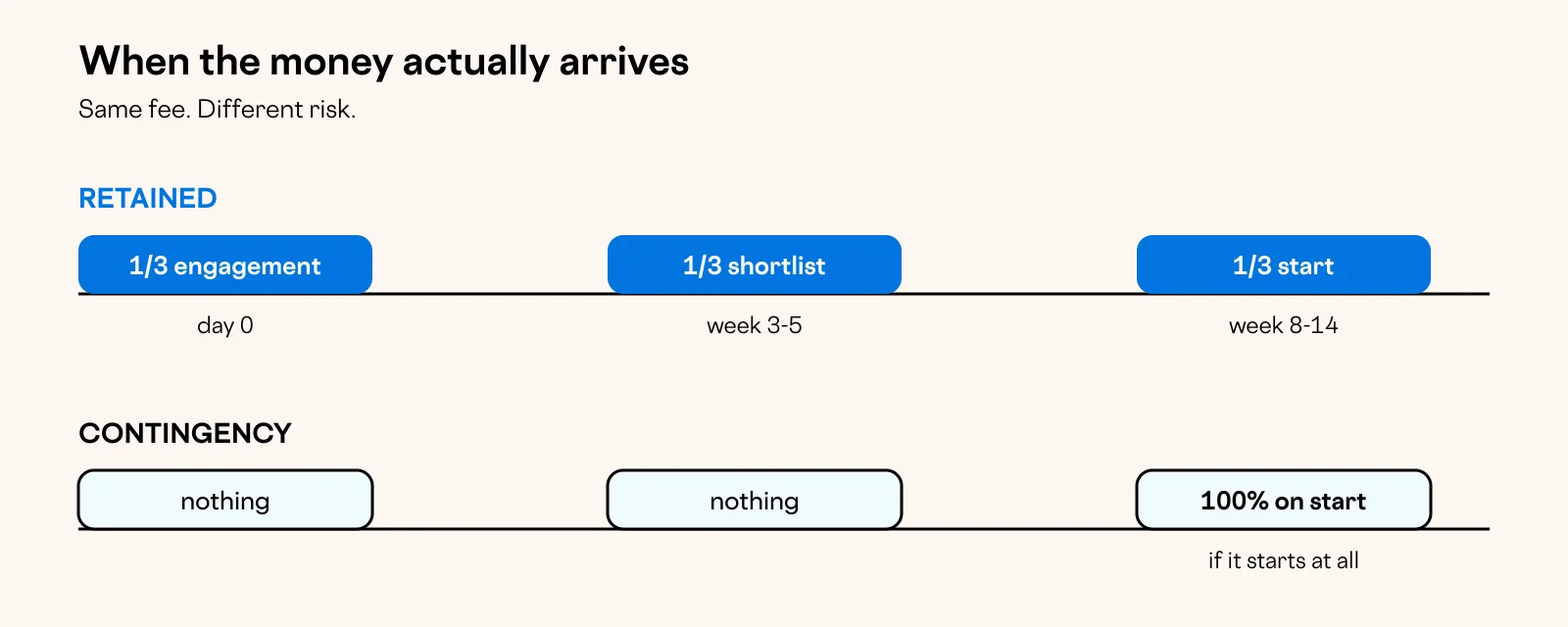
Retained and contingency fees compared
The table below sets out how the three engagement types differ in practice. Read down the "who carries the risk" row first, because everything else follows from it.
| Feature | Contingency | Engaged | Fully retained |
|---|---|---|---|
| Typical fee | 25%-33% of first-year pay | Same rate, part paid up front | Often 2-5 points lower than the contingency rate |
| When you invoice | On start date only | Deposit, then balance on start | Thirds across the search |
| Exclusivity | None. Client uses several firms | Usually informal | Written and mutual |
| Who carries the risk | You | Shared | Client |
| Work expected | Send candidates fast | Send candidates fast | Market map, assessment, reporting |
| Best fit | Repeatable roles, several buyers per candidate | New clients you want to test | Scarce roles owned by a decision maker |
David Bradley, speaking on The Elite Recruiter roundtable, described exactly this trade being offered as a menu: "We'll offer two options right up front. We can go straight contingency at 33%, or we'll do a retainer if you want to give us money up front, we'll drop that fee down to 28% net fee total." His firm's retainer is typically $7,500, non-refundable, credited against the final invoice. His stated floor on any fee is 25%.
Note what each side is buying with that five-point discount. The client buys certainty of your attention. You buy certainty of some revenue. Both are paying for risk reduction, which is why the deal holds.
The odds are the whole argument
Louise Archer, who built a practice converting contingent clients onto retainers, put the contingent maths plainly on The Art of Retained Search: "When you win a contingent project you win, statistically, and this is studying years and years of contingent fill rates, about a 20% chance of making a fee. So you win a project that has an 80% chance of you not making anything at all on it. So okay, it's easy to win a contingent job, but you haven't actually won anything."
Terry Edwards, on the same podcast, is a little more generous with the range and reaches the same conclusion: "The average contingent recruiter will fill between 20 and 40% of the roles that they work on. So the average contingent recruiter, most of the time, is working and not getting paid."
Neither figure is a published industry statistic, and we are not presenting them as one. They are the working assumptions of two people who have run the model for years. Put a real fee against them and the shape of the problem becomes obvious.
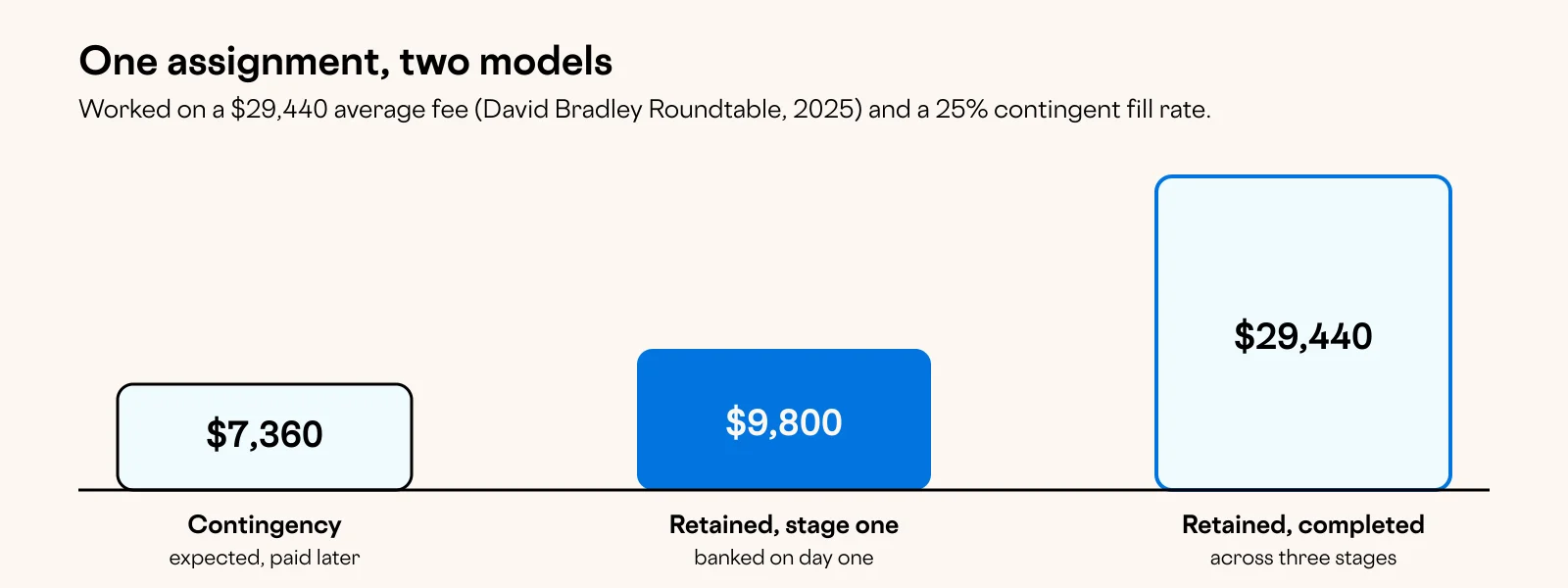
Bradley's firm reported an average fee of $29,440 across 2025. At a 25% fill rate, taking that assignment on contingency is worth about $7,360 in expected revenue before you spend an hour on it. Take the same assignment retained and roughly $9,800 lands before you make the first call.
Scott Love, who has coached recruiters through this transition for years, frames the difference as a loyalty problem rather than a cash-flow one. On his Elite Recruiter session: "In contingency recruiting your loyalty is to the deal that's going to close the quickest, not to a certain client. All of my clients that I work with on a contingency basis, they're working with 20 other search firms and it's the game of first in wins it."
That is the honest description of a contingency desk. It is a speed business, and you optimize it by spreading candidates across buyers, not by going deep on one client.
What recruiters actually charge on retained work
Three structures come up repeatedly among the operators we have interviewed, and they sit on a spectrum rather than in separate boxes.
- Engagement fee. A fixed sum up front, credited against the placement fee. Scott Love quotes $7,500 as his standard. A million-dollar biller interviewed on the same show works at $7,500 to $10,000 and says the point is filtering: "It just proves that they're generally real clients."
- Thirds. A third on engagement, a third on shortlist, a third on start. Louise Archer never takes less than a third at commencement, and accepts two thirds on completion only on lower-level projects.
- Monthly retainer. A recurring fee across a defined term, deducted from any placement fees that arise. Love has used $10,000 a month across six months, where the firm becomes an extension of the client's team.
For what any of this means for your own take-home rather than the firm's, our recruiter commission calculator runs the split, and the guide to how recruiter commission structures work covers where retained fees sit in an agency's plan.
When contingency still wins
This is the part retained search firms do not put on their websites. Retained is not universally better, and the people who teach it are often the first to say so.
Love recruits partners for global law firms and is direct about his own desk: retained "is not an appropriate model most of the time" in his niche. The reason is structural. When the same candidate can go to a dozen firms with the same need, exclusivity destroys your economics. "The best way for me to make money is to have 12 organizations looking for the same type of person."
Jeremy Jenson, placing executives into private-equity-backed businesses, made the owner's version of the argument on The Elite Recruiter: "I would rather have a 60% close ratio on 300 job orders a year than a 90% close ratio on 100." He acknowledges the power of retained on an individual desk and still runs the business contingent, because throughput beats conversion at his volume.
Contingency is the better model when at least two of these hold:
- Your roles repeat across clients, so one sourcing effort serves several searches.
- Your candidate pool is deep enough that speed, not access, decides the outcome.
- You bill enough volume that a 20% to 40% fill rate still clears your costs.
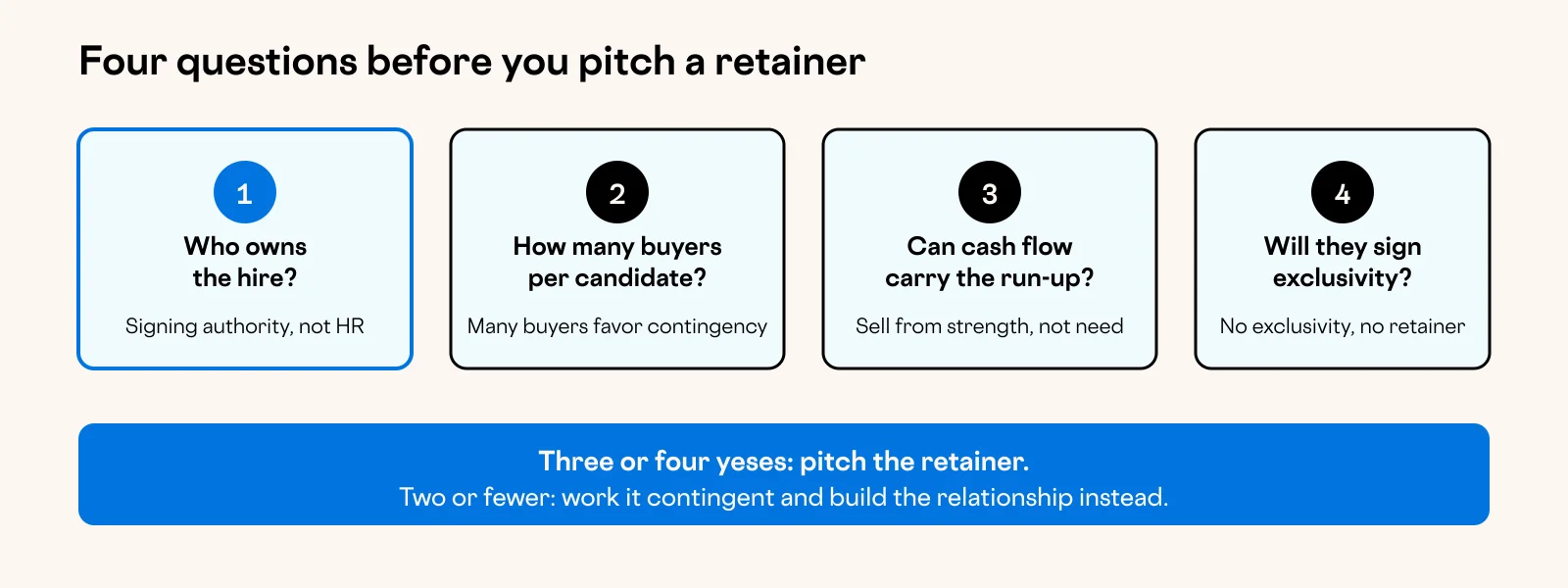
- Your buyers are HR functions with vendor lists rather than executives with signing authority.
How to tell which model your desk can carry
Retained work needs a run-up. Love's advice is not to flip overnight: build deal flow and cash flow first, get to roughly one to one and a half placements a month with two sendouts a week, then start raising fees and introducing engagement fees on new clients. Selling a retainer while you are short of cash is how recruiters end up folding at the first objection, and folding is expensive. As Love puts it, if the client says no and "you say okay well let's do it contingent, you've lost all the potency of your offering and you've lost credibility as well."
The market context, briefly
None of this is happening in a growth market. Staffing Industry Analysts forecast in its March 2026 US staffing industry update that the US market will grow 1% in 2026 to $180.2 billion, with about 2% growth to roughly $183 billion in 2027. Bullhorn's 2026 Recruitment Industry Trends Report, drawn from nearly 2,300 industry professionals, found hiring freezes and budget constraints to be the biggest obstacle agencies face in winning new business. In a flat market the argument for exclusivity gets easier to make, and the argument for spreading yourself across ten vendor lists gets harder.
Frequently asked questions
What is a retained executive search?
A retained executive search is a search where the client pays the firm in instalments across the assignment rather than on the hire. The firm works exclusively, maps the market, assesses candidates, and reports on progress. Payment follows the process, so the firm is paid whether or not a hire is made.
How much does a retained search cost?
The recruiters we have interviewed quote 25% to 33% of first-year pay, with retained rates often set a few points below the same firm's contingency rate in exchange for money up front. The first instalment is commonly a third of the total or a flat engagement fee in the $7,500 to $10,000 range. Fees are usually calculated on total first-year pay, not base alone, so confirm the definition in the agreement.
How does a retained search work?
The client signs an agreement and pays the engagement fee. The recruiter runs an in-depth briefing, maps the target market, approaches candidates directly, and assesses a longlist down to a shortlist. Shortlist delivery usually triggers the second payment. The client interviews, selects, and hires, which triggers the final payment. Most agreements run a defined term, commonly around 120 days.
What is the difference between contingent and retained search firms?
A contingent firm is paid only if its candidate is hired, competes with other firms on the same role, and optimizes for speed. A retained firm is paid across the search, works exclusively, and optimizes for coverage of the market. The fee rate is similar. The risk allocation is the opposite.
What does "retained" mean in retained executive search consulting?
It means the client has retained the consultant's time for the search, in the same sense a business retains a lawyer. The first payment buys the work, not the result. In agency practice the retainer is almost always credited against the total fee, so the client is not paying twice.
Can a small agency win retained work?
Yes, and most of the recruiters quoted here did it from small firms. The usual route is converting an existing contingent client who already values your delivery, rather than pitching retained search cold. A boutique cannot compete on brand, so the sale has to rest on your process and your access to the specific market.
Retained executive search is not a better business than contingency in the abstract. It is a better business on the desks where roles are scarce, buyers are singular, and the client will sign for exclusivity. On desks where the same candidate has ten homes, contingency will out-earn it every year. Work out which desk you are actually running, then pick the model that matches it.
If you are weighing a move to a firm that runs retained work, browse current executive search jobs and agency recruiter roles to see which firms are hiring and what they disclose about fee models, or search the directory of 2,397 recruiting and staffing firms to research a specific one before you take the call.