
Selling a Recruitment Agency: Valuation and Exit

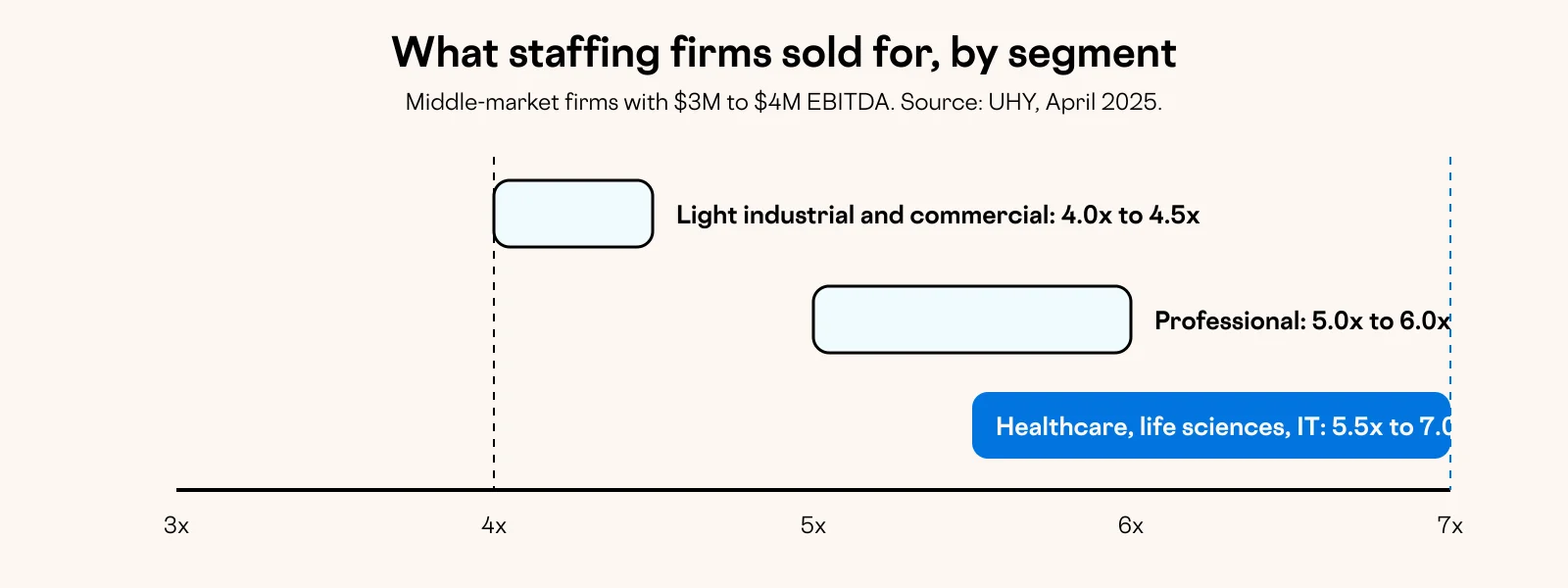
Selling a recruitment agency in the US means selling a multiple of profit, not a multiple of revenue. Middle-market staffing firms with $3 million to $4 million of EBITDA traded between 4.0x and 7.0x depending on sector, according to UHY's staffing M&A update published in April 2025. Where you land inside that band is decided by recurring revenue, client concentration, and how much of the business runs without you.
That last factor is the one owners underestimate. A firm where the founder holds the client relationships is a firm the buyer has to re-underwrite from scratch, and they will price that risk into the deal. This guide covers what agencies actually sell for, what buyers examine, how the money is really paid, and what to fix in the two years before you go to market. It is general information, not financial or legal advice.
Key takeaways
- Light industrial and commercial staffing firms with $3 million to $4 million of EBITDA traded at 4.0x to 4.5x, professional staffing at 5.0x to 6.0x, and healthcare, life sciences and IT at 5.5x to 7.0x (UHY, April 2025).
- US staffing M&A volume fell from a record 139 deals in 2022 to 116 in 2023 and 93 in 2024, with 85 to 100 forecast for 2025.
- Contract and recurring revenue attracts a higher multiple than perm-only revenue, because the buyer is purchasing a book rather than a track record.
- The headline multiple is not the check. Expect a meaningful portion in earnout and retention tied to performance after close.
- Diligence goes well beyond the numbers. Buyers commission independent reviews of HR policy, contracts, and worker classification.
What recruitment agencies actually sell for
Multiples cluster by sector, because sector predicts margin durability. These ranges are for middle-market firms with roughly $3 million to $4 million of EBITDA, reported by UHY in April 2025 and repeated in Griffin Financial Group's October 2025 market update.
| Segment | EBITDA multiple | Why |
|---|---|---|
| Light industrial and commercial | 4.0x to 4.5x | Commoditized, low switching costs, thin margin |
| Professional staffing | 5.0x to 6.0x | Higher bill rates, stickier client relationships |
| Healthcare, life sciences and IT | 5.5x to 7.0x | Scarce skills, regulatory barriers, strong demand |
Two things those ranges assume. First, real EBITDA, adjusted for a market-rate salary for the owner. If you are paying yourself $80,000 and drawing the rest as profit, the buyer will normalize that and your EBITDA will fall. Second, scale. Firms materially below this EBITDA band typically transact lower, because they carry more key-person risk and fewer buyers can be bothered with them.
What buyers are actually buying
Buyers are not buying last year's billings. They are buying the probability that next year's billings happen without you.
That is why revenue mix matters more than revenue size. Jon Davis, describing on The Elite Recruiter podcast how his firm grew to $300 million and sold, put the turning point at building delivery capacity behind contract work: "we realized our clients, they gave us these jobs for a reason. We need to fill those jobs. So we need to follow through and build a delivery mechanism to do that. And over the course of a couple of years, we built a dedicated delivery team that just focused on recruiting for those contract jobs." The shift toward contract revenue is what made the business saleable. This is one operator's account from a single podcast, not a market study, but it matches how buyers price.
A perm-only firm sells a track record. A contract book sells a run rate. If you are still choosing your mix, our comparison of recruitment business models covers the trade-off in detail.
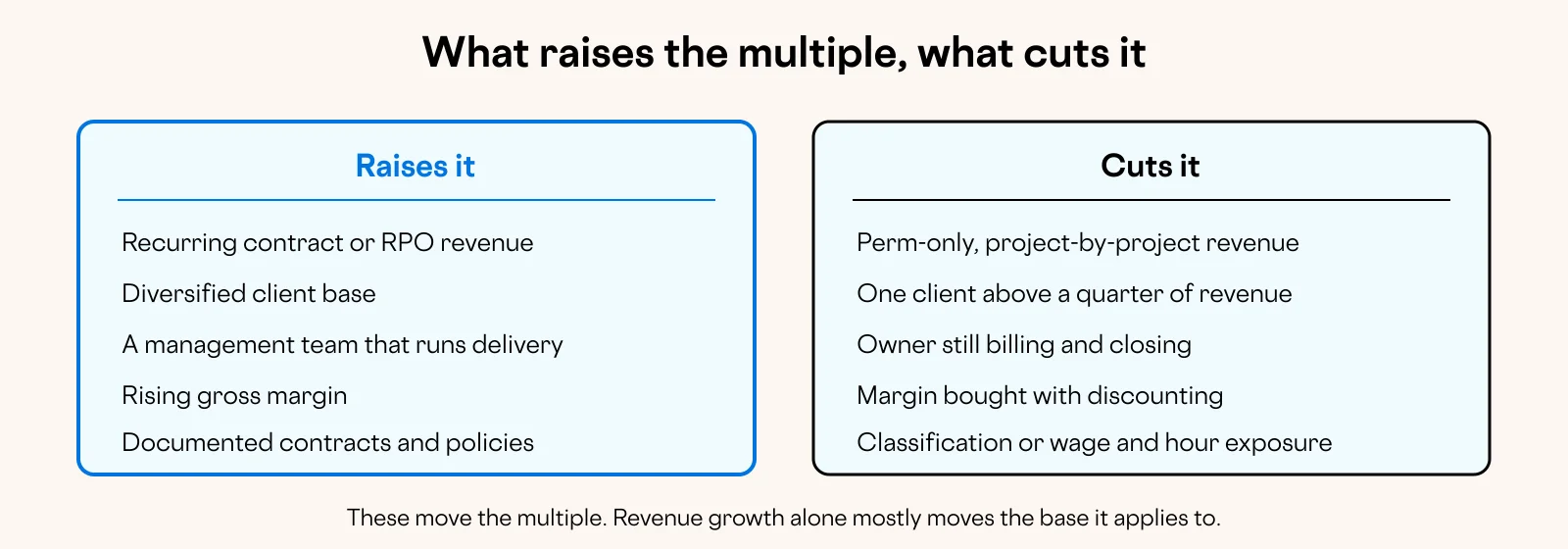
The five things that move your multiple
- Revenue recurrence. Contract, RPO and embedded revenue price higher than perm placements, because it renews rather than restarting each month.
- Client concentration. A single client over about a quarter of revenue is a discount, sometimes a deal-breaker. Buyers model what happens if that client leaves.
- Owner dependency. If you personally bill, hold the client relationships, or approve every deal, the buyer is acquiring a job. Multiples reflect that.
- Gross margin durability. Rising margin signals pricing power. Margin bought with discounting signals the opposite.
- Clean compliance. Worker classification, wage and hour exposure, and contract quality are diligence items that reduce price or create escrow. Our guide to recruitment agency compliance covers what gets examined.
The headline multiple is not the check
Owners hear "6x" and picture a wire transfer. Deals are rarely structured that way. Expect the price to be split across some combination of cash at close, an earnout tied to profit over the following one to three years, retention payments contingent on you staying, an escrow held against diligence findings, and sometimes rolled equity in the buyer.
Two consequences follow. First, negotiate the earnout mechanics as carefully as the multiple, because a buyer who controls the cost base after close controls the profit your earnout is measured against. Second, the deal does not end at signing. If a third of your consideration depends on the next two years, you have swapped ownership for a bonus scheme you no longer set the rules for.
Due diligence: what buyers actually look for
Diligence is adversarial by design. Marc Cohen, discussing his exit on the same podcast, was direct about it: "they are looking for skeletons. They are not going to give you a big check. They want to find faults in your business, that's their job. They've hired a firm, an HR company in the US, just to look at our HR policies, everyone, documents, emails, interactions, any complaints, how we handled it."
Expect independent review of contractor classification, client contract terms and termination rights, wage and hour records, insurance history, HR complaints and how they were resolved, and revenue quality on a client-by-client basis. Anything unresolved becomes a price reduction or an escrow. The cheapest time to fix these is 24 months before you go to market, not during the process.
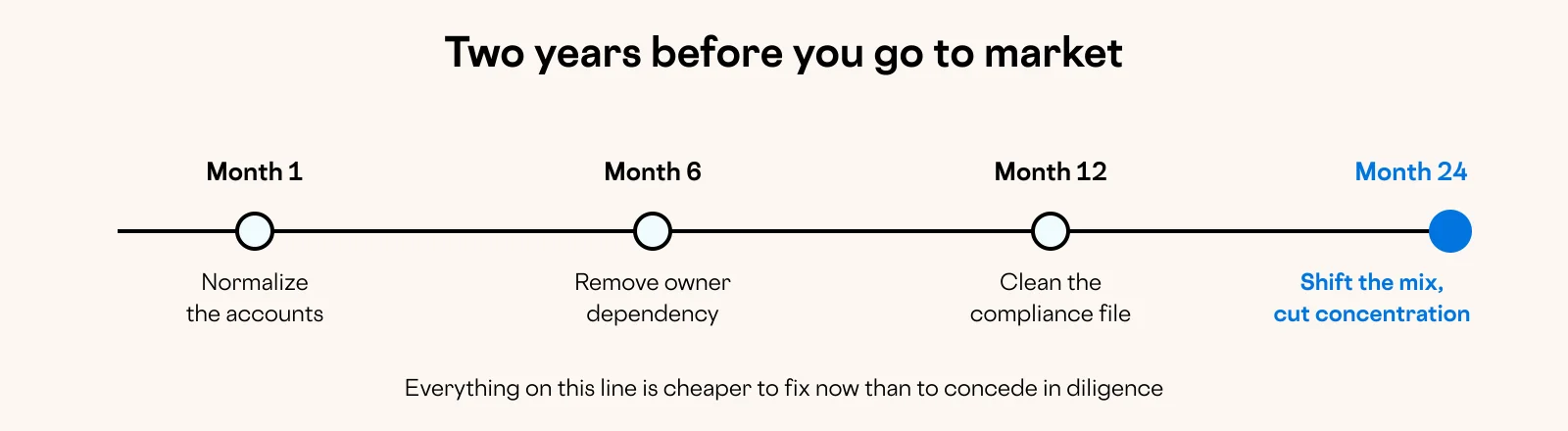
A 24-month preparation plan
- Months 1 to 6. Normalize the accounts. Pay yourself a market salary, take personal expenses out of the business, and produce monthly management accounts a buyer can rely on.
- Months 6 to 12. Reduce owner dependency. Move client ownership to named account leads, and stop billing personally.
- Months 12 to 18. Fix the compliance file. Contracts signed and current, classification reviewed, insurance certificates in order, HR policies documented.
- Months 18 to 24. Shift the mix. Grow recurring revenue and cut concentration, ideally getting no client above about 15% to 20% of revenue.
The market you are selling into
Timing is not fully in your control, but you should know the conditions. US staffing M&A volume peaked at 139 deals in 2022, fell 17% to 116 in 2023, and fell another 20% to 93 in 2024, with 85 to 100 deals forecast for 2025. Underneath that, Staffing Industry Analysts forecasts the US staffing market at $180.2 billion in 2026, roughly 1% growth and still below its pre-pandemic size.
A softer market does not mean you cannot sell. It means fewer buyers per asset and more scrutiny per buyer, which rewards the firms that did the preparation work. For context on who the acquirers are, see our roundup of the largest staffing companies and our read on the state of the staffing industry.
This article is general information about selling a recruitment agency in the US. It is not financial, tax or legal advice. Valuation is specific to your business, and you should take advice from a qualified M&A adviser and an attorney before entering a process.
FAQ
How much is my recruitment agency worth?
Value is a multiple of adjusted EBITDA, not revenue. UHY reported in April 2025 that middle-market staffing firms with $3 million to $4 million of EBITDA traded at 4.0x to 4.5x for light industrial and commercial, 5.0x to 6.0x for professional staffing, and 5.5x to 7.0x for healthcare, life sciences and IT. Adjust your profit for a market-rate owner salary before you apply any multiple, and expect smaller firms to transact below these ranges.
Is a perm agency worth less than a staffing agency?
Generally yes, at the same profit level. Contract and RPO revenue recurs, which lets a buyer forecast it, while perm revenue restarts every month. That does not make perm a bad business, and a high-margin retained firm can be extremely profitable to own. It does mean the exit value of two firms with identical profit can differ significantly based on mix.
How long does it take to sell a recruitment agency?
A prepared process typically runs several months from going to market to close, but the preparation is the long part. Normalizing accounts, moving client relationships off the founder, cleaning up contracts and classification, and shifting revenue mix realistically takes 18 to 24 months. Owners who compress it into a quarter usually pay for it in the deal terms.
Will I have to stay on after the sale?
Almost certainly, in some form. Buyers structure deals with earnouts and retention precisely because the risk is that the business walks out with the founder. Assume a transition period of one to three years, and negotiate what you are accountable for and what you control during it, because those two things drift apart quickly after close.
What kills a recruitment agency sale?
Client concentration, undocumented or misclassified contractors, missing or unsigned client contracts, and revenue that turns out to depend entirely on the owner. Most collapsed deals fail in diligence rather than in negotiation, on issues the seller knew about and hoped would not surface.
Where to go next
If a sale is a few years out, the practical work is building a business that does not need you, which starts with the model. Compare the options in our guide to recruitment business models, and price the risk transfer in our guide to recruitment agency insurance. To reduce owner dependency you need people: post a recruiter job, benchmark against live agency recruiter jobs, or research potential acquirers and competitors in the company directory.