
Recruitment Agency Compliance: The US Checklist

Recruitment agency compliance in the US breaks into five obligations: state licensing or registration where your state requires it, worker classification and joint employment, fair hiring and background screening under the FCRA and EEO law, pay transparency in job postings, and the newer rules governing automated hiring tools. There is no single federal recruiting license. Almost everything that binds you is state law.
That is the part generic compliance guides miss. A perm-only firm in Georgia and a contract staffing firm operating in New York, California and Illinois face genuinely different obligations, and the gap widens every year as states legislate. This guide is general information, not legal advice.
Key takeaways
- There is no federal license to operate a recruitment agency. Licensing and bonding are set state by state, and New York requires an Employment Agency License for each location.
- The NLRB's 2023 joint employer standard was vacated by a federal court on 8 March 2024, and the Board formally withdrew it with effect from 27 February 2026, restoring the 2020 "substantial direct and immediate control" test.
- The EEOC received 88,531 new charges of discrimination in FY2024, up more than 9% on FY2023, and recovered almost $700 million (EEOC, January 2025).
- NYC Local Law 144 requires an independent annual bias audit and 10 business days' notice before an automated employment decision tool is used, and it names employment agencies explicitly. Penalties start at $500.
- Most recruiting firms have no Form I-9 obligation for candidates they place. Staffing firms that put contractors on their own payroll do, because they are the employer.
The recruitment agency compliance map
Work down this table and mark which rows apply to your desk. Most owners find the contract rows are the ones they have never checked.
| Obligation | Source | Applies to |
|---|---|---|
| Employment agency license or registration | State law (NY, NJ, and others) | Perm and contract, varies by state |
| Surety bond | State law, tied to licensing | Licensed states only |
| Worker classification (W-2 vs 1099) | FLSA, IRS, state tests | Anyone paying workers directly |
| Joint employment | NLRA, FLSA, Title VII | Contract and temp desks |
| Form I-9 verification | IRCA, USCIS | The entity that employs the worker |
| Background screening process | FCRA, state fair chance laws | Anyone ordering a consumer report |
| Pay range in job postings | State pay transparency laws | Anyone posting a role in a covered state |
| Automated hiring tool audits | NYC Local Law 144 and similar | Agencies screening candidates with AI |
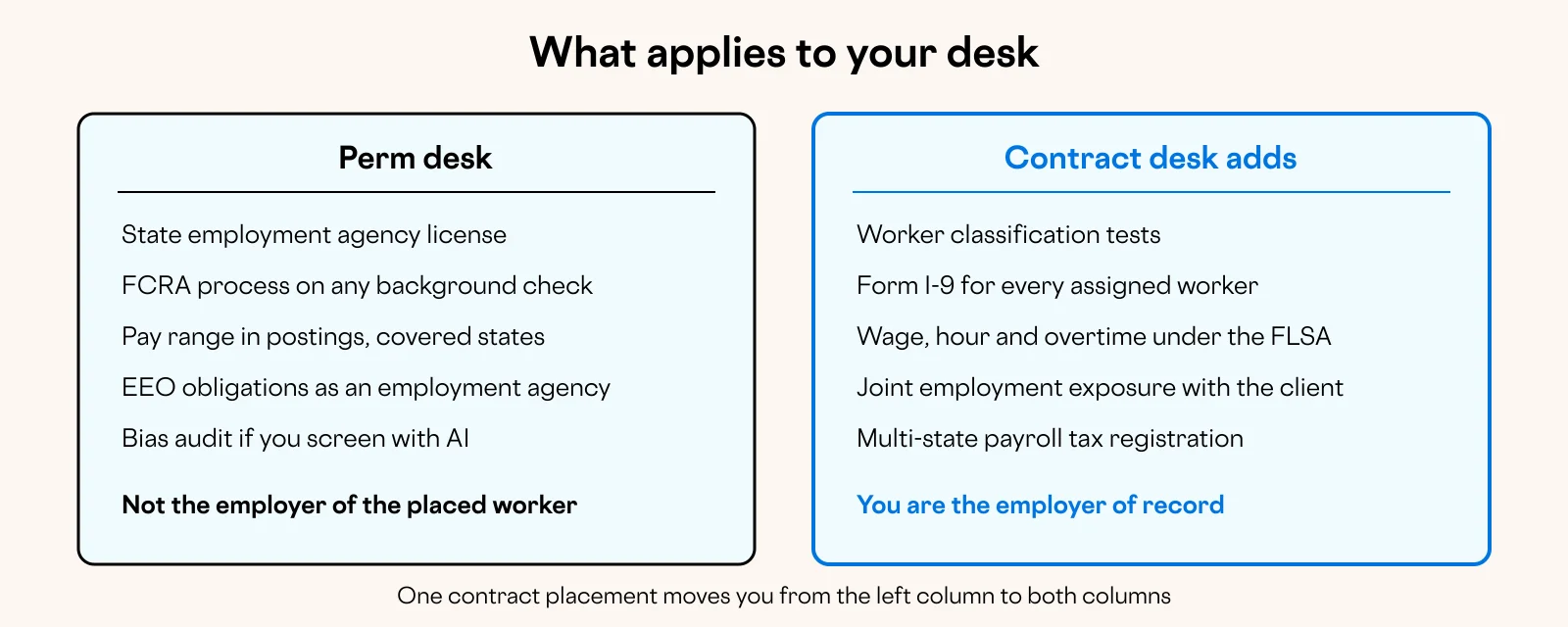
State licensing and registration
There is no federal recruiting license. Licensing sits with the states, and it turns on how you operate rather than what you call yourself.
New York is the strictest of the big markets. The New York State Department of Labor requires an Employment Agency License before you conduct business, a separate license for each location, the license posted on the premises, and at least two years of verifiable experience in a licensed employment agency for the applicant. Breaches draw fines and license suspension or revocation.
Other states run registration or bonding regimes instead, and several exempt firms placing only executive or professional candidates where the employer pays the fee. The practical rule: check the statute in every state where you have an office, and again for every state where you run payroll, because payroll usually triggers registration even when placement does not.
Worker classification and joint employment
These are the two areas where the money at stake is largest, and they are linked.
Classification is whether a worker is your W-2 employee or a genuine 1099 contractor. The tests differ between the IRS, the FLSA, and state law, and several states apply a stricter standard than the federal one. Getting it wrong costs back taxes, unpaid overtime, and penalties, and it is one of the least insurable exposures an agency carries.
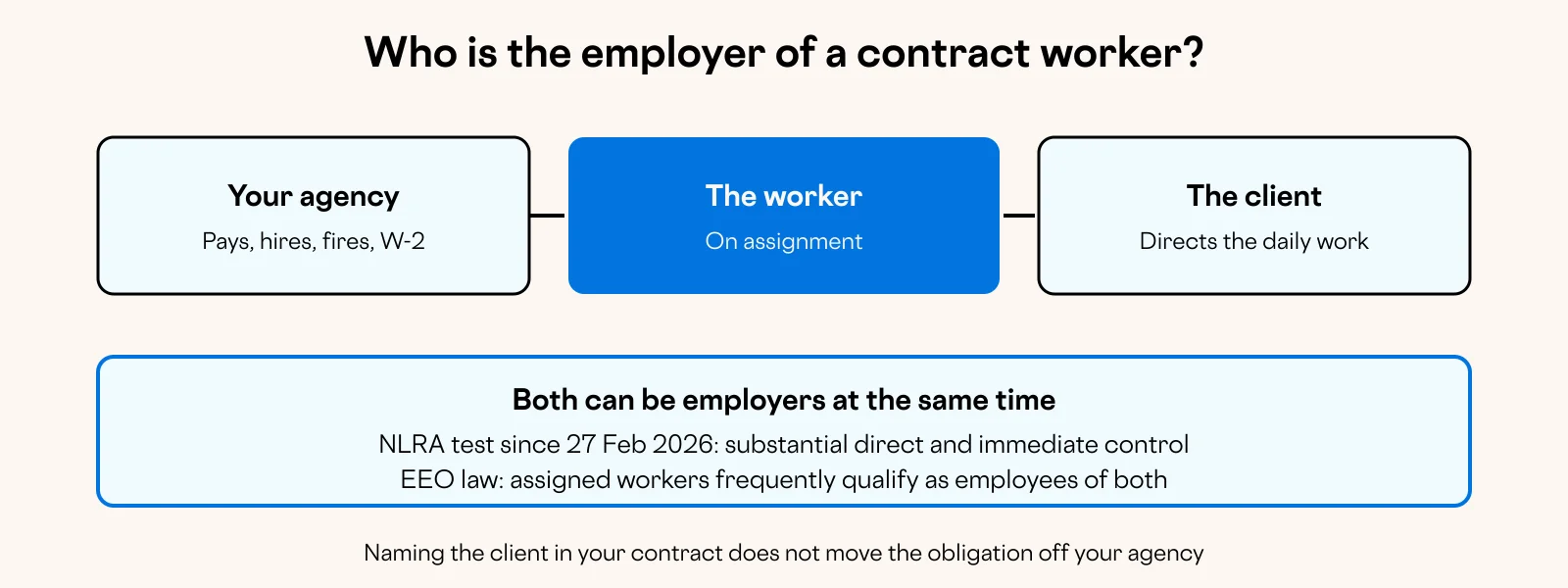
Joint employment is the question of whether you and your client are both employers of the same worker. The rule moved recently and is worth getting straight. The NLRB issued a broader joint employer standard in 2023; a federal judge in the Eastern District of Texas vacated it on 8 March 2024; and the Board published its formal withdrawal of the 2023 standard effective 27 February 2026. The operative test under the NLRA is once again the 2020 rule: substantial direct and immediate control over essential terms and conditions of employment.
Labor law is only half of it. The EEOC's enforcement guidance on contingent workers takes the position that assigned workers frequently qualify as employees of both the staffing firm and the client, and that a staffing firm must take immediate corrective action if it learns a client has discriminated against one of its workers. You do not get to point at the client.
Form I-9: the obligation most guides get wrong
A lot of compliance content tells recruiters they must complete Form I-9 for candidates they refer. For most agencies that is wrong. Under the Immigration Reform and Control Act the duty falls on the employer, and USCIS restricts the "recruiters and referrers for a fee" category to agricultural associations, agricultural employers, and farm labor contractors. A perm agency introducing a candidate to a client does not complete an I-9; the client does.
The reverse is more consequential. If you run a contract desk and the worker is on your payroll, you are the employer and you carry the full I-9 obligation, including timing, re-verification, and retention. Errors are assessed per form.
Background screening and fair hiring
If you order a background report from a screening company you are using a consumer report, and the Fair Credit Reporting Act applies. The procedure is where the claims come from.
- Give a clear and conspicuous written disclosure in a standalone document, and obtain written authorization before ordering the report.
- If the report might cost the candidate the role, send a pre-adverse action notice containing a complete copy of the report and the CFPB's summary of rights.
- Allow a reasonable window for the candidate to respond before sending the final adverse action notice.
Layer on the EEO position. The EEOC and FTC joint guidance is that criminal history should be assessed on an individualized basis, and state and city fair chance laws restrict when you may ask about convictions at all. As an employment agency you are a covered entity under Title VII in your own right.
Pay transparency in job postings
This is the rule that changes most often and the one agencies breach most casually, because it attaches to the advert rather than the hire.
California's SB 642 took effect on 1 January 2026, clarifying what "pay scale" means and extending the recovery period to six years, and Rhode Island's written pay notice requirement for new hires started the same day, according to Jackson Lewis in January 2026. Nevada names employment agencies directly in its wage disclosure duty.
Two consequences for agencies. A remote posting is generally subject to the law of every state where the work could be performed, so the strictest rule governs. And posting on a client's behalf does not move the obligation off the client, while in several states it puts you on the hook too. Build the range into the intake form so a role cannot be advertised without one.
AI screening tools and bias audits
If you screen, rank or score candidates with an automated tool, you are now regulated in some jurisdictions.
New York City's Local Law 144 is the model. It applies to employers and employment agencies using automated employment decision tools on candidates in New York City, and requires an independent bias audit within the previous year, a public summary of the results, and at least 10 business days' notice to candidates before the tool is used. Penalties start at $500 for a first violation and run to $1,500 per day for continuing non-compliance. Enforcement began on 5 July 2023, and a December 2025 New York State Comptroller audit criticized the enforcement effort as too passive, which usually precedes a tightening.
If you are evaluating tooling, our review of AI recruiting tools covers what vendors actually do with candidate data. Ask for the bias audit before you sign, not after.
Building a compliance routine you can actually run
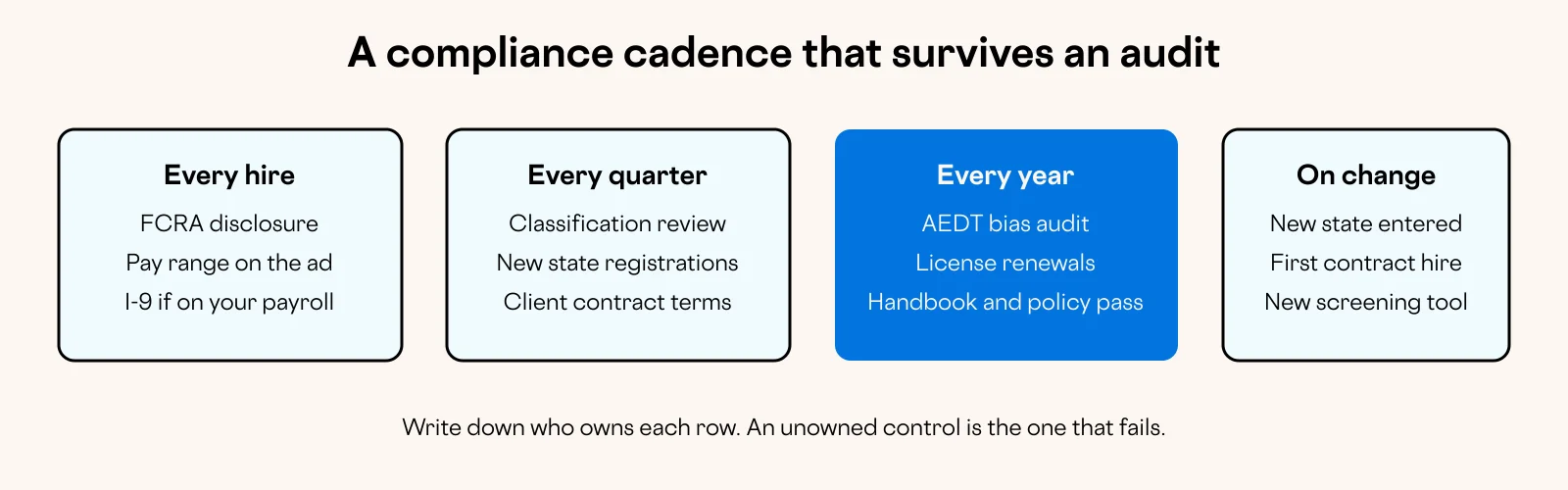
Small agencies do not need a compliance department. They need a documented process for each obligation above, a named owner for each one, dated records, and a calendar. Regulators and plaintiff attorneys ask the same question: did you follow your own process consistently?
Two habits do most of the work. Keep dated evidence of every disclosure, authorization and notice, because in an FCRA or EEO dispute the paperwork is the defense. And treat every new state as a project: registration, payroll tax, posting rules, and fair chance rules all move together.
Get recruitment agency compliance right and it stops being a cost. It becomes the reason an enterprise client can add you to their supplier list without a six-week legal review.
This article is general information about US recruitment agency compliance, not legal advice, and it does not cover every state. Rules change frequently. Take advice from an employment attorney licensed in each state where you operate.
FAQ
Do I need a license to run a recruitment agency in the US?
There is no federal license. Several states require one: New York requires an Employment Agency License for each location, with a two-year experience requirement for the applicant, and other states run registration or bonding regimes. Some states exempt firms placing only professional or executive candidates when the employer pays the fee. Check the statute in every state where you have an office or run payroll.
Is a staffing agency a joint employer with its client?
Often, and the answer differs by statute. Under the National Labor Relations Act the operative test since the Board's withdrawal took effect on 27 February 2026 is the 2020 rule, which requires substantial direct and immediate control over essential terms and conditions of employment. Under EEO law the EEOC's position is that assigned workers frequently qualify as employees of both the staffing firm and the client, so both carry obligations regardless of what the services agreement says.
Does a recruitment agency have to complete Form I-9 for candidates?
Only if you are the employer. USCIS limits the "recruiters and referrers for a fee" category to agricultural associations, agricultural employers, and farm labor contractors, so a perm agency introducing a candidate to a client does not complete an I-9. A staffing firm that puts contractors on its own payroll carries the full obligation, including re-verification and retention.
Do pay transparency laws apply to agency job postings?
Yes, in covered states. The obligation attaches to the posting, so it applies whether the client or the agency publishes the advert, and several states name employment agencies directly. Remote roles are generally subject to the law of every state where the work could be performed, so the strictest applicable rule governs. Capture the range at intake.
What happens if my agency uses AI to screen candidates?
In New York City, Local Law 144 requires an independent bias audit conducted within the previous year, a public summary of the results, and at least 10 business days' notice to candidates before the automated tool is used. It names employment agencies as covered entities. Penalties begin at $500 for a first violation. Other jurisdictions are legislating in the same direction, so ask vendors for their audit documentation before you buy.
Where to go next
Compliance costs money, so it belongs in the model. Our recruitment agency business plan template and our guide to recruitment agency insurance cover the two lines owners most often underestimate. If you are hiring, post a recruiter job, browse agency recruiter jobs to see how competitors are positioning, or check the company directory for firms building teams in your market.