
Recruitment Agency Insurance Explained

Recruitment agency insurance is a stack of four covers: professional liability, general liability, employment practices liability, and workers' compensation. Only workers' compensation is mandated by statute in most states, and only once you employ someone. The rest is driven by what your client contracts demand. If you run a contract desk, both your exposure and your premium change completely.
That last point is where owners get caught. A perm-only firm and a firm placing 200 W-2 contractors are two different insurance risks wearing the same job title. This guide is written for US agencies, and it is general information rather than legal or insurance advice.
Key takeaways
- Workers' compensation is the only cover most states actually require, and Texas is the exception where private employers may opt out as non-subscribers.
- Professional liability (errors and omissions) and employment practices liability are the two policies that respond to how recruiters actually get sued.
- The EEOC received 88,531 new charges of discrimination in FY2024, up more than 9% on FY2023, and recovered almost $700 million (EEOC, January 2025). That is the risk EPLI exists for.
- Nobody can quote you a meaningful average premium. Workers' compensation alone is priced per $100 of payroll by class code, so a light industrial desk and an accounting desk are not comparable.
- Most of your coverage limits will be set by your clients' master service agreements, not by your own risk appetite.
What recruitment agency insurance actually covers
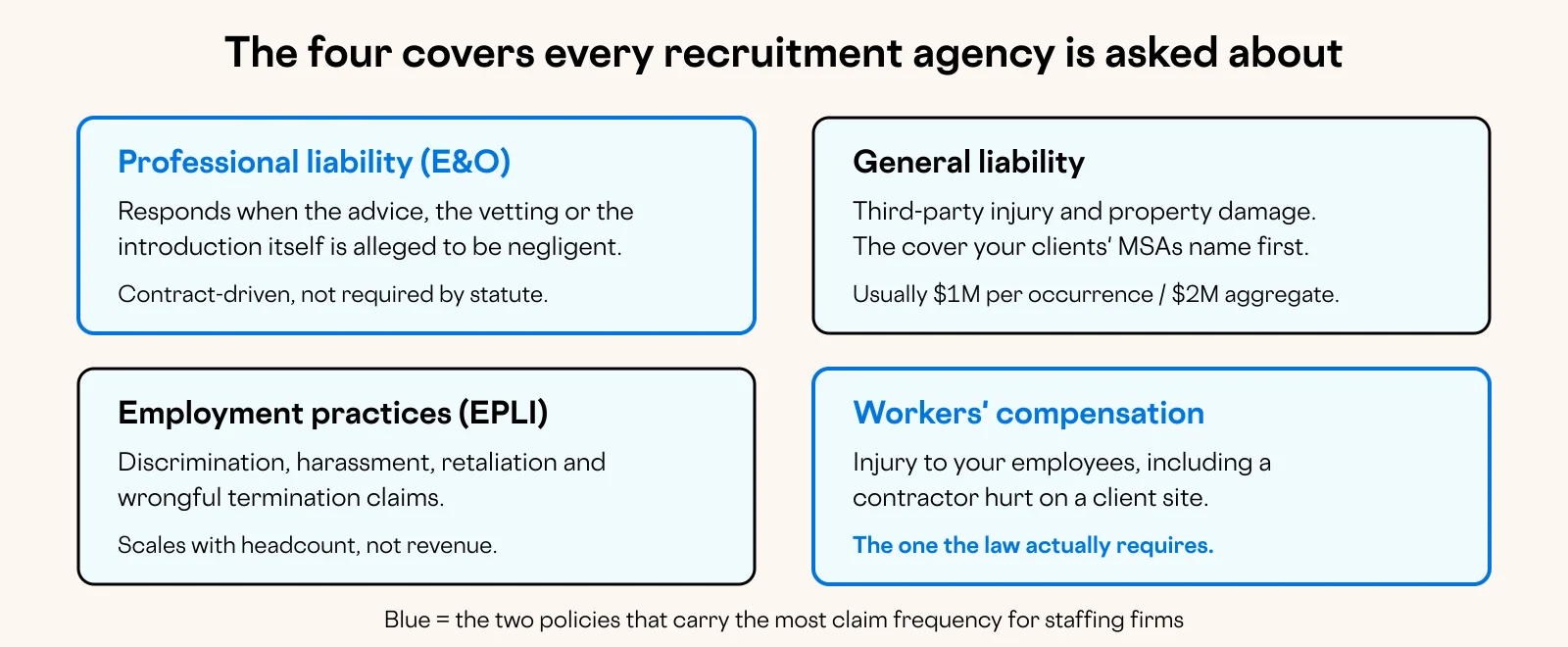
Seven policies come up in staffing and recruiting programs. Read the middle column, because the names are misleading and owners routinely buy the wrong one.
| Cover | What it responds to | Who needs it |
|---|---|---|
| Professional liability (E&O) | Claims that your recruiting service was negligent: a bad reference, a missed credential check, a candidate who was not qualified | Every agency |
| General liability | Third-party bodily injury and property damage, plus advertising injury | Every agency, and required by most client contracts |
| Employment practices liability (EPLI) | Discrimination, harassment, wrongful termination and retaliation claims brought by your own staff or your assigned workers | Anyone with employees or contractors on their own payroll |
| Workers' compensation | Medical costs and lost wages when an employee is injured at work, including a contractor injured on a client site | Legally required for employers in nearly every state |
| Commercial crime / fidelity bond | Theft by your employees, including theft from a client's premises | Contract desks; often a client contract requirement |
| Cyber liability | Breach of candidate data, ransomware, business email compromise on payroll runs | Any agency holding a candidate database, which is all of them |
| Commercial auto | Vehicles owned or used by the business | Required in most states if the business owns a vehicle |
Which recruitment agency insurance is legally required
Short answer: workers' compensation, once you have employees, and commercial auto if the business owns a vehicle. There is no federal insurance requirement specific to recruiting.
Workers' compensation is set state by state, and the trigger threshold varies from the first employee upward. The notable exception is Texas, where the Texas Department of Insurance confirms private employers can choose not to carry coverage. Texas non-subscribers have to report their non-coverage to the state and report any work-related injury involving more than one day of lost time, and they give up the liability limitation that coverage provides. For a staffing firm putting people on client sites, opting out is a decision to be sued directly rather than through a no-fault system.
One thing that gets confused with insurance: several states require an employment agency license or a surety bond. New York, for example, requires an Employment Agency License for each location. A surety bond is not insurance. It protects your clients and candidates, not you. We cover the licensing side in our guide to recruitment agency compliance.
A perm desk and a contract desk are different insurance risks
This is the single biggest variable, and it is worth being blunt about it before you get a quote.
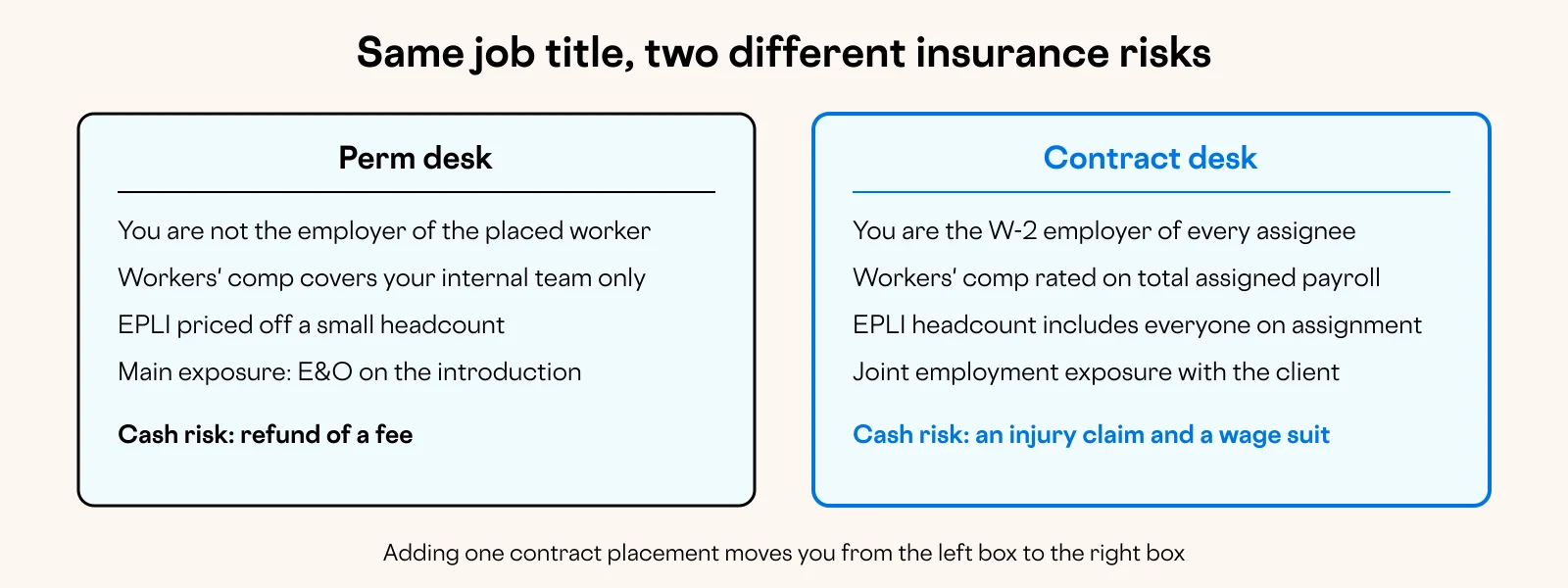
On a perm desk, your product is advice and an introduction. The client hires the person. Your exposure is mostly professional liability: you vouched for someone, the placement failed, and the client wants the fee back and then some. Your headcount is your internal team, so your EPLI is priced off a small number.
On a contract desk, you are the employer of record. The American Staffing Association reports that nearly 2.2 million temporary and contract employees worked for US staffing companies in an average week in 2024. Every one of those workers sits on someone's workers' compensation policy and inside someone's EPLI headcount. The EEOC's long-standing enforcement guidance on contingent workers is explicit that assigned workers frequently qualify as employees of both the staffing firm and the client, which means both carry obligations, and both can be named.
If you are weighing that move, our breakdown of the contract recruiter model covers the operational side, and the insurance consequence should be part of the same decision. Using an employer of record to carry the payroll is a legitimate way to keep the exposure off your own balance sheet while you test the desk.
What actually drives the price
We are not going to publish an average premium, because a credible one does not exist. Here is what a broker is actually pricing.
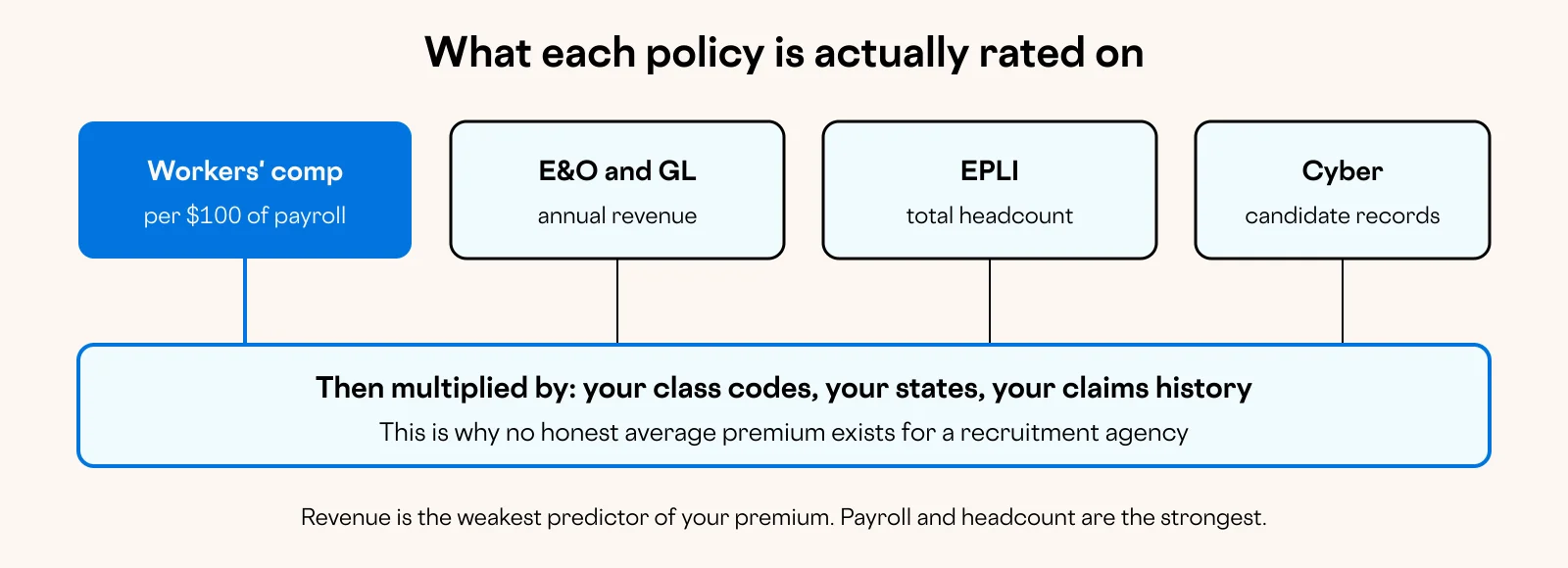
- Workers' compensation is rated per $100 of payroll against a governing class code, then adjusted by your experience modification factor. Placing warehouse operatives and placing controllers sit in wildly different class codes. Payroll volume, not revenue, is the driver.
- Professional and general liability are rated on revenue, the services you actually perform, the limits and retention you pick, and your claims history.
- EPLI is rated on total headcount including assigned workers, plus the states you operate in. California and New York cost more for a reason.
- Cyber is rated on record count and controls. A large candidate database is a material exposure.
Two agencies with identical revenue can sit an order of magnitude apart on premium because one runs light industrial payroll in five states and the other places directors from a spare room. Treat any single "average cost" figure you see online as marketing.
What your clients will demand
In practice your limits get set in procurement, not in your risk review. Expect a master service agreement to ask for some combination of the following.
- A certificate of insurance naming the specific policies and limits, refreshed at every renewal
- An additional insured endorsement on your general liability
- A waiver of subrogation on workers' compensation
- Primary and non-contributory wording
- Named limits, commonly $1 million per occurrence and $2 million aggregate on general liability, with larger enterprises and healthcare or government clients asking for more
Read the indemnity clause before you read the insurance schedule. Agencies routinely sign contractual indemnities far broader than their policies will respond to, which means the certificate looks compliant and the exposure is uninsured. If you are pricing new client work, our guide to starting a recruiting business covers the contract stage in more detail.
The gaps that catch agency owners out
- E&O excludes bodily injury. If a contractor you placed is hurt, that is workers' compensation and general liability territory, not professional liability.
- EPLI usually excludes wage and hour claims or offers only a small defense sub-limit. Misclassification and overtime disputes are among the most common staffing claims and among the least covered.
- Staffing exclusions. Some general liability forms carve out injury to temporary workers. If you place contractors, that carve-out has to be bought back.
- Certificates lapse quietly. A COI that expired mid-contract is a breach, and it is usually discovered at the worst moment.
- Prior acts. Claims-made policies respond to the claim date, not the placement date. Switching carriers without retroactive cover leaves a hole under every placement you made before the switch.
Getting your recruitment agency insurance right
Start with what you actually do. A perm-only firm needs professional liability, general liability, cyber, and workers' compensation for its internal staff. Add a contract desk and workers' compensation, EPLI and joint-employer exposure become the main event. Let your client contracts set the limits, and have someone who is not your broker read the indemnity clause. Review the whole program every time your payroll or your state footprint changes.
This article is general information, not legal, tax or insurance advice. Coverage terms and state requirements change. Confirm your position with a licensed broker and an employment attorney in every state where you operate.
FAQ
Do I legally need insurance to run a recruitment agency?
In most states the only insurance the law requires is workers' compensation, and only once you have employees. Commercial auto is required if the business owns a vehicle. Texas is the exception on workers' compensation: private employers may opt out as non-subscribers, but they must report that to the state and lose the liability protection coverage provides. Everything else is required by your clients' contracts rather than by statute.
How much does recruitment agency insurance cost?
There is no meaningful average, and you should treat any site quoting one with suspicion. Workers' compensation is priced per $100 of payroll against your governing class code and adjusted by your experience modification factor, so a light industrial staffing firm and a boutique search firm on the same revenue can differ by an order of magnitude. Get three quotes at identical limits and compare like for like.
Do I need workers' compensation if I only place permanent candidates?
You need it for your own employees, in almost every state, from the threshold that state sets. You do not need it for the candidates you place, because the client employs them. The moment you put a single contractor on your own payroll, that changes and your class codes change with it.
What is the difference between professional liability and employment practices liability?
Professional liability, also called errors and omissions, responds when your recruiting service is alleged to have been negligent: a reference you did not check, a credential you did not verify, a candidate who was not what you said. Employment practices liability responds to discrimination, harassment, retaliation and wrongful termination claims brought by people you employ, including workers on assignment. Recruiters buy E&O and then discover the claim was actually an employment practices claim.
What insurance limits will clients ask for?
General liability at $1 million per occurrence and $2 million aggregate is the common baseline in master service agreements, with healthcare, government and large enterprise clients asking for higher limits plus umbrella cover. They will also usually want additional insured status, a waiver of subrogation on workers' compensation, and a fresh certificate at each renewal.
Where to go next
Our recruitment agency business plan template carries the insurance line in the cost model. If you are growing the desk, post a recruiter job to reach recruiters who are actively looking, browse agency recruiter jobs to benchmark what competitors are offering, or check the company directory to see which firms in your market are staffing up.