
Recruitment Agency Business Models Compared

A recruitment business model is the answer to one question: what do clients pay you for, and when? There are seven that matter. Contingency, retained, container, temp and contract staffing, RPO, embedded, and split placement. The choice sets your cash cycle, your gross margin, how many people you need on the payroll, and what the firm is worth if you ever sell it.
Most owners pick a recruitment business model by accident, inherit it from the agency they left, then spend years fighting the economics it locked them into. This guide compares the seven on the terms that actually matter to a P&L.
Key takeaways
- Around 27,000 staffing and recruiting companies operate close to 54,000 US offices, and roughly 57% of the companies and 76% of the offices sit in the temporary and contract sector (American Staffing Association).
- Staffing Industry Analysts forecasts the US staffing market at $180.2 billion in 2026, up about 1%, and roughly $183 billion in 2027.
- SIA's direct hire benchmarking puts the most common perm fee at 20% of first-year salary, cited by 42% of staffing firms surveyed, with commercial firms at a 15% to 20% midrange and direct hire specialists at 20% to 25%.
- Perm models pay well per placement and produce lumpy revenue. Contract models pay less per head and produce a recurring book, which is what buyers pay a higher multiple for.
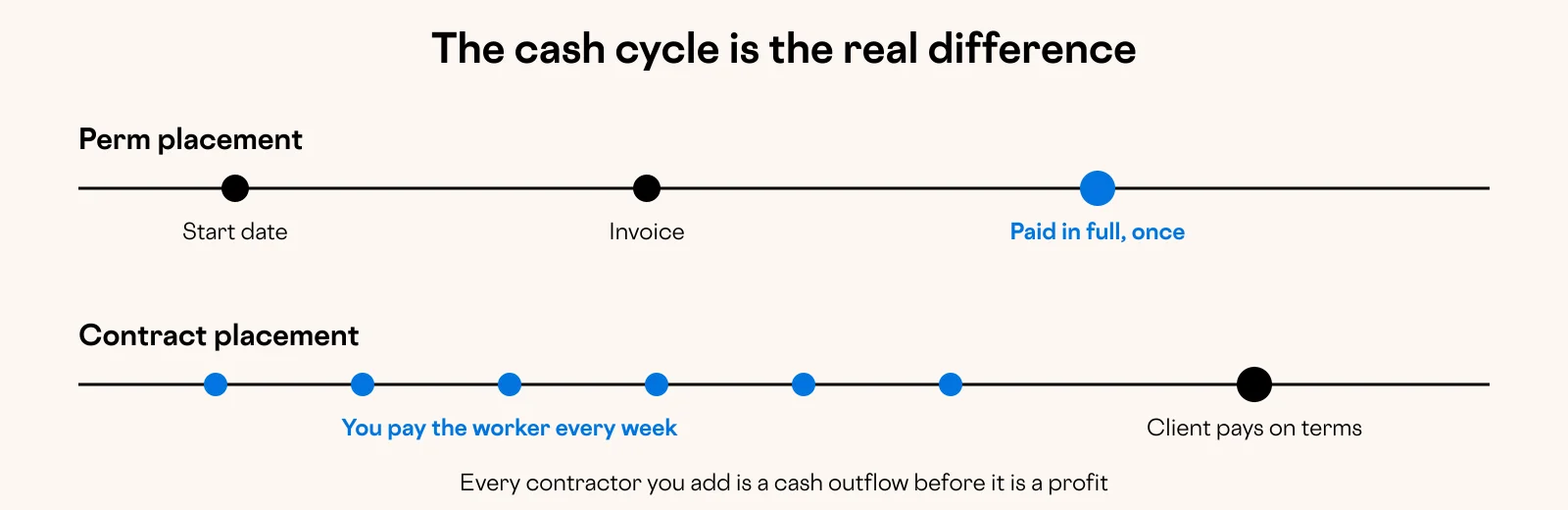
- Your model determines whether you need funding. Contract desks pay workers weekly and get paid on 30 to 60 day terms, so growth consumes cash.
The seven recruitment business models compared
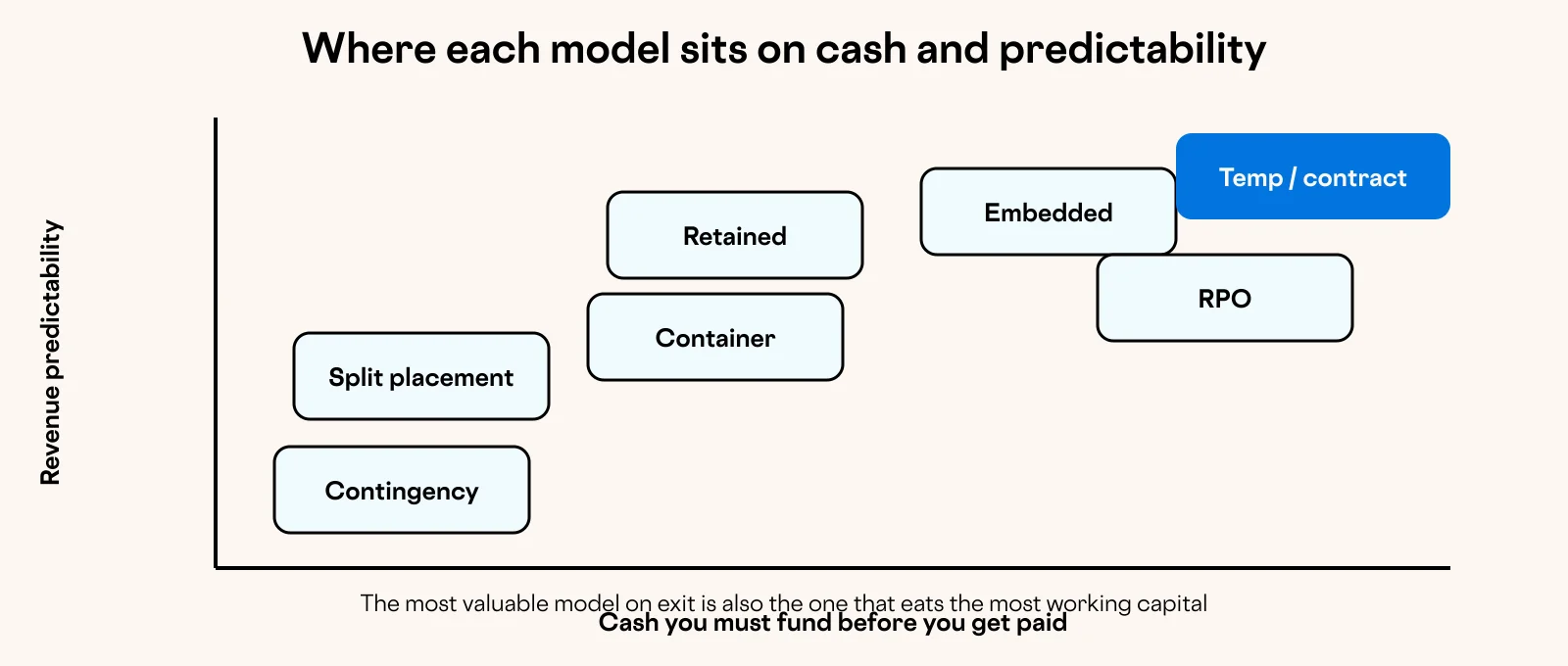
Read the cash cycle column first. It explains most of the failures in this industry better than fee percentage does.
| Model | How you get paid | Cash cycle | Best fit |
|---|---|---|---|
| Contingency | A fee on placement, typically a percentage of first-year salary | Invoice on start date, then client terms | Volume roles with multiple suppliers |
| Retained | Staged payments, commonly a third up front | Cash before delivery | Senior, confidential or scarce roles |
| Container | A smaller engagement fee up front, balance on placement | Partial cash up front | Clients who will not go fully retained |
| Temp and contract | Margin on hours worked, billed weekly or monthly | You pay first, then wait 30 to 60 days | Recurring demand, funded balance sheets |
| RPO | Monthly fee, per-hire fee, or a hybrid | Predictable monthly billing | Clients hiring continuously at volume |
| Embedded | Day rate or monthly rate for a recruiter inside the client | Monthly, low collection risk | Funded startups and scale-ups |
| Split placement | Fee shared with another firm, commonly 50/50 | Slow, and dependent on a third party | Filling gaps in a niche or geography |
Contingency: the default, and the hardest one to win on
Contingency is where almost every agency starts. You are paid only if your candidate is hired, which makes it easy to sell and brutal to deliver. Your fill rate, not your fee percentage, decides whether the desk works.
The economics only break when a role goes to several suppliers at once. Suzie Grieco, describing how subcontracted government roles get distributed on The Elite Recruiter podcast, calls them jump balls: "it's like 20 staffing agencies attacking one position." Twenty firms, one fee, and nineteen of them worked for nothing. Note this comes from a single podcast and reflects one recruiter's experience rather than industry-wide data.
Contingency still works, but only with exclusivity, a genuine niche, or a client relationship deep enough that you see the role first. Our guide to recruiter commission structures covers how the fee gets split once you have earned it.
Retained and container: getting paid to work
Retained search reverses the risk. The client pays in stages, commonly a third at engagement, a third at shortlist, and a third on start. You get working capital, exclusivity, and the ability to run a proper search process instead of racing.
The trade is that you have to be sellable at that level. Retained works on senior, confidential, scarce or specialist roles where the client accepts that a real search costs money. Container search is the compromise: a smaller engagement fee up front and the balance on placement. For a firm that cannot yet win full retainers, container is the practical bridge, and it filters out clients who were never serious.
Temp and contract staffing: recurring revenue, hungry balance sheet
This is the largest part of the market. The American Staffing Association reports around 27,000 staffing and recruiting companies operating close to 54,000 offices, with roughly 57% of the companies and 76% of the offices in the temporary and contract sector, and nearly 2.2 million temporary and contract employees working in an average week in 2024.
You earn margin on hours worked rather than a one-off fee. The revenue is recurring, the client relationship is stickier, and the book has real value on exit. The catch is cash. You pay workers weekly and invoice on 30 to 60 day terms, so every new contractor consumes working capital before contributing any. Payroll funding or an employer of record exists precisely to solve that, and turning down contract work because you cannot fund payroll is a common early mistake. If you are considering the move, our breakdown of the contract recruiter model covers the operational detail.
RPO and embedded: selling capacity, not placements
RPO and embedded models sell recruiting capacity rather than outcomes. In RPO you take over some or all of a client's hiring process for a monthly fee, a reduced per-hire fee, or both. Embedded is the lighter version: your recruiter works inside the client's team on a day or monthly rate, using the client's brand and systems.
Both convert lumpy placement income into predictable monthly revenue, which is exactly what makes a firm financeable. Both also cap your upside per hire and expose you to concentration risk, because losing one RPO contract can remove a quarter of your revenue in a month. Price on the assumption that every contract has a 12-month life, not a permanent one.
Split placement: cheap coverage, low margin
In a split, one firm holds the client and another supplies the candidate, and the fee is shared, usually evenly. It is a sensible way to serve a client outside your niche or geography without hiring for it, and a poor way to build a business on its own. You halve the fee, you depend on someone else's process, and you have no control over the client relationship.
How your model shapes ownership and headcount
The models above set your revenue mechanics. They also decide what the firm looks like internally.
Andrea Rishmawi described an alternative structure on the same podcast: "We set our company up very different than a traditional agency just in terms of how we work with recruiters. Take a company like ReMax. ReMax has an umbrella for the brand but everybody that works there has their own little business underneath it, meaning that they have their own LLC, they get paid as a contractor." That model trades employment overhead for higher payouts to producers. It works where recruiters are genuinely self-sufficient, and it fails where they need training and management. Again, one firm's approach, not a benchmark.
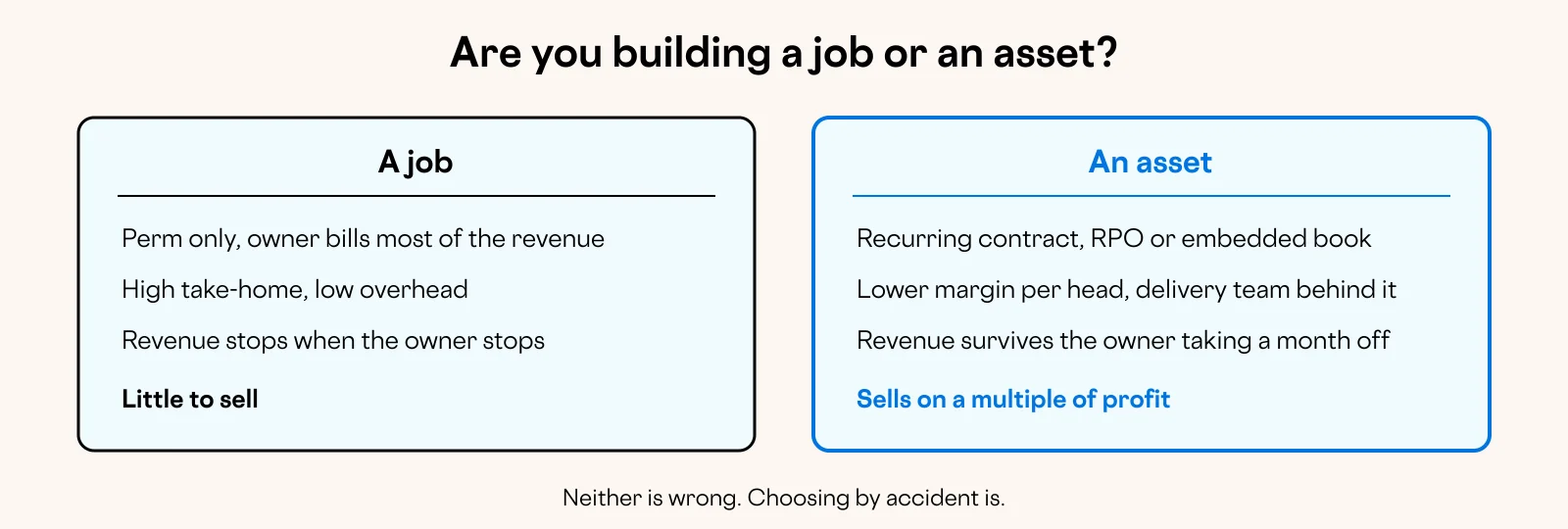
The practical question is whether you want a job or an asset. A solo perm desk on retained work can be highly profitable and worth very little to a buyer. A contract book with a delivery team behind it earns less per head and sells for a multiple. We cover what those multiples look like in our guide to selling a recruitment agency.
How to choose your recruitment business model
- Start with your niche's demand pattern. Continuous, high-volume hiring supports contract, RPO and embedded. Rare, senior hiring supports retained.
- Check your cash before your fee. If you cannot fund 60 days of payroll, do not open a contract desk without a funding partner.
- Pick the model your clients already buy. Selling retained into a market that has only ever bought contingency is a two-year education project.
- Decide what you want in five years. If the plan is to sell, weight the mix toward recurring revenue early, because buyers pay for it.
- Run one model properly before adding a second. Mixed models need different compensation, different systems, and often different people.
Most durable firms end up with two models, not one: a perm desk for margin and a contract or embedded book for stability. Getting there in the wrong order is what kills agencies. Our recruitment agency business plan template includes the financial model for testing a mix before you commit to it.
FAQ
What is the most profitable recruitment business model?
Per placement, retained search is the highest-margin model because you are paid in stages regardless of outcome and carry no payroll risk. Per business, contract staffing usually produces more total profit at scale because the revenue recurs, even though gross margin per head is lower. Profitability follows fill rate and cost control far more than it follows model choice.
How much do recruitment agencies charge?
Permanent fees are quoted as a percentage of first-year salary. Staffing Industry Analysts' benchmarking reports 20% as the single most common figure, cited by 42% of staffing firms surveyed, with commercial firms in a 15% to 20% midrange and direct hire specialists in a 20% to 25% midrange. Contract work is priced as a markup on the pay rate instead, and the margin varies widely by skill level and contract length.
Can a recruitment agency run more than one business model?
Yes, and most established firms do. The usual combination is a perm desk alongside a contract book, which balances margin against recurring revenue. The difficulty is internal: the two require different compensation plans, different cash management, and often different recruiters. Add the second model only once the first is running without you.
Which recruitment business model needs the least capital?
Retained and container search, because the client funds the work. Contingency perm is next, since you carry only your own overhead until the invoice clears. Contract staffing needs the most capital, because you pay workers weekly and wait 30 to 60 days for the client, and an employer of record or a payroll funder is the usual answer.
Which model is worth the most if I sell?
Buyers pay for recurring revenue, gross margin, and a business that runs without the founder, which favors contract, RPO and embedded books over perm-only firms. Client concentration cuts the other way: a large recurring contract with one client can lower your multiple rather than raise it.
Where to go next
If you are still deciding whether to launch, start with how to start a recruiting business, then check the compliance obligations attached to each model. When you are ready to build the team, post a recruiter job, benchmark against live agency recruiter jobs, or research competitors in the company directory.