
Recruitment Technology Trends That Will Define the Next 5 Years

Every year, someone predicts that technology will replace recruiters. Every year, they are wrong. But they are not completely wrong either. Recruitment technology is not replacing recruiters. It is changing what the job looks like day to day. And if you are not paying attention to these shifts, you are going to find yourself doing twice the work for the same results as the recruiter down the hall who has adapted.
This is not a recruitment technology product roundup or a tools comparison. This is about the macro trends in recruitment technology that are reshaping how agencies operate, how clients hire, and what skills recruiters need to stay competitive. Understanding these trends helps you make better career decisions: which agencies to work for, which skills to develop, and how to future-proof your desk.
AI-Powered Sourcing: The Biggest Shift in a Decade
Artificial intelligence has moved from buzzword to daily reality in recruitment technology. The tools available in 2026 can source candidates, parse resumes, match profiles to job specifications, and even draft outreach messages at a speed and scale that was not possible three years ago.
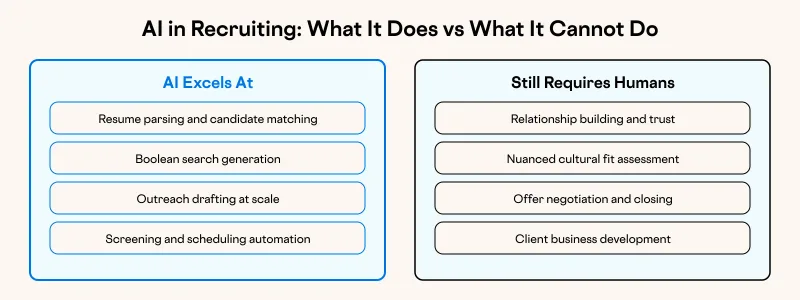
What AI Actually Does Well in Recruiting
Recruitment technology powered by AI excels at the repetitive, pattern-matching tasks that consume hours of a recruiter's day:
- Resume parsing and matching: AI can scan thousands of profiles and rank them against job requirements in minutes. Tools like hireEZ and SeekOut use AI to surface candidates from across the web, not just LinkedIn.
- Boolean search generation: Instead of spending 20 minutes building a complex Boolean string, AI tools generate optimised searches based on natural language descriptions of the ideal candidate.
- Candidate outreach drafting: AI can generate personalised outreach messages based on a candidate's profile, experience, and likely motivations. The messages still need human review and editing, but the first draft saves significant time.
- Screening and scheduling: AI chatbots can handle initial candidate screening questions and schedule interviews, freeing recruiters to focus on relationship-building and closing.
What AI Does Not Do Well
AI cannot replace the fundamentally human elements of recruiting:
- Relationship building: Candidates accept offers based on trust, rapport, and how they feel about the opportunity. No algorithm replicates this.
- Nuanced assessment: Understanding whether a candidate will thrive in a specific company culture, under a particular manager, in a certain team dynamic. This requires human judgement and experience.
- Negotiation: Closing offers, managing counteroffers, and navigating the emotional complexity of career decisions remain recruiter skills that AI cannot touch.
- Business development: Winning new clients, understanding their unstated needs, and building long-term partnerships is deeply human work.
The Recruiter Impact
Recruiters who embrace recruitment technology and use AI tools effectively are billing more than those who do not. The productivity gap is real and growing. According to LinkedIn's Global Talent Trends report, recruiters using AI-powered tools report a 30-40% reduction in time-to-shortlist.
However, "using AI tools" does not mean blindly trusting them. The best recruiters use AI for speed and scale, then apply human judgement for quality and nuance. Treat AI as an assistant that handles your research and admin, not as a replacement for your expertise.
ATS and CRM Consolidation
The recruitment technology stack is consolidating. For years, agencies cobbled together separate tools for applicant tracking, CRM, sourcing, outreach, and analytics. That era is ending.
The All-in-One Platform Trend
Platforms like Bullhorn, Loxo, Vincere, and Manatal are expanding to cover more of the recruitment workflow within a single tool. The benefits for recruiters are significant:
- Less context switching between multiple applications
- Better data because everything lives in one system
- Automated workflows that trigger actions across the entire process
- Unified reporting that connects sourcing activity to placement outcomes
Bullhorn remains the dominant ATS/CRM in the agency space, according to Staffing Industry Analysts' technology survey, but its market share is being challenged by newer, AI-native platforms. Loxo, in particular, has gained traction with its combined ATS/CRM/sourcing/outreach platform that eliminates the need for multiple subscriptions.
What This Means for Your Career
The agencies that invest in modern recruitment technology give their recruiters a genuine competitive advantage. When evaluating which staffing agency to work for, the tech stack should be a serious factor in your decision. An outdated ATS does not just frustrate you. It directly reduces your billing capacity.
If you are starting your own recruiting firm, the good news is that modern, all-in-one platforms are more affordable and capable than the legacy systems that large agencies are stuck with. A solo recruiter on Loxo or Recruit CRM can be as technologically capable as a consultant at a major agency.
Skills-Based Hiring Platforms
The shift from credential-based to skills-based hiring is one of the most significant recruitment technology trends reshaping the profession. Platforms like LinkedIn, TestGorilla, and HackerRank are building infrastructure that assesses candidates on what they can do, not just where they have worked.
Why This Matters for Recruiters
Skills-based hiring changes the sourcing equation. Instead of filtering for candidates with the "right" degree from the "right" school who worked at the "right" companies, recruiters can now identify talent based on demonstrated capabilities. This widens candidate pools and challenges traditional screening methods.
For recruiters, this means:
- Broader candidate pools: You can present non-traditional candidates who demonstrate the right skills, even if their resume does not match the conventional pattern.
- More defensible placements: Skills assessments provide objective data that supports your candidate recommendations to clients.
- New client conversations: You can proactively advise clients on skills-based hiring approaches, positioning yourself as a strategic partner rather than just a resume pipeline.
The recruiters who understand skills-based hiring methodology have an edge. Clients are increasingly receptive to this approach, and the recruiters who can deliver it stand out from those who are still screening purely on pedigree.
Recruitment Marketing Automation
Recruitment marketing, the practice of attracting candidates through content, employer brand campaigns, and targeted advertising, is becoming more automated and data-driven.
What Is Changing
Platforms like Beamery, Phenom, and SmashFly enable agencies and employers to:
- Build talent communities that nurture passive candidates over time
- Automate candidate engagement through triggered email sequences based on candidate behaviour
- Track candidate journey analytics from initial awareness to application to placement
- Run targeted advertising to attract candidates in specific niches and geographies
The Recruiter Impact
For agency recruiters, this recruitment technology means that the best candidates are increasingly being reached and engaged before you even know they are looking. Employers with sophisticated recruitment marketing are reducing their agency dependency for certain role types.
This does not eliminate agency recruiting, but it does shift the value proposition. The roles that come to agencies are increasingly the hardest to fill, the ones where automated marketing alone is not enough. This pushes agencies and recruiters further toward specialisation and relationship-driven placement.
Programmatic Job Advertising
Programmatic job advertising uses algorithms to buy and optimise job ad placements across multiple channels simultaneously. Instead of manually posting to Indeed, LinkedIn, and niche job boards for recruiters, programmatic platforms automatically distribute ads based on performance data.
Tools like Appcast, PandoLogic, and Joveo are making this accessible to mid-size agencies, not just enterprise employers. The technology optimises spend across channels in real-time, directing budget toward the sources that generate the most qualified applicants.
For recruiters, programmatic advertising means:
- Better candidate flow from job postings with less manual effort
- Lower cost-per-applicant through optimised ad spend
- Data-driven sourcing that identifies which channels work best for specific role types
Video and Asynchronous Interviewing
Video interviewing is not new, but the technology has matured significantly. Platforms like HireVue, Spark Hire, and VidCruiter now offer AI-powered analysis of video interviews, asynchronous interview capabilities, and structured evaluation tools.
The most significant trend is asynchronous video screening, where candidates record responses to pre-set questions on their own time. This accelerates the screening process: a recruiter can review 20 video responses in the time it takes to conduct 5 live phone screens.
For remote recruiter roles, video interviewing technology is essential. The ability to screen and assess candidates without scheduling live calls significantly increases throughput, particularly across time zones.
What Technology Do Recruiters Use in 2026?
The core recruitment technology stack for a well-equipped recruiter in 2026 looks like this:
| Category | Tools | Purpose |
|---|---|---|
| ATS/CRM | Bullhorn, Loxo, Vincere | Candidate and client management |
| Sourcing | LinkedIn Recruiter, hireEZ, SeekOut | Candidate identification |
| AI Assistant | Built into ATS or standalone (ChatGPT, Claude) | Search building, outreach drafting, research |
| Communication | Zoom, Teams, Slack | Candidate and client interaction |
| Assessment | TestGorilla, HackerRank, Codility | Skills verification |
| Analytics | Built into ATS or standalone BI tools | Performance tracking |
| Job Distribution | Broadbean, Appcast | Multi-channel posting |
The total cost of this stack ranges from $1,500-$3,000/month per recruiter. Agencies that provide this full suite are investing $20,000-$35,000 per recruiter annually in technology, a significant investment that directly impacts productivity.
How to Future-Proof Your Recruiting Career
Recruitment technology is not a threat to your career. It is a filter that separates adapters from laggards. Recruiters who adapt and use these tools will be more productive, more valuable, and better compensated. Those who resist will find themselves increasingly outpaced.
Here is how to stay ahead:
- Learn your tools deeply: Most recruiters use 20% of their ATS/CRM capabilities. Invest time in learning the full platform.
- Experiment with AI: Use AI tools for sourcing, outreach drafting, and research. Develop a feel for what they do well and where they fall short.
- Build relationships that technology cannot replicate: The more automated the top of the funnel becomes, the more valuable human relationships become in the middle and bottom.
- Understand data: Recruitment is becoming more data-driven. Recruiters who can interpret pipeline metrics, conversion rates, and market data are more valuable to agencies and clients.
- Stay informed: Follow trends in the staffing industry. Keeping up with recruitment technology gives you an edge over recruiters who react to changes rather than anticipate them. The recruiters who anticipate changes have an advantage over those who react to them.
Browse recruiter positions to see which firms are investing in modern tech stacks, and explore our company directory to research agencies before making your next move.
FAQ
Will AI replace recruiters?
No. AI is replacing specific tasks within recruiting, resume parsing, initial sourcing, outreach drafting, scheduling, but the core recruiter functions of relationship building, nuanced candidate assessment, negotiation, and business development remain fundamentally human. The recruiters most at risk are those who rely entirely on administrative tasks that AI can automate. Those who focus on relationship-driven, consultative recruiting are becoming more valuable, not less.
What technology do recruiters use the most?
The three most-used recruitment technologies are: (1) ATS/CRM platforms like Bullhorn or Loxo for managing the full recruitment pipeline, (2) LinkedIn Recruiter for candidate sourcing and networking, and (3) communication tools like Zoom and Teams for candidate and client interaction. AI-powered sourcing tools are rapidly growing in adoption and may join this top tier within the next 2-3 years.
How much should a recruiting agency spend on technology?
A well-equipped solo recruiter should budget $1,500-$2,500 per month for their technology stack. For agencies, the investment is typically $20,000-$35,000 per recruiter annually. The largest cost is usually LinkedIn Recruiter ($800-$1,200/month per licence), followed by the ATS/CRM ($50-$300/month per user). AI-powered sourcing tools add $100-$300/month per user. This investment pays for itself if it increases recruiter productivity by even 10-15%.
What recruitment technology trends should I watch?
The five most important recruitment technology trends for the next 5 years are: (1) AI integration across the full recruitment workflow, not just sourcing, (2) ATS/CRM consolidation into all-in-one platforms, (3) skills-based hiring replacing credential-based screening, (4) recruitment marketing automation reducing agency dependency for some role types, and (5) programmatic job advertising optimising candidate acquisition costs. Each of these trends creates both opportunities and challenges for recruiters.
How does recruitment technology affect recruiter compensation?
Recruitment technology generally increases earning potential for recruiters who adopt it. AI tools and modern platforms reduce the time spent on administrative tasks, allowing recruiters to manage more active searches simultaneously. This increased throughput translates to more placements and higher commission earnings. Agencies with better technology tend to attract and retain stronger recruiters, creating a virtuous cycle of better tools, better people, and better results.