
Recruiter to Operations Manager: The Realistic Path

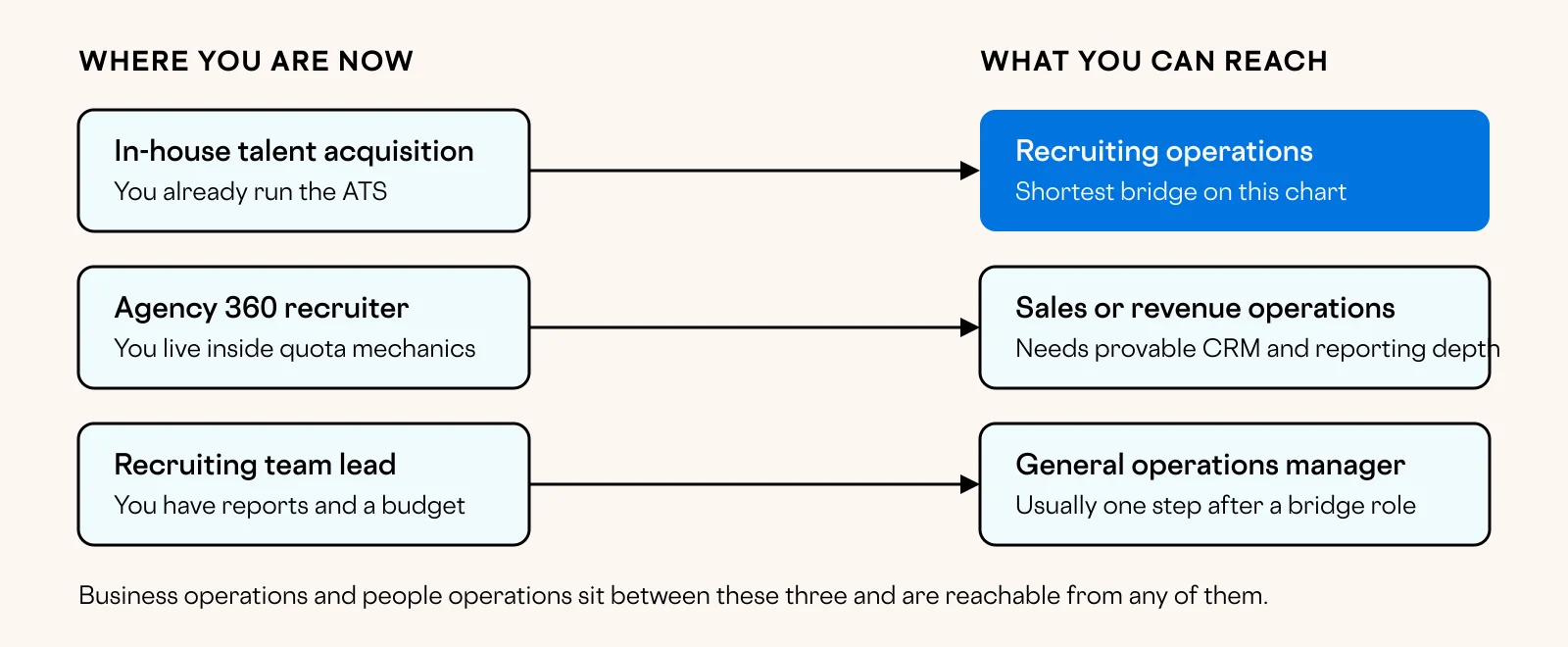
The recruiter to operations manager move is real, but it rarely happens in one step. The reliable route is sideways first: recruiting operations, people operations, or sales operations, then a general operations title. The pay gap explains the interest. US general and operations managers had a median wage of $105,770 in May 2025, against $75,940 for human resources specialists, the category most recruiters sit in.
Here is the problem with most advice on this move: "operations manager" is not one job. It covers at least five different roles that share a word and almost nothing else. A recruiting operations manager at a 400-person SaaS company and an operations manager at a distribution center do not do the same work, do not need the same skills, and will not hire the same candidate.
This guide separates them, tells you which ones a recruiter can actually get, what your desk experience is worth in each, and what the pay looks like once you account for lost commission.
Key takeaways
- Recruiters almost never go straight from a desk to a general operations manager title. The realistic first move is an operations role attached to a function you already know: recruiting operations, people operations, or sales operations.
- US general and operations managers earned a median of $105,770 in May 2025, with the middle half between $72,320 and $167,280 (BLS Occupational Employment and Wage Statistics). The spread matters more than the median.
- Your strongest transferable asset is not sourcing. It is running a repeatable process against a number under time pressure, with stakeholders who all think their thing is urgent.
- The gap that gets recruiters rejected is systems and budget. You have never owned a P&L line, and most operations job descriptions assume you have.
- Expect a flat or slightly negative first-year move on total earnings if you were a decent biller. The gain is in year three, not year one.
What "operations manager" actually means
Before you apply to anything, work out which of these five jobs you are chasing. They have different hiring bars and different owners.
The table below maps each flavor to the recruiting background that fits it best. Look at the "entry difficulty" column first: it is the honest read on whether you will get an interview without a bridge role.
| Operations role | What you own | Best recruiting background | Entry difficulty |
|---|---|---|---|
| Recruiting operations | ATS administration, hiring process design, requisition workflow, recruiting data and reporting | In-house talent acquisition, especially anyone who ran the ATS or built the reports | Low. The most direct bridge that exists. |
| People operations | Onboarding, HRIS, employee lifecycle admin, policy rollout, internal tooling | In-house recruiter at a company under 500 people, where you already did some of this | Low to moderate |
| Sales operations | CRM hygiene, pipeline reporting, quota and territory design, commission plans | Agency recruiter who ran a 360 desk and understands quota mechanics from the inside | Moderate. Requires provable spreadsheet and CRM depth. |
| Business operations | Cross-functional projects, internal process fixes, vendor management, planning cycles | Anyone with strong project and stakeholder evidence, usually after a bridge role | High without an intermediate step |
| General operations manager | A site, a team, a budget, and a service or delivery target | Recruiting team leads and branch managers with direct reports and P&L exposure | High. This is the one people mean and the hardest to reach directly. |
What transfers from a recruiting desk, and what doesn't
Recruiters oversell the wrong things in operations interviews. Nobody hiring an operations manager cares that you can find a passive candidate. They care whether you can hold a process together when three teams want incompatible outcomes.
What genuinely transfers:
- Running a repeatable process against a weekly number, with the discipline that requires
- Managing stakeholders who outrank you and disagree with each other
- Forecasting from a pipeline and being held to the forecast
- Vendor selection and management, if you have owned job board or tooling contracts
- Working out where a process breaks by looking at conversion rates between stages
What doesn't, and where recruiters get caught:
- Budget ownership. Most recruiters have never held a cost line, forecast spend, or defended a variance. Operations roles assume it.
- Systems depth. Knowing an applicant tracking system (ATS) as a user is not the same as configuring one. Operations wants people who build the workflow, not people who work inside it.
- Documentation. Recruiting rewards speed and improvisation. Operations rewards a written process another person can follow without you.
- Scale of coordination. A desk is you plus a handful of hiring managers. Operations is often 50 or more people affected by a change you make on a Tuesday.
If you want the fuller translation exercise, the recruiter transferable skills guide covers how to reframe desk language for non-recruiting hiring managers.
The pay picture, honestly
The headline gap is real but the range is what should shape your decision. Look at the middle 50% rather than the median, because operations titles cover everything from a shift supervisor to a regional director.
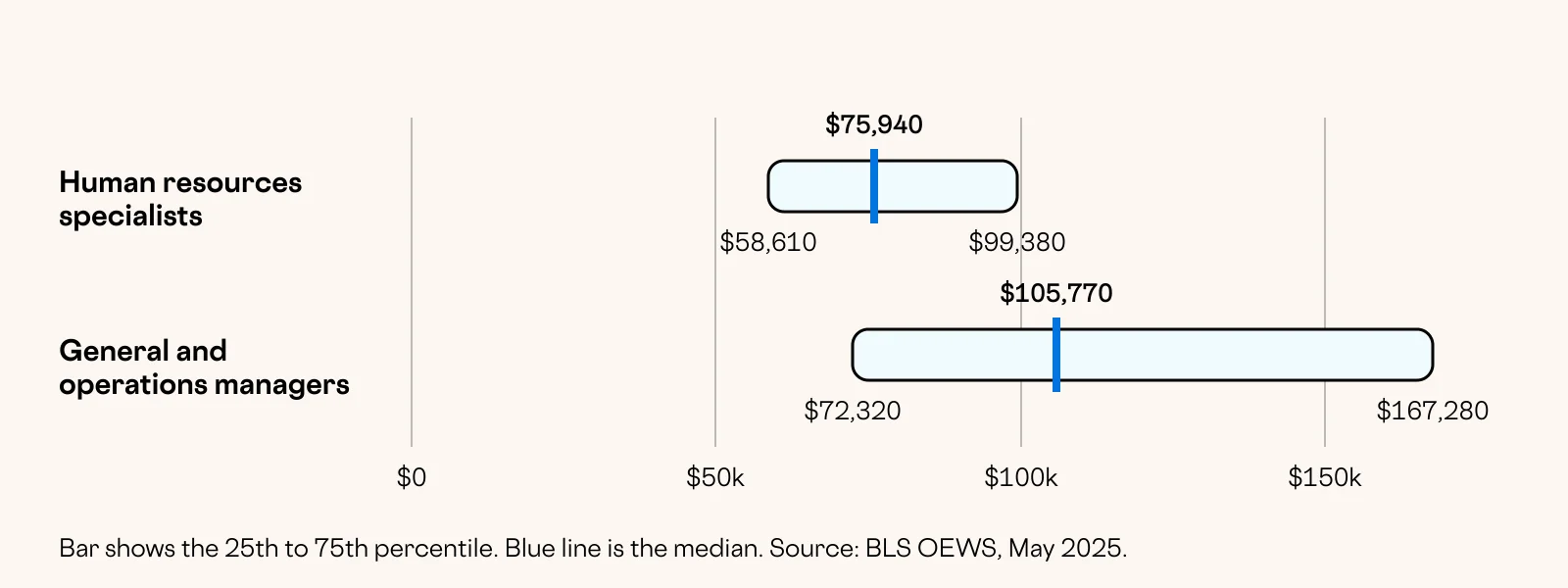
Now the part the salary tables hide. If you bill well in agency, your first operations offer will probably feel like a pay cut, because a base salary of $95,000 replaces a base of $55,000 plus commission that occasionally doubled it. You are trading variance for a floor. That is a genuine trade, not a free upgrade, and it is worth being clear-eyed about which one you actually want. Our recruiter salary report has the current base and OTE spreads if you want to compare properly before you move.
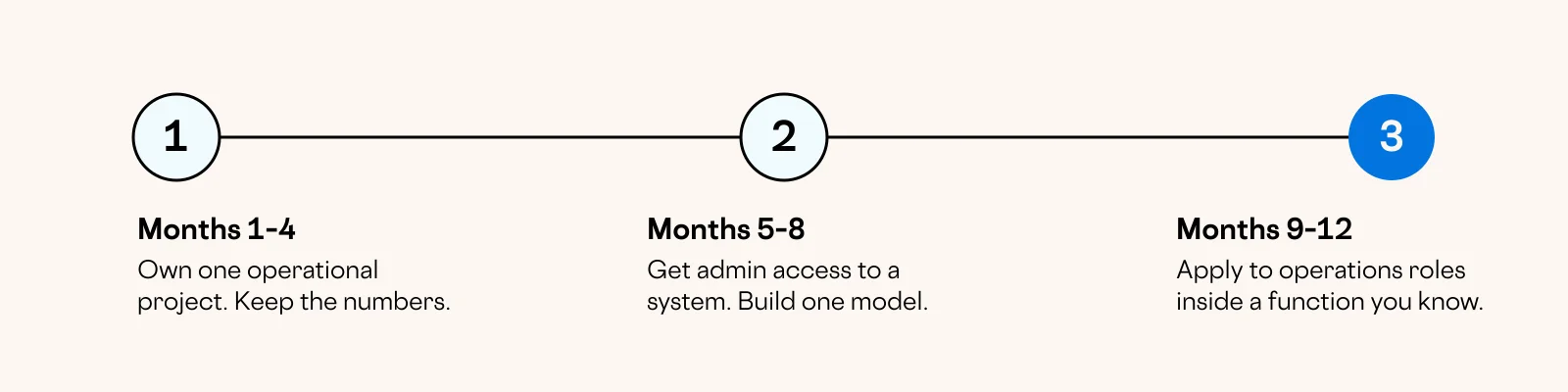
How to make the recruiter to operations manager move in 12 months
Months 1–4: own something operational where you already are
You need one artifact that is not a placement. Take the piece of your current function that nobody wants and own it: the ATS cleanup, the interview scheduling workflow, the hiring manager training doc, the quarterly recruiting report. Write it down, measure the before and after, and keep the numbers.
If you are in-house, the recruiting data is right there. Pull time to fill, offer acceptance, and stage conversion for your team, and build the report nobody has built. The recruiting metrics guide covers which ones actually mean something.
Months 5–8: close the two gaps that get you rejected
Spreadsheets and systems. Not "I use Excel", but pivot tables, lookups, and a model you built that someone else uses. On the systems side, get administrator access to something: the ATS, the human resources information system (HRIS), the customer relationship management (CRM) tool. Administrator experience on any one platform is the credential that moves you from "recruiter applying to ops" to "ops candidate with a recruiting background".
Months 9–12: apply to bridge roles, not the dream title
Apply to recruiting operations, people operations, and talent operations roles. These hire recruiters. They are also where the general operations track starts, because two years in recruiting operations gives you process design, systems ownership, and reporting evidence that reads as operations experience to any hiring manager.
When not to make this move
Three situations where the recruiter to operations manager switch tends to disappoint.
You want out of the pressure. Operations has targets too, and they are usually daily rather than monthly. You swap billing pressure for service-level pressure and a queue that never empties.
You are a strong biller chasing a title. A recruiter billing consistently is in the top quartile of earners in the profession. Moving to a mid-level operations job to gain a manager title is often a downgrade dressed as progress.
You dislike detail. Operations is documentation, edge cases, exceptions, and reconciliation. If the appeal of recruiting was the conversation and the close, that is exactly what operations removes.
If the honest problem is the desk rather than the profession, it may be worth looking at what else is out there first. Browse current recruiter jobs and talent acquisition roles before you commit to retraining, and check the company directory to see who is building out operations-heavy talent teams.
Frequently asked questions
Can a recruiter become an operations manager without an operations background?
Yes, but almost always through a bridge role. Recruiting operations, people operations, and talent operations hire directly from recruiting and give you the process, systems, and reporting evidence that a general operations manager job description asks for. Going straight from a desk to a general operations manager title happens mostly for people who already managed a team and a budget.
Is operations manager a high-paying job?
It has a high ceiling and an ordinary floor. US general and operations managers had a median wage of $105,770 in May 2025, but the 10th percentile was $50,090 and the 90th was $253,390 (BLS Occupational Employment and Wage Statistics, May 2025). The title tells you very little about the pay, so read the scope, the headcount, and the budget rather than the job title.
What certification helps most for a recruiter moving into operations?
None of them are required, and most are not worth the money on their own. If you are going to spend on one, spend it on demonstrable systems administration or a project management credential, because both fill the gap operations hiring managers actually flag. A certificate with no accompanying project is decoration.
Is recruiting operations a real career or a coordinator job with a better name?
It is a real function, and it has become the standard route from recruiting into both talent leadership and wider business operations. The work is process design, systems ownership, and reporting. It is worth checking the specific job description carefully, though, because some companies do still use the title for scheduling work.
How long does the recruiter to operations manager transition usually take?
Plan for two to three years to reach a genuine operations manager title, with the first move happening inside 12 months. People who compress it further usually do so internally, by taking over an operational function at a company that already knows them.
Is the recruiter to operations manager move right for you?
The recruiter to operations manager path works when you like the machinery more than the conversation. If the best part of your week is fixing the process rather than closing the candidate, operations will suit you, and the pay ceiling is meaningfully higher than a non-managing recruiting seat.
It works badly as an escape route. Operations is not calmer than recruiting, it is differently demanding, and the first-year pay move is often sideways at best. Take the bridge role, own something operational where you are now, and get administrator access to one system. That sequence is what turns a recruiting resume into an operations one.
If you are still weighing the options, the complete career change from recruiting guide compares every exit route side by side.