
Recruiter to Customer Success: Is It the Right Move?

Recruiter to customer success is one of the cleanest exits out of recruiting into software, and agency recruiters have the strongest case: you already manage client relationships against a renewal cycle and a number. The pay is comparable rather than transformative. Customer Success Collective reported a US median customer success manager salary of $88,500 for 2025.
The pitch you will hear is that customer success is "relationship work without the cold calling". Half true. The relationships are real, and so is a retention target, a churn number, and a set of accounts that will renew or won't based partly on things you cannot control. It is a quota job wearing a friendlier job title.
This guide covers what a customer success manager actually does day to day, which recruiters convert well and which don't, what your recruiting experience is worth in the interview, and the pay trade you are making.
Key takeaways
- Customer success has no US occupational classification of its own, so national wage data doesn't exist for it. The closest official proxy, sales representatives of services, had a May 2025 median of $69,990 (BLS). Company-level survey data puts customer success manager pay meaningfully higher.
- Agency recruiters convert better than in-house recruiters, because account ownership, renewal pressure, and commercial conversations are the core of the job.
- Your best entry point is a software company selling into a function you recruited for. Domain knowledge is what gets you past the "no software experience" filter.
- The skill you are missing is product depth, not people skill. Customer success managers are expected to configure, troubleshoot, and demonstrate a product on a call.
- Base salaries are usually higher than an agency base and the variable component is smaller, so the trade is a higher floor for a lower ceiling.
What a customer success manager actually does
The title covers a wide range, but a mid-market customer success manager's week usually breaks down like this.
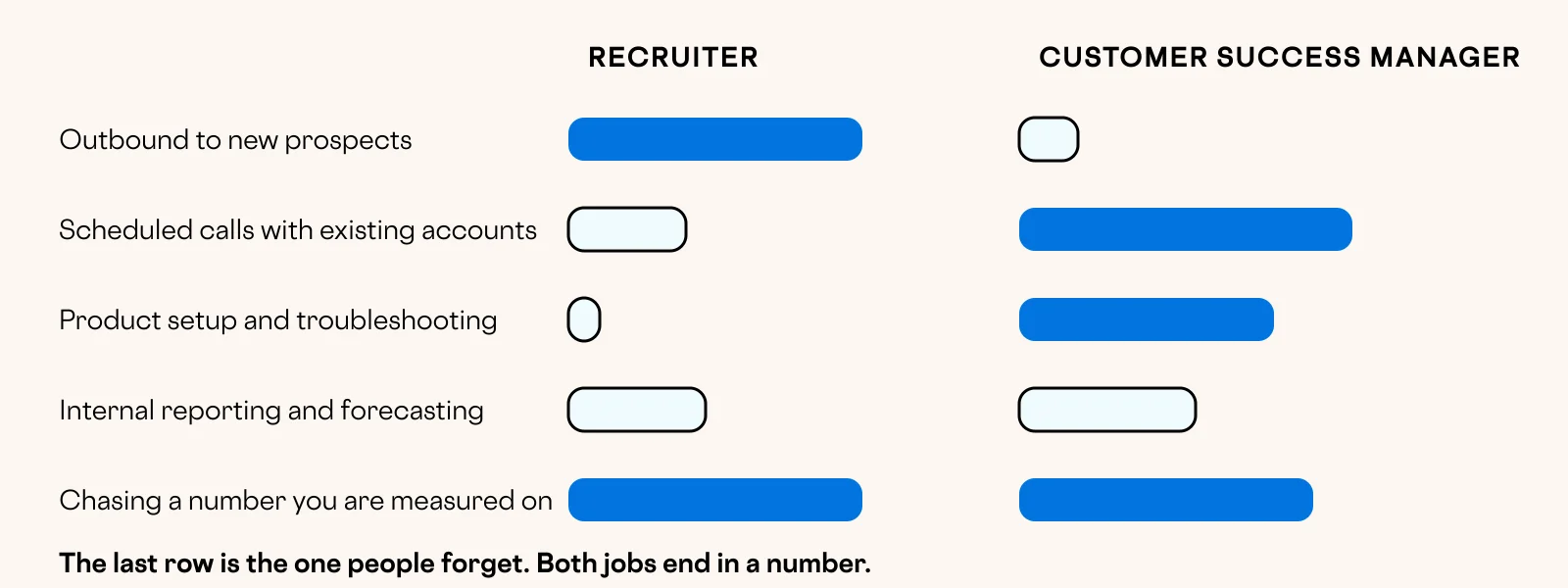
The core loop is onboarding a new customer, driving them to use the thing they bought, spotting the accounts that are drifting, and getting to a renewal. Most customer success managers carry a retention target expressed as net revenue retention, which is renewals plus expansion minus churn across the accounts they own. Many also carry an expansion quota, which is straightforwardly a sales number.
The part recruiters underestimate is product work. You will be expected to configure the software, run a demonstration, diagnose why an integration broke, and explain a release note to a customer who is annoyed. That is closer to solutions engineering than to account management, and it is the most common reason a recruiter fails the interview loop.
Which recruiters convert well
Not evenly. The table below is the honest read on how each background lands with a customer success hiring manager.
| Your background | How it reads to a customer success hiring manager | Odds |
|---|---|---|
| Agency 360 recruiter | You have owned accounts, handled a renewal conversation, and been measured on revenue from existing clients | Strong |
| Recruiter at a staffing or recruiting software vendor | You already know the product category and the buyer. The shortest possible move. | Strongest |
| Technical recruiter | You can hold a technical conversation, which is the gap most customer success candidates have | Strong for technical products |
| In-house talent acquisition | Good stakeholder skills, but no commercial ownership. Expect questions about whether you can carry a number. | Moderate |
| Sourcer or recruiting coordinator | Usually routed to an onboarding specialist or customer success associate role first | Entry level only |
The highest-probability version of this move is joining a company that sells into recruiting: an applicant tracking system (ATS) vendor, a sourcing tool, an assessment platform, a job board. You know the buyer, the workflow, and the objections. That domain knowledge is worth more than any customer success certification you could take.
What transfers, and what you will have to learn
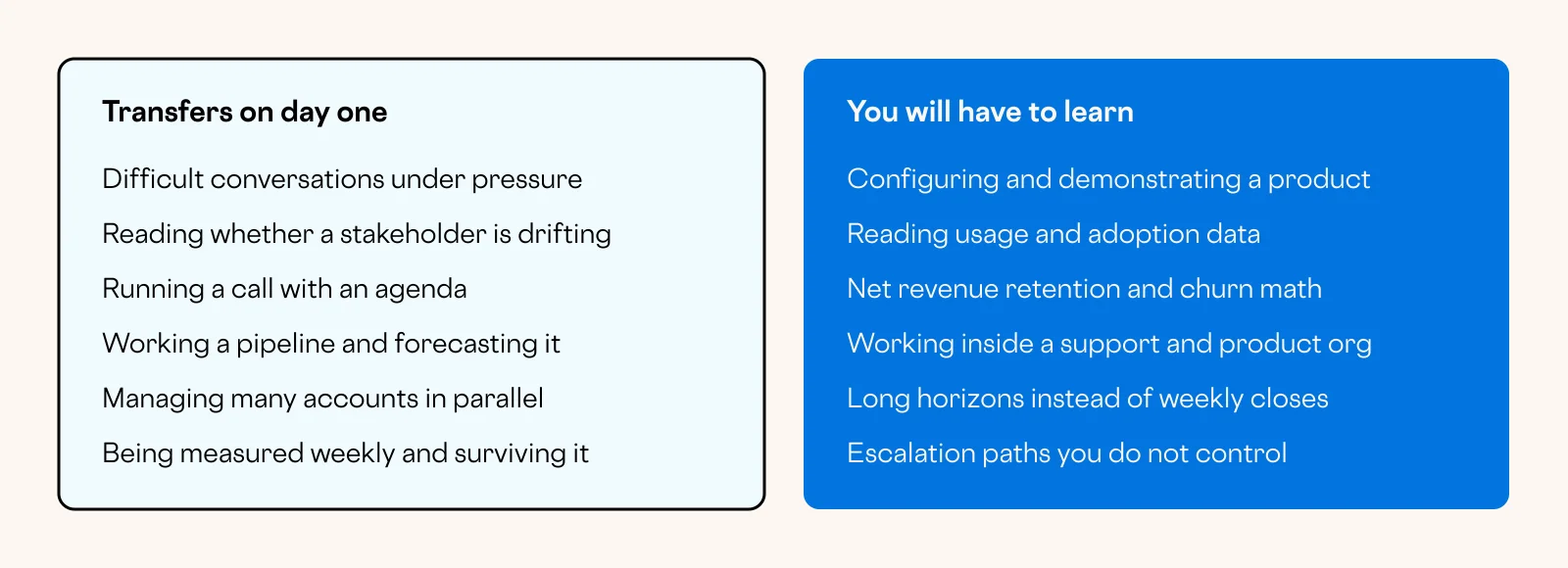
The hardest adjustment is pace. Recruiting gives you a result every week: a placement, a rejection, a live offer. Customer success gives you a result every quarter, and the work in between is patient and cumulative. Recruiters who miss the dopamine of a close tend to drift toward sales rather than settle into customer success. If that sounds like you, the recruiter to sales guide covers the alternative honestly.
The pay trade
There is no official US wage series for customer success managers, which is worth knowing before you read any salary claim about the role. The Bureau of Labor Statistics has no occupational code for it, so every figure you will see comes from self-reported survey data or job posting scrapes.
Two reference points. Customer Success Collective's salary research put the US median customer success manager salary at $88,500 for 2025. The closest official comparison, sales representatives of services, had a May 2025 median of $69,990 with the middle half between $47,670 and $100,480 (BLS, May 2025).
What that means in practice for a recruiter: expect a higher base than an agency base, a smaller variable component than agency commission, and a total number that lands somewhere between a bad billing year and a good one. If you are consistently in the top quartile of billers, this is a pay cut. If you are grinding an average desk, it is a raise and a much steadier one. For reference, the human resources specialist category that most in-house recruiters fall under had a May 2025 median of $75,940. Check your own position against the current market first using the recruiter salary report.
How to position a recruiting resume for customer success
- Lead with retained revenue, not placements. "Managed 14 client accounts generating $1.2m in repeat business over two years" reads as customer success. "Filled 62 roles" does not.
- Name the renewal work explicitly. Contract renegotiations, terms extensions, and preferred-supplier reviews are renewal conversations. Say so.
- Show a save. Every recruiter has rescued an account that was about to walk. That story is the single most useful thing you can bring to a customer success interview.
- Close the product gap before you apply. Get hands-on with the product category you are targeting. Free tiers, trial accounts, and vendor certification courses all count, and they turn "no software experience" into "here is what I built in your product".
When customer success is the wrong move
You want to stop selling. You won't. Expansion revenue sits inside most customer success targets, and the renewal conversation is a close.
You want more autonomy. Customer success sits between product, support, and sales, and you will spend real time coordinating people who do not report to you and do not share your priorities.
You are chasing remote work specifically. Customer success roles are often remote, but so are a lot of recruiting roles now. If flexibility is the actual goal, that is achievable without retraining. Have a look at current remote recruiter jobs before you rebuild your resume for a different profession.
Frequently asked questions
Is customer success hard to get into from recruiting?
Moderately, and it depends where you apply. Applying cold to a software company with no domain overlap is difficult, because you are competing against candidates with product experience. Applying to a vendor that sells into recruiting is much easier, because your knowledge of the buyer is exactly what they cannot hire elsewhere.
What skills do you need to be a customer success manager?
Account ownership, commercial conversation skills, and enough product depth to configure and demonstrate the software without help. Recruiters usually arrive with the first two and have to build the third. Data literacy matters too, because you will be reading product usage reports to spot accounts at risk.
What is a typical customer success manager salary?
Customer Success Collective reported a US median of $88,500 for 2025. Segment drives most of the variation: enterprise customer success managers with fewer, larger accounts typically earn more than small-business customer success managers carrying 80 accounts. Treat any single figure as directional, because there is no official wage series for the role.
Do I need a customer success certification?
No. Hiring managers weight domain knowledge and evidence of account ownership far above certification. If you have budget to spend on the move, spend it on getting hands-on with the specific product category you are targeting rather than on a general customer success course.
Should I go into customer success or account management?
Account management is closer to what an agency recruiter already does and usually pays more variable compensation. Customer success is broader, more product-facing, and steadier. If you liked client work but disliked the constant new business pressure, customer success is the better fit. If new business was the part you were good at, account management will suit you better.
Is recruiter to customer success right for you?
The recruiter to customer success move works best for agency recruiters who liked owning clients and disliked starting from zero every month. You keep the relationship work, you gain a base salary you can plan around, and you enter an industry with clearer progression than most recruiting desks offer.
It works badly if you expected the number to go away, or if you are not willing to become genuinely good at a piece of software. Pick a product category you already understand, get hands-on with it, and rewrite your experience around retained revenue rather than placements.
Still weighing it up? The roundup of jobs recruiters transition into compares customer success against the other realistic exits, and recruiter transferable skills covers how to translate your experience for any of them. If you would rather stay in the profession and fix the desk instead, browse current recruiter jobs and talent acquisition roles, or check the company directory to see who is hiring.