
Recruiter to Sales: Why It's the Most Common Switch

If you are an agency recruiter considering the recruiter to sales transition, it is probably already on your radar. There is a good reason for that: you are already in sales. You just call it recruiting.
Every day as a recruiter, you pitch candidates on roles they did not know existed. You pitch clients on candidates they were not expecting. You negotiate fees, overcome objections, manage a pipeline, and close deals on a timeline. The only difference between your desk and a sales desk is that you are placing people instead of selling software.
The recruiter to sales switch is the fastest and most common career transition in the recruiting profession, and it is also one of the best-compensated. Sales leaders at SaaS companies, tech firms, and professional services organisations actively recruit from agency backgrounds because they know the skill overlap is nearly identical.
This recruiter to sales guide covers which sales roles map to which recruiter backgrounds, how compensation compares, what the actual adjustment looks like, and how to position yourself for a sales role when your resume says "recruiter."
Why the Recruiter to Sales Move Works
This is not speculation. Sales hiring managers have told me directly, and the pattern is consistent across industries. Here is what makes the recruiter to sales transition so successful.
You already know how to prospect. Cold calling candidates and cold calling prospects are the same skill. You have built the muscle for outbound outreach, follow-up cadences, and pipeline development. Most new sales hires struggle with prospecting. You have been doing it for years.
You handle rejection professionally. Recruiters hear "no" more times in a week than most professionals hear in a month. Candidates ghost you. Clients change the spec. Offers fall through at the last minute. That rejection tolerance is genuinely rare and genuinely valuable in sales.
You manage complex, multi-stakeholder deals. A recruitment placement involves the candidate, the hiring manager, the HR team, and sometimes the C-suite. You navigate competing priorities, manage expectations, and drive toward a close date. That is enterprise sales in miniature.
You understand revenue pressure. If you worked at an agency with billing targets, you already know what it feels like to have a number on the board and a deadline to hit it. You understand commission structures, quarterly targets, and the psychology of performance-based compensation.
You think in pipelines. Your recruiting CRM is structurally identical to a sales CRM. You have stages, conversion rates, time-in-stage metrics, and forecasting. Sales leaders do not have to teach you pipeline discipline because it is already how you think.
According to a 2024 survey by Pavilion, former recruiters who make the recruiter to sales move reach quota attainment within their first year at higher rates than career-switchers from most other backgrounds. The skills translate that directly.
Recruiter to Sales: Which Roles Suit Which Backgrounds
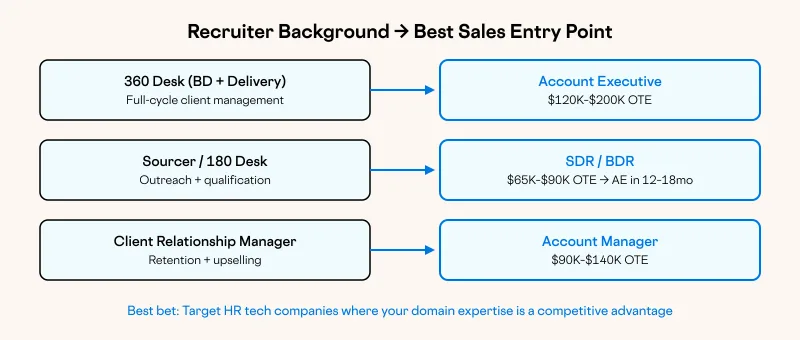
Not all recruiter to sales paths are the same, and your specific recruiting experience determines which entry point makes the most sense.
Recruiter to Sales via Account Executive (AE)
If you ran a full 360 desk, sourcing candidates, developing client relationships, and closing placements, you were already doing the work of an Account Executive. AEs own the full sales cycle: prospecting, discovery, demos, proposals, negotiation, and close. Your 360 recruiting experience maps almost perfectly.
Best sectors to target: SaaS, HR tech, staffing technology, professional services, recruiting platforms. Companies in the talent acquisition ecosystem particularly value your domain expertise.
Typical OTE: $120,000 to $200,000 at mid-market SaaS companies. Enterprise AE roles at established companies can reach $250,000 to $350,000 OTE.
Recruiter to Sales via SDR/BDR
If your background is primarily in sourcing, finding candidates, making initial outreach, qualifying interest, and passing warm leads to a senior recruiter, the SDR or BDR role is the direct parallel. SDRs prospect, qualify leads, and book meetings for Account Executives.
The SDR role is typically a stepping stone to AE, not a long-term position. Most companies promote strong SDRs to AE within 12-18 months. The role is excellent if you want to learn sales methodology from scratch before owning a full quota.
Typical OTE: $65,000 to $90,000. Top-performing SDRs at well-funded startups can earn $100,000 or more.
Recruiter to Sales via Account Manager
If you spent most of your time managing existing client relationships rather than developing new business, account management is your lane. Account Managers focus on retention, expansion, and upselling within existing accounts. You keep clients happy, identify growth opportunities, and protect revenue. Sound familiar?
Typical OTE: $90,000 to $140,000 base plus bonus. Account management compensation is typically more base-heavy and less commission-dependent than pure sales roles.
Recruiter to Sales in HR Tech
Here is the specific recruiter to sales play that works exceptionally well: target companies that sell to recruiters or HR teams. ATS platforms, sourcing tools, job boards, background check companies, interview scheduling software, and recruiting analytics platforms all need salespeople who understand the buyer. Your recruiting experience is not just transferable in these contexts; it is a competitive advantage.
Companies like LinkedIn, Indeed, Greenhouse, Lever, Ashby, BrightHire, GoodTime, and dozens of others in the HR tech ecosystem regularly hire ex-recruiters into revenue roles. You understand the pain points because you have lived them.
Recruiter to Sales: Compensation Comparison
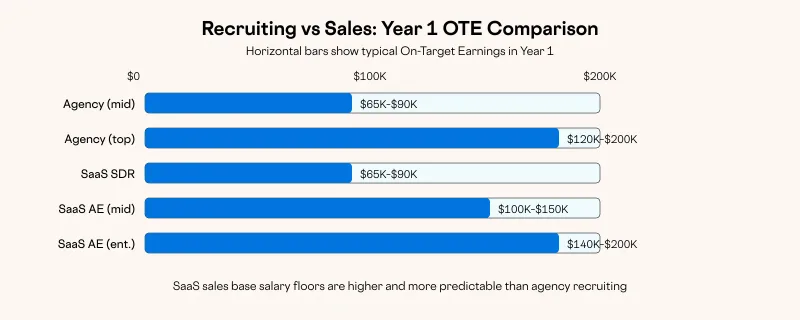
Let us put real numbers on the recruiter to sales compensation comparison.
| Role | Year 1 OTE | Year 3 OTE | Year 5+ OTE |
|---|---|---|---|
| Agency recruiter (mid-performer) | $65K-$90K | $90K-$130K | $120K-$180K |
| Agency recruiter (top biller) | $120K-$200K | $150K-$250K | $200K-$400K |
| SaaS SDR/BDR | $65K-$90K | N/A (promoted to AE) | N/A |
| SaaS AE (mid-market) | $100K-$150K | $140K-$200K | $180K-$280K |
| SaaS AE (enterprise) | $140K-$200K | $200K-$300K | $250K-$400K |
| Account manager | $80K-$120K | $100K-$140K | $120K-$180K |
A few things to notice about these numbers.
The base salary floor in SaaS sales is higher. Most SaaS AEs earn $70,000 to $100,000 base salary before commission. That is a more predictable income than agency recruiting, where base salaries of $40,000 to $60,000 are common and the rest depends on placements.
The commission upside in enterprise sales is massive. If you are a top biller in agency recruiting, you already know what uncapped commission feels like. Enterprise SaaS sales has the same structure but with larger deal sizes. Closing a $200,000 annual contract at a 10% commission rate beats most recruiting placement fees.
The career ceiling is higher. In recruiting, the path is recruiter, senior recruiter, team lead, maybe branch manager. In sales, the path extends to VP of Sales, CRO (Chief Revenue Officer), and eventually CEO. A disproportionate number of tech company CEOs came up through sales. The leadership opportunities are broader.
For context on where your current recruiting compensation sits relative to the market, check the recruiter salary guide.
What Actually Changes in the Recruiter to Sales Switch
The skills transfer, but the context changes. Here is what to expect when making the recruiter to sales move.
The sales cycle is longer. Most recruiting placements close in 2-8 weeks. SaaS sales cycles run 1-6 months for mid-market and 6-18 months for enterprise. You need to build patience for deals that take quarters, not weeks, to close. The dopamine hit of a quick placement is replaced by the slow build of a large contract.
The product does not change. In recruiting, every placement is unique. Every candidate is different. Every client has different needs. In sales, you are selling the same product, day after day. Some people find this boring. Others find it liberating because you can actually master your pitch and refine your approach over time.
The metrics are different but familiar. Instead of placements and billings, you track pipeline value, conversion rates, average deal size, and sales cycle length. Instead of a billing target, you have a quota. The pressure is the same. The language is different.
You stop working weekends (usually). Agency recruiting bleeds into evenings and weekends because candidates are available when they are not at work. Sales, particularly B2B sales, operates on business hours. You will still work hard, but the boundaries are clearer.
The tools are better. Recruiting technology has improved, but it still lags behind sales technology. Sales teams use Salesforce, HubSpot, Gong, Outreach, ZoomInfo, and a dozen other tools that are purpose-built for pipeline management and deal execution. If you were frustrated by clunky ATS platforms, you will appreciate the sales tech stack. According to LinkedIn's 2024 State of Sales report, top-performing sales teams use an average of 5 integrated tools, and proficiency with this stack is a key differentiator for new hires.
Recruiter to Sales: The Transition Playbook
Reframe Your Resume
This is not optional. A resume that leads with "Senior Recruiter" and lists "sourced 500 candidates" will get filtered out by sales hiring managers who do not understand recruiting.
Translate your experience:
| Recruiting Language | Sales Language |
|---|---|
| Filled 40 roles in Q3 | Closed 40 deals in Q3 |
| Managed a $500K billing desk | Managed a $500K revenue book |
| Built pipeline of 200+ candidates | Built pipeline of 200+ qualified opportunities |
| Negotiated client fee agreements | Negotiated contract terms and pricing |
| Developed 15 new client accounts | Prospected and closed 15 new accounts |
| Maintained 85% offer acceptance rate | Achieved 85% close rate on qualified opportunities |
This is not exaggeration. The recruiter to sales translation is accurate. The work is the same; the words are different. For a comprehensive skills translation framework, see the recruiter transferable skills guide.
Learn the Basics of Sales Methodology
You already sell intuitively. But sales organisations use structured methodologies that you need to at least be conversant in during interviews.
MEDDIC (Metrics, Economic Buyer, Decision Criteria, Decision Process, Identify Pain, Champion) is the most common enterprise sales framework. Understanding the concepts will help you speak the language in interviews.
SPIN Selling (Situation, Problem, Implication, Need-Payoff) is a consultative selling approach. It maps closely to how good recruiters conduct intake meetings with clients.
Challenger Sale is about teaching prospects something they did not know. Recruiters who advise clients on market conditions, salary benchmarking, and talent availability are already using this approach.
You do not need a certification. Read one or two books, watch a few YouTube breakdowns, and be able to discuss the frameworks intelligently. That is enough to clear the bar.
Target the Right Companies
HR tech and recruiting tech companies are the best bet for a recruiter to sales first role. Your domain expertise is a genuine differentiator. You understand the buyer, the market, and the pain points because you have experienced them firsthand.
High-growth startups (Series A through C) tend to be more open to non-traditional sales backgrounds. Enterprise companies with formal sales training programmes are also strong options because they invest in developing raw talent.
Avoid companies that are looking for "5+ years of SaaS sales experience." Those roles are not for career-changers. Target listings that mention "coachable," "high-energy," "entrepreneurial mindset," or "sales-adjacent experience welcome."
Nail the Interview
Sales interviews will test you on skills you already have. The difference is that they will frame the test in sales language.
Role-play exercises. You will be asked to sell something on the spot or do a mock discovery call. This is your agency pitch meeting with different vocabulary. Treat it the same way: listen, ask questions, identify the pain, propose a solution.
Pipeline walk-through. Describe a complex deal you closed from start to finish. Use a recruiting placement as your example: the sourcing, the screening, the client management, the negotiation, the close, and the post-placement follow-up. It maps perfectly.
"Why sales?" Have a clear, confident answer. The winning version: "I have been in a revenue-generating, quota-carrying role for X years. The skills I have built in prospecting, negotiation, and pipeline management are directly applicable, and I want to apply them in a product context where I can build longer-term relationships with clients." The losing version: "I am burned out from recruiting."
Recruiter to Sales: The Honest Downsides
No recruiter to sales guide would be complete without the full picture.
Quota pressure is real. You know billing targets. Sales quotas are similar but often less forgiving. Miss two quarters in a row at most SaaS companies and you are on a performance improvement plan. The pressure is not necessarily worse than agency recruiting, but it is more formalised.
Ramp time is longer than you expect. Most companies give new AEs 3-6 months to ramp. During that period, you are learning the product, building pipeline, and not yet closing deals. If you are used to agency recruiting where you are expected to bill in month one, the slow ramp can feel uncomfortable.
The product can be limiting. In recruiting, you sell an outcome (finding the right person). In sales, you sell a specific product with specific features and limitations. If the product has problems, you are still expected to sell it. That ethical tension is different from recruiting's ethical tension, but it exists.
You are starting over in terms of relationships. Your recruiting network may or may not transfer to your new sales role. If you move into HR tech sales, your recruiter contacts become prospects, which is ideal. If you move into a completely different industry, you are building from scratch.
Or Maybe You Just Need a Better Recruiting Role
Before you make the switch, consider this: if what you love about recruiting is the deal-making, the relationship-building, and the commission, but what you hate is the specific environment you are in, a different recruiting role might give you everything sales would, without the ramp-up period.
Executive search firms operate with longer sales cycles and higher fees. RPO firms offer stability with revenue-generating work. Freelance recruiting lets you set your own terms. The variety within recruiting is broader than most people realise.
Browse open recruiter roles to see what is available before you commit to a full career change.
If you are evaluating all your options beyond just sales, the complete career change from recruiting guide covers every path. And if you are at the "should I leave or stay" stage, read about the signs it is time to leave recruiting.
Frequently Asked Questions
How long does the recruiter to sales transition take?
Most recruiters going from recruiter to sales land a role within 1-3 months of active searching, particularly if they target HR tech companies or startups. The transition is one of the fastest career changes available because the skills overlap is so high. Once in the role, expect 3-6 months of ramp time before you are fully productive.
Will the recruiter to sales switch increase my earnings?
It depends on your current performance level. Average agency recruiters typically see a pay increase, particularly in base salary. Top billers at major agencies may see a short-term dip in total comp but a higher ceiling over time. The enterprise SaaS sales career path has more upward mobility in both compensation and leadership opportunities than most recruiting career paths.
Do I need sales certifications to make the switch?
No. Sales certifications carry much less weight than HR certifications. What matters is demonstrating you understand sales concepts, can articulate your pipeline management experience in sales language, and can perform in a role-play or mock sales call. Read one or two sales methodology books and you will be sufficiently prepared.
Is recruiter to SDR a step backward?
It depends on where you are in your career. For a recruiter with 1-3 years of experience, SDR is a lateral move that puts you on a clear path to AE within 12-18 months. For a senior recruiter with 5+ years, SDR may feel like a demotion. Senior recruiters should target AE or account management roles directly, using their closing experience.
Which is better for work-life balance: recruiting or sales?
B2B sales generally offers better work-life boundaries than agency recruiting. You work business hours because your buyers work business hours. There are no weekend candidate calls or evening client pitches. However, quarter-end crunch periods in sales can be intense. Overall, most recruiters who switch to sales report improved work-life balance.
Can I go back to recruiting if sales does not work out?
Absolutely. Recruiting always needs experienced people, and your sales experience will actually make you a better recruiter if you return. You will have sharper commercial awareness, better negotiation skills, and a broader network. The door to recruiting never closes.