
Signs It's Time to Leave Recruiting (And What to Do)

You are reading this article for a reason. Maybe it is Sunday evening and you are already dreading Monday. Maybe you just finished a billing cycle that left you exhausted and underpaid. Maybe you have been telling yourself "I will give it one more quarter" for the last four quarters, and leaving recruiting keeps coming back to mind.
Whatever brought you to consider leaving recruiting, I am not going to patronise you with a list of "self-care tips for stressed recruiters." If you are searching for whether leaving recruiting is the right choice, you have moved past the stage where a yoga class and a long weekend will fix things.
This article is about making a real assessment about leaving recruiting. Not an emotional one driven by a bad week, but a clear-headed evaluation of whether what you are feeling is burnout (which can be fixed) or fundamental misalignment (which means leaving recruiting is the right call). Because the answer changes everything about what you do next.
The Difference Between Burnout and Being Done
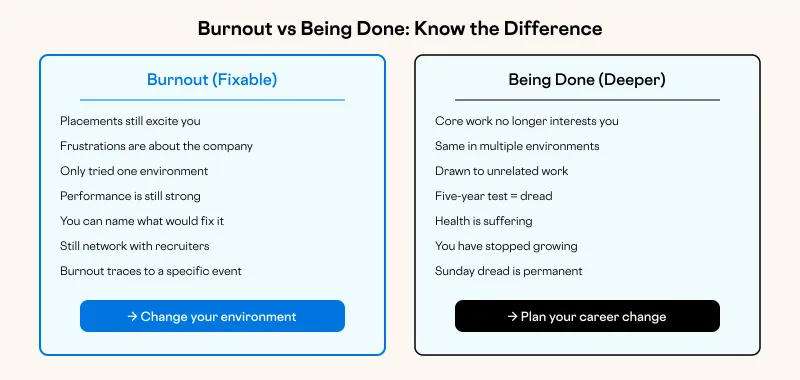
This is the most important distinction you can make right now. Getting it wrong costs you either way: leaving recruiting when you actually love the profession because of a temporary situation, or staying in a career that is slowly draining you because you keep hoping it will get better.
Burnout is a response to your environment. It is caused by specific, identifiable factors: unrealistic targets, toxic management, bad desk culture, insufficient support, or a mismatch between your skills and your current role. Burnout is fixable. You change the environment, different company, different desk, different sector, and the passion comes back.
Being done is something deeper. It is a loss of interest in the core work itself, not just the context around it. When the idea of making a placement no longer excites you. When you have worked in multiple environments and felt the same hollowness in each one. When leaving recruiting is not a fantasy triggered by a bad day but a persistent thought about leaving recruiting that shows up even during good weeks.
Both feel terrible. Both make you want to quit. But only one means leaving recruiting is actually the right decision.
Seven Signs That Suggest Burnout (Not Leaving Recruiting)
If most of your frustrations land in this category, you probably need a better recruiting role, not leaving recruiting entirely. And that is genuinely good news.
1. You Still Get a Buzz From Placements
When a candidate accepts an offer and you feel something, pride, excitement, satisfaction, that tells you the core work still resonates. The fire is not out. It is just buried under the weight of everything else. If the placement itself still matters to you, the issue is your environment, not your profession.
2. Your Frustrations Are Mostly About Your Manager or Company
"My manager takes credit for my placements." "The commission structure changed and nobody told us." "The culture is toxic." These are company problems, not career problems. They feel career-ending when you are in them, but they disappear the moment you walk into a better organisation.
3. You Have Only Worked in One Recruiting Environment
If you have only ever done agency recruiting, you have not experienced recruiting. You have experienced one version of it. In-house talent acquisition, executive search, RPO, contract recruiting, and freelance recruiting are fundamentally different jobs that share a name. Leaving the profession based on one environment is like deciding you hate restaurants because you worked at one bad one.
4. Your Performance Is Still Good
If you are still hitting targets, still building relationships, and still closing placements, even while unhappy, that is a signal. You have not lost the ability. You have lost the motivation that your current environment is supposed to provide.
5. You Can Identify Exactly What Would Fix It
"If I had a better commission split, I'd be fine." "If my manager actually supported me, I'd enjoy this." "If I could recruit in healthcare instead of finance, I'd be energised." Specificity is a sign that the problem is solvable. When you cannot articulate what would fix it, that is when leaving becomes the right conversation.
6. You Still Network With Recruiters by Choice
If you still engage with recruiting communities, attend industry events, and enjoy talking shop with other recruiters, part of you still identifies with the profession. People who are truly done do not voluntarily spend time in the world they want to leave.
7. Your Burnout Correlates With External Events
If you were fine six months ago and miserable now, trace back what changed. A new manager. A restructured team. A lost client. A missed promotion. A market downturn. When you can link your burnout to a specific event, the burnout is situational, which means it is solvable.
If this section described you, stop planning your exit and start planning your next move within recruiting. Browse open recruiter roles or explore remote recruiter positions if geography or flexibility is part of the problem.
Seven Signs That Leaving Recruiting Is the Right Move
If most of your experience maps to this section, it is time to take leaving recruiting seriously. Not as a fantasy, but as a plan.
1. The Core Work No Longer Interests You
Sourcing, screening, interviewing, pitching, negotiating, closing. These are the atoms of recruiting. If you have lost interest in all of them, not just the prospecting or the admin but the actual work of connecting people with opportunities, that is a signal that goes deeper than environment.
2. You Have Tried Multiple Environments and Felt the Same
This is one of the strongest signs that leaving recruiting is the right call. You moved from agency to in-house. Or from corporate to startup. Or from perm to contract. And in each environment, the same dissatisfaction followed you. When the common denominator across different companies and different desk types is you, the answer is not another lateral move. It is leaving recruiting for a real career change.
3. You Are Drawn to Work That Has Nothing to Do With Hiring
You spend your free time reading about product management, or you find yourself fascinated by your company's operations team, or you keep gravitating toward projects that have nothing to do with filling roles. When your curiosity and energy consistently point away from recruiting, pay attention.
4. You Cannot See Yourself Doing This in Five Years
Five years is the honest test for whether leaving recruiting makes sense. One year feels manageable even when you are miserable. Ten years feels abstract. But five? If the thought of still being on a desk in five years fills you with genuine dread, that is not burnout talking. That is your gut telling you something your brain has not accepted yet.
5. Your Health Is Suffering
This is the one people ignore until it is too late. Chronic sleep disruption. Elevated anxiety. Physical symptoms of stress: headaches, digestive problems, chest tightness. If recruiting is making you physically unwell, that is not something you push through. That is your body telling you what your mind is trying to rationalise away.
Research from the American Institute of Stress consistently shows that prolonged occupational stress leads to measurable health outcomes. Do not treat this as weakness. Treat it as data.
6. You Have Stopped Growing
You are doing the same job you were doing three years ago. No new challenges. No new learning. No development that excites you. The ceiling in recruiting is real, particularly in individual contributor roles, and if you have hit it, staying means choosing stagnation.
7. The Sunday Dread Has Become Permanent
Everyone has bad Sundays occasionally. But when the dread starts on Saturday afternoon. When it bleeds into your holidays. When you feel a physical weight every time you think about Monday, that is not a phase. That is your nervous system telling you this situation is unsustainable. The Mayo Clinic's research on occupational burnout identifies persistent dread and emotional exhaustion as key indicators that go beyond normal work stress.
A Practical Framework for Making the Decision
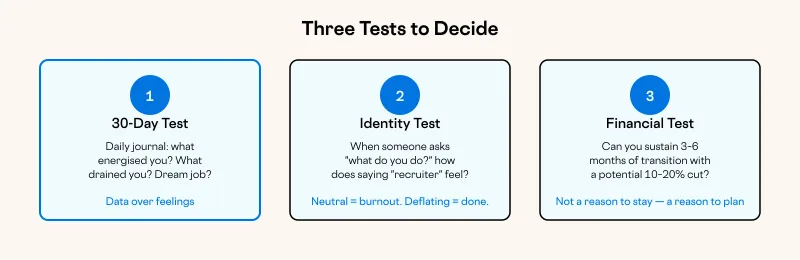
If you are still not sure which category you fall into, here is a structured way to evaluate.
The 30-Day Test
For the next 30 days, keep a brief daily journal answering these three questions:
- What did I do today that I genuinely enjoyed? (Even small things count.)
- What did I do today that drained me?
- If I could do any job tomorrow, what would it be?
After 30 days, review your answers. If the "enjoyed" column consistently includes recruiting activities, you are burned out and need a change of environment. If the "enjoyed" column consistently excludes recruiting activities, you are done with the profession. If the "any job" column repeatedly names the same thing, you have found your direction.
The Identity Test
When someone at a social event asks "what do you do?" and you say "I am a recruiter," how does it feel?
If it feels neutral or slightly positive, you still identify with the profession. Your dissatisfaction is environmental.
If it feels embarrassing, deflating, or like you want to add "but I am looking to leave," you have already disidentified from the career. That is significant.
The Financial Test
Can you afford to make a transition? Not "can you afford to quit tomorrow" (almost nobody can), but "can you sustain a 3-6 month transition period with potentially a 10-20% pay cut?" If yes, the financial barrier is not a reason to stay. If no, that does not mean you should stay forever. It means you need a financial plan before you leave. Start saving, reduce expenses, and build a runway.
What to Do When Leaving Recruiting Is Not the Answer
If you have worked through this and concluded that you are burned out, not done, leaving recruiting is not necessary. Here is your action plan:
- Identify the specific factors causing your burnout. Write them down. Be concrete.
- Determine which factors are fixable at your current company. Talk to your manager. Ask for changes. You might be surprised.
- If they are not fixable, start a confidential job search. Target recruiting roles that address the specific issues. Hate cold calling? Look for in-house. Hate the pace? Look at executive search. Hate the instability? Look at RPO or contract recruiting.
- Set a timeline. Give yourself 90 days to find a better role. If nothing changes, revisit this assessment.
Browse open recruiter positions and filter by role type, sector, and location to find something that addresses your specific pain points.
What to Do When Leaving Recruiting Is the Right Decision
If you have concluded that leaving recruiting is the right decision, here is your action plan for leaving recruiting successfully:
- Read the complete career change from recruiting guide. It covers every path, the practical steps, and what to expect in year one.
- Audit your transferable skills. Understand exactly what you bring to the table and how to translate it.
- Pick your direction. The most common transitions are recruiter to HR and recruiter to sales. If those do not appeal, explore underrated careers for ex-recruiters.
- Build your exit plan. Timeline, financial runway, skills gaps to close, resume rewrite, networking strategy.
- Execute with a deadline. Open-ended plans fail. Set a target date for your first application and work backward.
For practical guidance on the mechanics of leaving, see the detailed walkthrough in our guide on how to get out of recruiting.
The Hardest Part of Leaving Recruiting
Leaving recruiting is not just a career decision. It is an identity shift. You have been "a recruiter" for years. Your network is in recruiting. Your LinkedIn connections are recruiters. Your professional identity and your social identity are intertwined.
When you leave, you lose some of that. Not the relationships (the real ones stay), but the shared language, the inside jokes, the instant camaraderie of knowing that someone else understands what a bad billing cycle feels like. That loss is real, and pretending it does not exist does a disservice to anyone making this decision.
But here is what the other side looks like: you wake up on Monday without the dread. You discover skills you did not know you had. You build a new professional identity that fits who you are now, not who you were when you fell into recruiting at 22.
The recruiters I know who succeeded at leaving recruiting all say the same thing: the hardest part was deciding. Once they decided, the rest was just execution. And if there is one thing recruiters know how to do, it is execute under pressure.
Whatever you decide, make it a deliberate choice, not a reaction to a bad week. You have spent your career helping other people navigate their next move. Give yourself the same careful attention.
Frequently Asked Questions
How do I know if I am just having a bad month or if leaving recruiting is the right decision?
A bad month is characterised by specific, identifiable frustrations (a lost placement, a difficult client, a missed target) that you can trace to a cause. The desire to leave follows a pattern: it spikes during bad weeks and subsides during good ones. When the desire to leave is constant, present during good weeks and bad weeks alike, that is a different signal entirely. The 30-day journal exercise described above will help you distinguish between the two.
I hate my recruitment job. Does that mean I should leave the profession?
Not necessarily. Many recruiters who say "I hate recruiting" actually hate their specific role, company, or desk type. Before concluding that recruiting is not for you, honestly evaluate whether you have experienced enough variety within the profession. If you have only worked at one agency, or only done one type of recruiting, you owe it to yourself to try a different environment before making a permanent decision.
What if I am afraid of leaving recruiting because it is all I know?
Fear of leaving recruiting is normal and rational. You have built expertise, relationships, and earning potential in a specific field. Walking away from that feels risky. But staying in a career that makes you miserable carries its own risks: health consequences, relationship strain, and the opportunity cost of years spent in the wrong profession. The career change from recruiting guide covers how to manage the transition practically so the risk is calculated, not reckless.
Can taking a break from recruiting help me decide?
Sometimes. If your company offers sabbaticals or you can afford a short career break, the distance can provide clarity. But be intentional about the break. Use it to explore other interests, talk to people in other professions, and reflect on what you actually want, not just recover from exhaustion. Recovery without direction leads to going back to the same situation refreshed but unchanged.
Should I talk to my manager before deciding to leave?
It depends on your manager and your company culture. If you trust your manager and believe they will act in your interest, a candid conversation can sometimes lead to solutions you had not considered: a different desk, a new specialisation, a role change within the company. If you do not trust your manager, or if your company has a track record of pushing people out once they express doubt, keep your evaluation private until you have a plan.
How long should I try to fix things before deciding to leave?
Give yourself a clear, time-bounded period. 90 days is a reasonable window. In that time, take concrete actions to address the factors causing your unhappiness: have difficult conversations, apply for internal moves, explore different desk types. If nothing has changed or improved after 90 days of genuine effort, you have your answer.