Recruiter to Project Manager: How the Switch Works

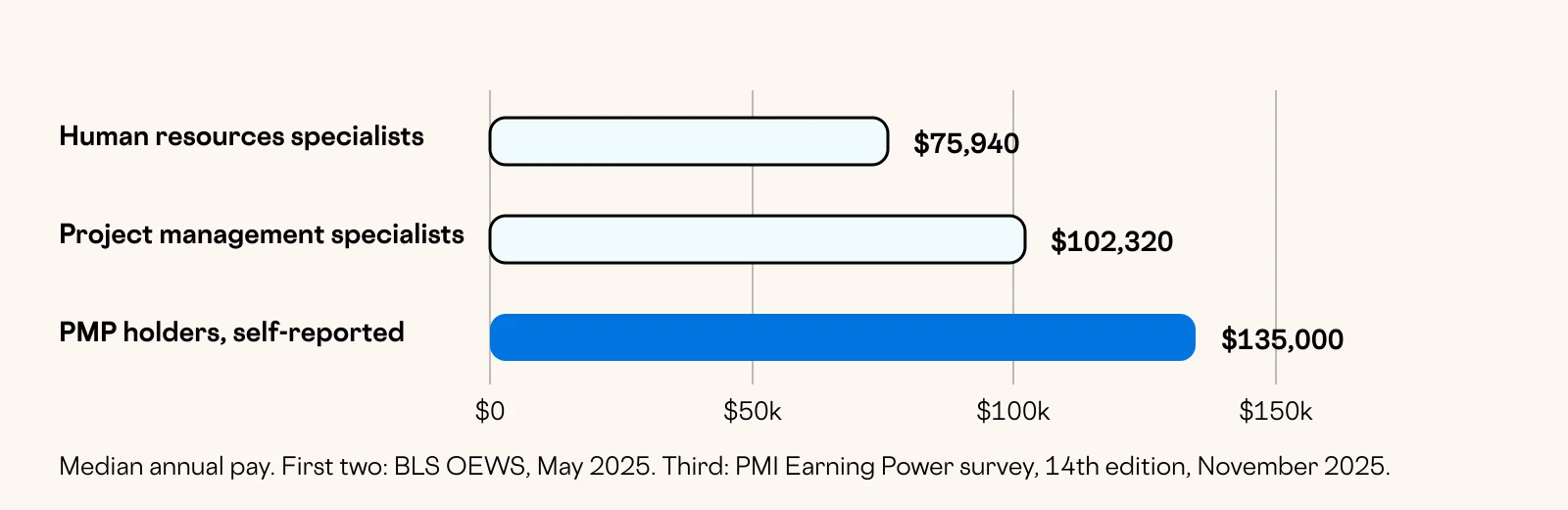
The recruiter to project manager switch works because a recruiting desk already is project management: several live workstreams, stakeholders who disagree, and hard dates you don't control. What's missing is the vocabulary and one piece of evidence. US project management specialists had a median wage of $102,320 in May 2025, against $75,940 for human resources specialists.
That gap is why the move gets recommended so often. What gets left out is that project management hiring managers screen on things a recruiting resume does not contain: a named delivery method, a budget you have owned, and a project with a defined start, end, and scope. You have done the work. You have almost certainly not written it down in a form a project management office recognizes.
This guide covers what actually transfers, the three gaps that get recruiters rejected, which project manager roles to target first, and whether the certification is worth the effort.
Key takeaways
- US project management specialists earned a median of $102,320 in May 2025, with the middle half between $78,440 and $133,100 (BLS Occupational Employment and Wage Statistics).
- The certification premium is real but conditional. PMI's 14th edition salary survey, published November 2025, put the US median for PMP holders at $135,000 against $109,157 for non-certified respondents.
- Your first project manager role will almost always be inside a function you already understand: talent programs, human resources technology rollouts, or implementation work at a staffing vendor.
- The gaps that get recruiters rejected are budget ownership, scope control, and being able to name a delivery method. All three are fixable in under a year.
- You cannot apply for the PMP until you have the project hours. Start with the CAPM or a vendor certificate and build the hours in your current job.
Why recruiters land well in project management
Strip the job titles away and a 360 desk looks like a portfolio of small projects run in parallel. Each search has a scope, a client, a deadline, a set of dependencies you do not control, and a stakeholder group that changes its mind in week three. That is the daily reality of project management, and it is the reason the transition succeeds more often than it fails.
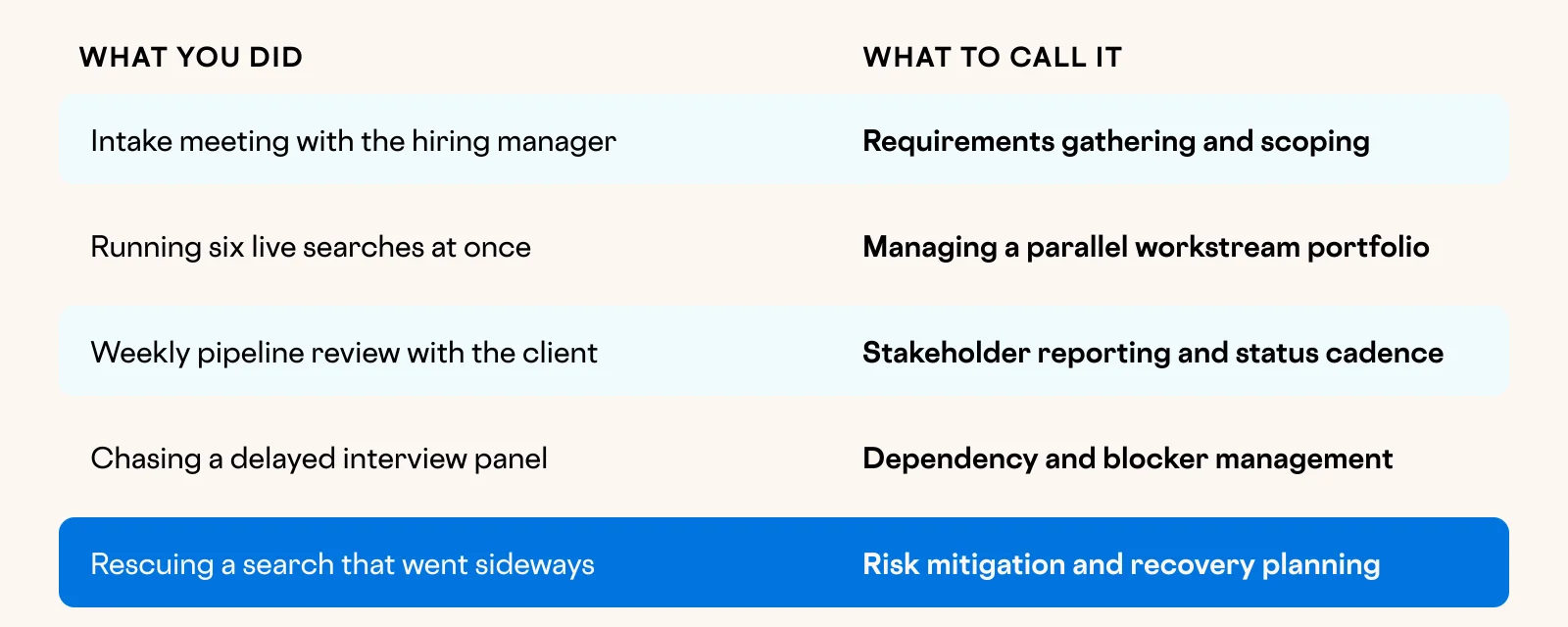
Here is the translation exercise. The left column is what you write on a recruiting resume. The right column is what the same work is called in a project management interview.
The three gaps that get recruiters rejected
Budget. Project managers are accountable for cost, not just delivery. Most recruiters have never forecast spend, tracked a variance, or defended an overrun. If you have owned a job board contract, an agency spend line, or an event budget, that counts, so put a dollar figure on it.
Scope control. Recruiting rewards flexibility. When a client changes the brief you absorb it. Project management rewards the opposite: recognizing the change, pricing it, and forcing a decision about what comes out of the plan. Answer a scope-creep question with "I'd have absorbed it" and the interview is over.
A named method. You need to be able to say which delivery approach you used and why. Waterfall, agile, or a hybrid. You do not need to be a Scrum expert, but you do need to have a view, and to be able to explain when a stage-gate plan beats a two-week sprint.
Which project manager roles to target first
The direct route is a project manager job in the function you already know. The table below is ordered by how likely you are to get a first interview from a recruiting background, not by pay.
| Role | What you would run | Why a recruiter gets hired |
|---|---|---|
| Talent or people programs manager | Hiring process redesign, employer brand launches, campus and early-careers programs | You know the subject matter, so they hire for delivery skill rather than domain knowledge |
| Human resources technology project manager | ATS and HRIS implementations, migrations, integrations | Implementation vendors want people who understand the buyer's workflow |
| Implementation or onboarding manager at a talent vendor | Rolling out recruiting software to new customers | Product knowledge is the barrier, and you already have it |
| Recruitment process outsourcing program manager | Client accounts, service levels, delivery teams | Closest to your current job. The hardest to leave recruiting behind in. |
| Generalist project manager (IT, construction, professional services) | Whatever the sector delivers | Realistic only after a certification plus one documented project |
Is the certification worth it?
The honest answer depends on which one and when. The PMP has a documented pay association: PMI's Earning Power salary survey, 14th edition, published 13 November 2025 from responses collected in spring 2025, reported a US median of $135,000 for PMP holders against $109,157 for non-certified respondents. Read that as a correlation with seniority as much as a reward for the exam.
The catch is eligibility. The PMP requires 35 hours of project management education plus documented project experience: 36 months of leading projects with a four-year degree, or 60 months without one. You cannot buy your way past that. The CAPM has no experience requirement and needs 23 hours of project management education, which makes it the realistic starting point for a recruiter with no formal project history.
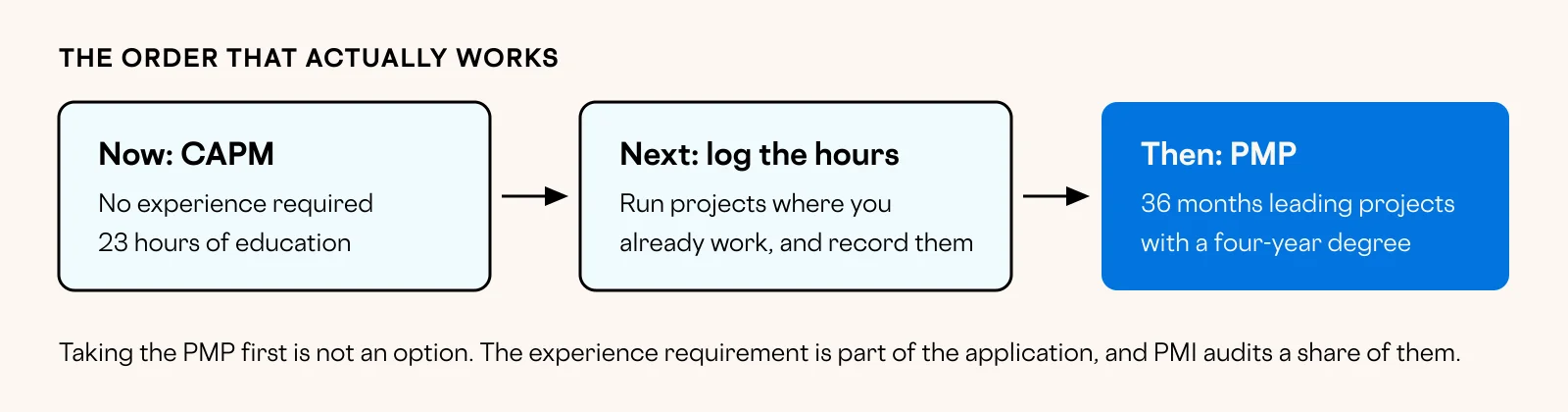
Sequence it like this: CAPM or an equivalent vendor certificate now, project hours logged in your current role over the next 12 to 18 months, PMP once you qualify. If you want a broader comparison of which credentials carry weight in this profession, the recruiting certifications guide applies the same test.
What the pay actually looks like
Three reference points, all from named and dated sources. Read the ranges rather than the midpoints, because project manager pay varies more by sector than by seniority.
One caveat worth holding on to. If you bill well in agency, a project manager base salary may not beat your current total earnings for two or three years. You are buying stability and a higher ceiling, not an immediate raise. Compare against the real numbers rather than the base you are on: our recruiter salary report has the current spreads.
A 12-month plan for the recruiter to project manager move
- Months 1–3. Volunteer for a cross-functional project where you work. An ATS migration, an onboarding redesign, a careers site rebuild. Take the coordination role nobody wants and keep a written record of scope, dates, and cost.
- Months 4–6. Complete the CAPM or a recognized project management course. You want the vocabulary before the interviews, not the certificate on the wall.
- Months 7–9. Rewrite your resume around projects rather than placements. Each entry needs a scope, a duration, a budget or headcount figure, and an outcome.
- Months 10–12. Apply to the roles in the table above, starting with talent programs and human resources technology. Keep logging hours toward PMP eligibility while you interview.
If you are not sure project management is the right destination, the roundup of jobs recruiters transition into compares it against the other realistic exits, and recruiter transferable skills covers the resume translation in more detail.
Frequently asked questions
Can I become a project manager with no project management experience?
You have project management experience, it just isn't labeled that way. Every search you ran had a scope, a schedule, dependencies, and stakeholders. What you need is one project written up in project language, with a budget figure and a defined start and end. That is usually enough to get a first interview for a programs or implementation role.
Is it hard to get hired as a project manager?
Harder than it was, and harder without a domain. Generalist project manager postings attract very high application volumes. The recruiters who get hired quickly are the ones applying inside talent, human resources technology, or staffing software, where their background is an advantage rather than a question mark.
Do I need the PMP to move from recruiting to project management?
No, and in most cases you can't get it yet. The PMP requires 36 months of documented project leadership with a four-year degree. Start with the CAPM, which has no experience requirement, and treat the PMP as a year-two goal once you are in a project role and accruing hours.
Will I take a pay cut moving from recruiting to project management?
Probably in year one if you were billing well, and probably not if you were on a flat in-house salary. The BLS medians favor project management by roughly $26,000 a year, but the comparison that matters is your actual total earnings against a specific offer, not two national medians.
Which is the easier move, project management or operations?
Project management, if you enjoyed running searches and hitting dates. Operations, if you enjoyed fixing the process behind the searches. They ask for different evidence: project management wants a delivered project, operations wants a system you own.
Is recruiter to project manager the right move for you?
The recruiter to project manager transition is one of the few exits where your existing experience is a genuine asset rather than something to explain away. The mechanics of the job are familiar. What you are buying is a title that scales, a documented pay premium, and a career where the ceiling is not defined by how many people you personally place.
What you are giving up is commission upside, and the immediacy of a close. Get one project written up properly, take the entry-level certification, and target a first role in a function you already understand.
And if the honest conclusion is that you like recruiting and dislike your desk, that is a different problem with a faster fix. Browse current recruiter jobs and talent acquisition roles, or look through the company directory to see who is hiring in your market before you commit to retraining.