
Transferable Recruiter Skills Every Employer Wants (2026)

Here is the most frustrating thing about being a recruiter who wants to leave recruiting: you know you are good at your job, but your transferable skills do not seem to matter outside the profession. You list "full-cycle recruiting" and "ATS management" on your resume, and hiring managers in other functions glaze over because they have no idea what that means in their world.
The problem is not that recruiter transferable skills are weak. They are remarkably strong. The problem is translation. Recruiters describe their experience in recruiting jargon that only other recruiters understand. When you say "pipeline management," a sales leader hears something different from what you mean. When you say "sourcing," a marketing manager draws a blank.
This guide exists to fix that. It catalogs every recruiter transferable skill you have built, translates it into universal business language that hiring managers across every function understand, and gives you specific resume examples you can use today. By the end, you will stop underselling yourself and start presenting your background the way it deserves to be presented: as recruiter transferable skills that apply to nearly any business role.
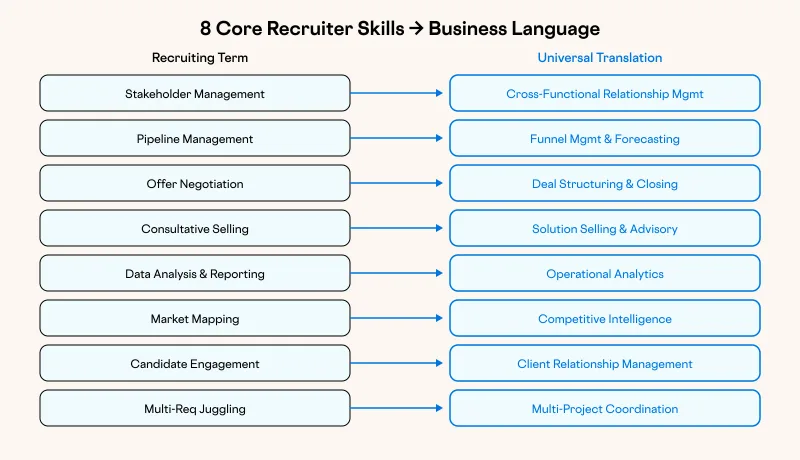
The Core Recruiter Transferable Skills
These are the recruiter transferable skills that every recruiter develops, regardless of whether you work agency, in-house, perm desk, contract desk, or executive search. These transferable skills form the foundation of your professional value outside recruiting.
1. Stakeholder Management
What it is in recruiting: Managing competing priorities between candidates, hiring managers, HR teams, and sometimes C-suite executives. You balance everyone's expectations, mediate disagreements about role requirements, and keep multiple parties aligned toward a shared outcome.
What it is in business: Cross-functional relationship management. The ability to navigate different priorities, communicate effectively with senior leaders, and drive alignment without direct authority.
Where it applies: Account management, customer success, consulting, project management, product management, HR business partnering.
Resume translation:
Instead of: "Managed relationships with 15 hiring managers across 4 departments"
Write: "Managed cross-functional stakeholder relationships across 4 business units, aligning competing priorities and driving consensus on strategic talent decisions"
2. Pipeline and Funnel Management
What it is in recruiting: Building and maintaining a pipeline of candidates at various stages, from initial outreach to offer acceptance. You track conversion rates at each stage, forecast outcomes, and adjust your approach based on where candidates drop off.
What it is in business: Sales pipeline management, project portfolio management, or operational workflow optimisation. The ability to build, track, and optimise a multi-stage process to drive predictable outcomes.
Where it applies: Sales, revenue operations, marketing, project management, product management.
Resume translation:
Instead of: "Maintained a pipeline of 200+ active candidates"
Write: "Built and managed a multi-stage pipeline of 200+ qualified opportunities, tracking conversion rates across 5 stages and forecasting outcomes with 85% accuracy"
3. Negotiation
What it is in recruiting: Negotiating salaries, fees, start dates, notice periods, and contractual terms. You bridge the gap between what a candidate wants and what a client is willing to pay, often finding creative solutions that satisfy both parties.
What it is in business: Deal structuring and closing. The ability to find mutually beneficial outcomes in competitive or adversarial situations while maintaining relationships.
Where it applies: Sales, procurement, partnerships, business development, account management, consulting.
Resume translation:
Instead of: "Negotiated offers with 95% acceptance rate"
Write: "Negotiated complex multi-party agreements with a 95% close rate, balancing commercial requirements with counterparty expectations to structure mutually beneficial outcomes"
4. Consultative Selling
What it is in recruiting: Understanding a client's real hiring need (which is often different from what they say they want), advising on market conditions, challenging unrealistic expectations, and positioning your solution (candidates) as the answer to their problem.
What it is in business: Consultative or solution selling. The ability to diagnose a client's real problem, challenge their assumptions when necessary, and propose a solution that addresses root causes rather than surface symptoms.
Where it applies: Sales (especially enterprise and solution selling), consulting, customer success, account management, professional services.
Resume translation:
Instead of: "Advised clients on hiring strategy and market conditions"
Write: "Provided consultative advisory to senior leaders on market dynamics, talent strategy, and competitive positioning, resulting in improved decision-making and 30% faster time-to-resolution"
5. Data Analysis and Reporting
What it is in recruiting: Tracking time-to-fill, source-of-hire, cost-per-hire, pipeline conversion rates, and candidate quality metrics. Building reports for stakeholders. Using data to justify decisions and optimise your process.
What it is in business: Operational analytics. The ability to collect, analyse, and present data that drives business decisions.
Where it applies: Revenue operations, people analytics, marketing analytics, business intelligence, operations, project management.
Resume translation:
Instead of: "Tracked recruiting metrics and produced weekly reports"
Write: "Developed and maintained operational dashboards tracking 8+ KPIs, using data analysis to identify process bottlenecks and recommend optimisations that improved conversion rates by 20%"
6. Market Research and Intelligence
What it is in recruiting: Mapping competitor hiring patterns, benchmarking salaries, identifying talent pools, understanding industry trends, and advising clients on market conditions.
What it is in business: Competitive intelligence and market analysis. The ability to gather, synthesize, and act on market information.
Where it applies: Strategy, marketing, business development, product management, consulting, corporate development.
Resume translation:
Instead of: "Conducted market mapping and salary benchmarking for clients"
Write: "Conducted competitive market intelligence including compensation benchmarking, competitive talent analysis, and industry trend assessment, delivering actionable insights to C-level stakeholders"
7. Persuasion and Influence
What it is in recruiting: Convincing passive candidates to take your call. Persuading hiring managers to interview someone they were initially sceptical about. Influencing compensation decisions. Moving people through a process when they are inclined to stall.
What it is in business: Influence without authority. The ability to drive decisions and actions from people you do not manage.
Where it applies: Sales, marketing, change management, consulting, leadership, product management, customer success.
Resume translation:
Instead of: "Successfully approached passive candidates with 40% response rate"
Write: "Developed and executed targeted outreach strategies achieving 40% engagement rate with cold contacts, demonstrating strong persuasion and value articulation skills"
8. Project Management
What it is in recruiting: Managing multiple concurrent requisitions, each with its own timeline, stakeholders, requirements, and complications. Coordinating interviews across time zones. Keeping a dozen processes moving simultaneously without dropping any.
What it is in business: Multi-project coordination. The ability to manage competing deadlines, shifting priorities, and parallel workstreams while maintaining quality.
Where it applies: Project management, programme management, operations, event management, marketing campaigns.
Resume translation:
Instead of: "Managed 20+ open requisitions simultaneously"
Write: "Managed a portfolio of 20+ concurrent projects with independent timelines, stakeholders, and deliverables, consistently meeting or exceeding deadlines"
Hidden Recruiter Transferable Skills
Beyond the core competencies, recruiters develop several transferable skills that rarely make it onto a resume but are highly valued in other functions.
Emotional Intelligence and Empathy
You spend your days reading people. You assess motivation, detect dishonesty, sense when someone is about to accept or reject an offer, and calibrate your communication style to each individual. That emotional intelligence is rare and valuable in any client-facing, team-leading, or people-managing role.
Resilience and Stress Tolerance
According to a 2023 report from Recruiter. com, recruiters experience higher rates of workplace stress than professionals in most other white-collar functions. The rejection rate, the unpredictability, and the revenue pressure build a tolerance for adversity that employers in sales, consulting, and startup environments actively seek.
Writing and Communication
Recruiters write dozens of emails, messages, and job descriptions daily. You learn to be concise, persuasive, and clear under time pressure. That communication skill transfers to marketing, content, internal communications, and any role that requires clear written output.
Time Management and Prioritisation
When you are juggling 20 requisitions, 100 candidate conversations, and 10 client relationships simultaneously, you develop an instinct for what matters most right now. That prioritisation skill is the backbone of any operations, project management, or leadership role.
Sales Psychology
You understand buyer motivation, objection handling, urgency creation, and the psychology of commitment. These recruiter transferable skills are actually human behaviour skills that apply anywhere persuasion matters. Research from Harvard Business Review consistently shows that consultative sellers who can diagnose problems and propose solutions outperform transactional sellers by 2-3x in complex B2B environments.
How to Use This Guide: Your Career Development Plan
If you are planning a career transition, here is how to put your recruiter transferable skills to work.
Step 1: Audit Your Strengths
Review the recruiter transferable skills above and honestly rate yourself on each one. Which are your strongest? Which do you enjoy most? The intersection of strength and enjoyment should guide your career direction.
If your strengths are in negotiation, pipeline management, and consultative selling, target sales roles. If they are in stakeholder management, data analysis, and project management, target operations or consulting. If they are in empathy, communication, and relationship management, target customer success or HR.
Step 2: Rewrite Your Resume
Take your current resume and translate every bullet point into recruiter transferable skills using the frameworks above. Remove all recruiting-specific jargon. Replace it with universal business language. Have someone outside of recruiting read your resume and tell you what they think you do. If they say "recruiter," rewrite it again.
Step 3: Update Your LinkedIn
Your headline should not say "Recruiter." It should describe what you do in transferable terms: "Relationship Manager | Pipeline Strategist | Negotiation Specialist" or "Stakeholder Management & Business Development Professional." Your About section should lead with where you are going, not where you have been.
Step 4: Prepare Your Interview Narratives
For each target role, prepare 3-5 stories from your recruiting experience that demonstrate the skills that role requires. Use the STAR format (Situation, Task, Action, Result) and tell the story in business language, not recruiting language. Your closing a difficult placement becomes closing a complex multi-stakeholder deal. Your restructuring a client's hiring process becomes delivering a process improvement engagement.
Step 5: Network Strategically
Connect with people who have made the transition you are targeting. Ask them what worked, what they would do differently, and which transferable skills they found most valuable. Join professional communities in your target function. Your recruiting network is a starting point, but you need to build in your target space.
For the complete career change framework, read our career change from recruiting guide. For specific transition paths, see recruiter to HR, recruiter to sales, and underrated careers for ex-recruiters.
The Recruiter Advantage Nobody Talks About
Here is something I want you to understand clearly: recruiter transferable skills make you one of the most versatile professionals in the job market. You combine sales skills with people skills, data skills with relationship skills, and operational skills with strategic thinking. Most professionals have two or three of those dimensions. You have all of them.
The reason you feel stuck is not because your transferable skills are limited. It is because you have been describing recruiter transferable skills in a language that only your profession speaks. Fix the language, and you unlock access to careers you did not know were available to you.
Whether you decide to stay in recruiting, move into a new function, or build something of your own, these recruiter transferable skills will serve you. The only question is how you choose to deploy them.
If you are ready to explore your options, browse recruiter roles that might reignite your interest in the profession. Or, if you know it is time for something new, find jobs that recruiters transition into and start planning your next move.
Frequently Asked Questions
What are the most important recruiter transferable skills?
Stakeholder management, negotiation, pipeline and funnel management, consultative selling, and data analysis are the five most important recruiter transferable skills. These competencies are valued across sales, operations, consulting, customer success, and management roles in virtually every industry.
How do I present recruiter transferable skills on a resume for non-recruiting jobs?
Replace recruiting-specific terminology with universal business language. "Candidate sourcing" becomes "market research and lead generation." "Pipeline management" becomes "funnel management and forecasting." "Offer negotiation" becomes "deal structuring and closing." Use the translation table in this guide as your starting framework.
Do recruiter transferable skills work in tech?
Yes. Tech companies value relationship management, data-driven decision-making, pipeline thinking, and consultative selling, all core recruiter transferable skills. Roles in sales, customer success, product management, and people operations at tech companies are particularly accessible for ex-recruiters.
What is the biggest skill gap when leaving recruiting?
It depends on the target role. For HR, the gap is employee relations and performance management knowledge. For sales, it is product knowledge and structured sales methodology. For operations, it is systems and BI tools. For consulting, it is structured problem-solving frameworks. Identify your specific gap and address it directly through certification, self-study, or a stepping-stone role.
Can recruiter skills help me start my own business?
Absolutely. Recruiters build client development skills, relationship management instincts, and commercial awareness that are the foundation of any service-based business. Many ex-recruiters succeed as independent consultants, career coaches, HR advisors, and, of course, independent recruiters. For more on going independent, see the freelance recruiter guide.
Are recruiter transferable skills valued by hiring managers?
Yes, when presented correctly. The key is translation. Hiring managers outside recruiting do not know what "full-cycle recruiting" means. They do know what "end-to-end project ownership," "cross-functional stakeholder management," and "pipeline-driven revenue generation" mean. Speak their language and your skills will be recognised immediately.