
Is Recruiting a Dead End Job? An Honest Answer

No. Recruiting is not a dead end job, but it has a real ceiling in one specific configuration, and most people asking the question are sitting in it. The market backdrop is genuinely hard: US employment services payrolls peaked at 3,928,100 in March 2022 and bottomed at 3,137,700 in October 2025, a fall of 20%.
That number explains most of the pessimism you will read on Reddit and Fishbowl. Three years of contraction produced flat commission, frozen headcount, and a lot of recruiters who watched two rounds of layoffs go past their desk. Feeling stuck in that market is a rational response to the market, not evidence that the profession has no future.
The useful question is narrower: is your version of recruiting a dead end? For some configurations the answer is honestly yes. This piece separates the two, using what the data actually shows rather than what the forums feel.
Key takeaways
- US employment services payrolls have stopped falling. The industry added 63,100 jobs between December 2025 and July 2026 (BLS Current Employment Statistics), the first sustained recovery since the 2022 peak.
- The occupational category most recruiters sit in, human resources specialists, is projected to grow 6% between 2024 and 2034 with about 81,800 openings a year (BLS Occupational Outlook Handbook).
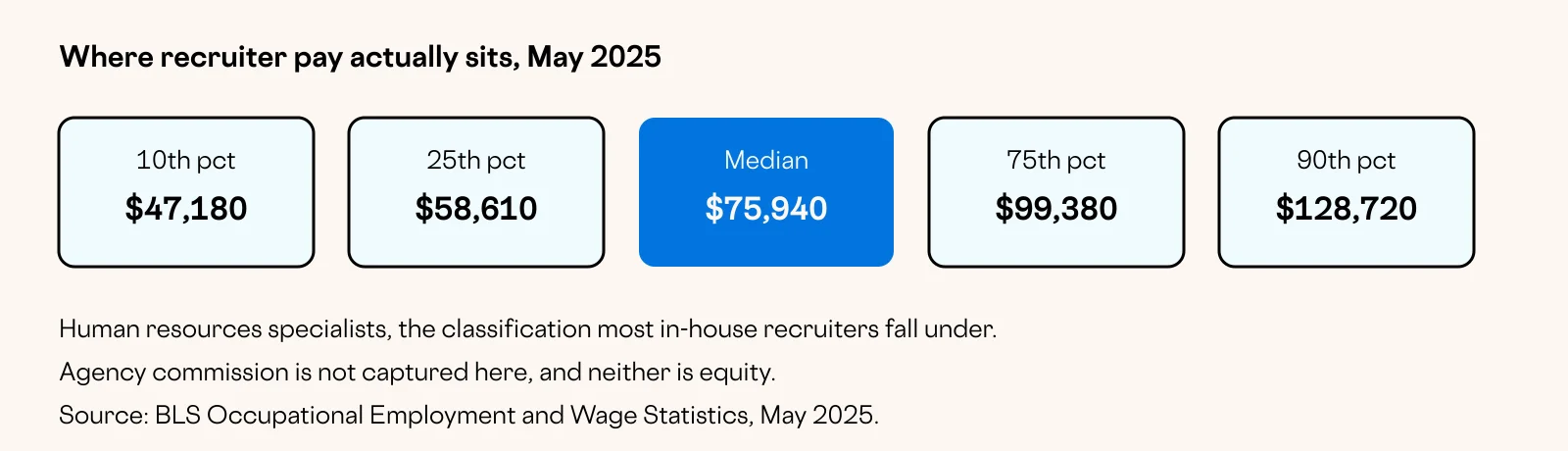
- The pay ceiling for a non-managing, non-billing recruiter is real. The 90th percentile for human resources specialists was $128,720 in May 2025, and that is where a salaried in-house career tops out without a leadership or billing route.
- Five routes out of the ceiling exist, and four of them keep you in the profession.
- The clearest diagnostic is whether your last two years produced new evidence. If you can't name a new skill, system, or number, the dead end is the desk rather than the industry.
Where the dead end feeling comes from
Five structural reasons, all of them legitimate.
The title ladder is short. Recruiter, senior recruiter, lead, manager. Four rungs, and rung four is a different job. Compare that to finance or engineering, where a technical track runs to principal level, and recruiting looks flat by year six.
Nobody outside recruiting knows what you do. The skills are real and the vocabulary is invisible. A hiring manager in operations reads "filled 62 roles" and learns nothing about whether you can run anything.
The work resets every month. A quarter of billing buys you nothing in the next quarter. That is motivating for a few years and corrosive after ten.
The last three years were bad. Not perception. Employment services shed roughly 790,000 jobs between March 2022 and October 2025, and recruiting seats were among the first cut at almost every company that shrank.
Agency structures cap you deliberately. Most agency models reward billing and offer very little else. If you don't want to manage and don't want to own a firm, an agency career genuinely does plateau. That one is worth taking seriously rather than arguing with.
What the data actually says
Three measurements, all from the Bureau of Labor Statistics, all more current than the forum threads ranking for this question.
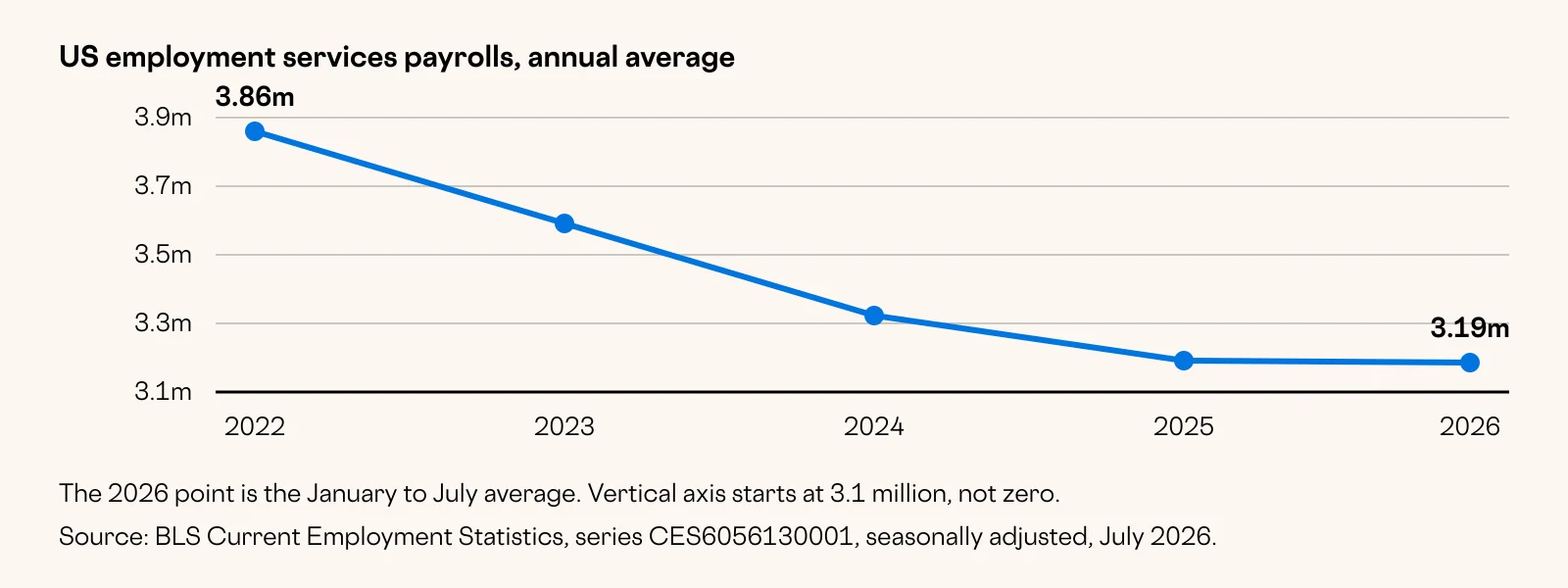
The industry has stopped shrinking. Employment services bottomed in October 2025 at 3,137,700 and stood at 3,206,800 in July 2026. That is a gain of 69,100 jobs off the low. It is not a boom, and it is not the 2022 market coming back. It is the end of a three-year decline, which is a materially different thing from a dying industry.
The occupation is projected to grow. Human resources specialists, the classification most in-house recruiters fall under, held 944,300 jobs in 2024 and is projected to grow 6% through 2034, with roughly 81,800 openings a year. Dead-end professions do not carry 81,800 annual openings.
The pay ladder is short but not flat. Median annual pay for human resources specialists was $75,940 in May 2025, the 25th percentile was $58,610, and the 90th percentile was $128,720 (BLS Occupational Employment and Wage Statistics). Above that you need a title change, a billing model, or equity.
Where the ceiling is real
Being honest about this is the point of the article. Three configurations genuinely plateau.
A contingency 360 desk with no equity and no management path. Your income is a function of how many hours you personally have. Ten years in, the job is the same job at a higher billing target.
An in-house recruiter at a company with one talent leader and no growth. There is exactly one job above you and it is not vacant. Promotion requires someone to leave.
A recruiting coordinator role with no defined progression. The most common trap for people two to four years in, and the one worth acting on fastest, because coordinator experience is the easiest to convert into recruiting operations or a full desk.
Five routes that are not dead ends
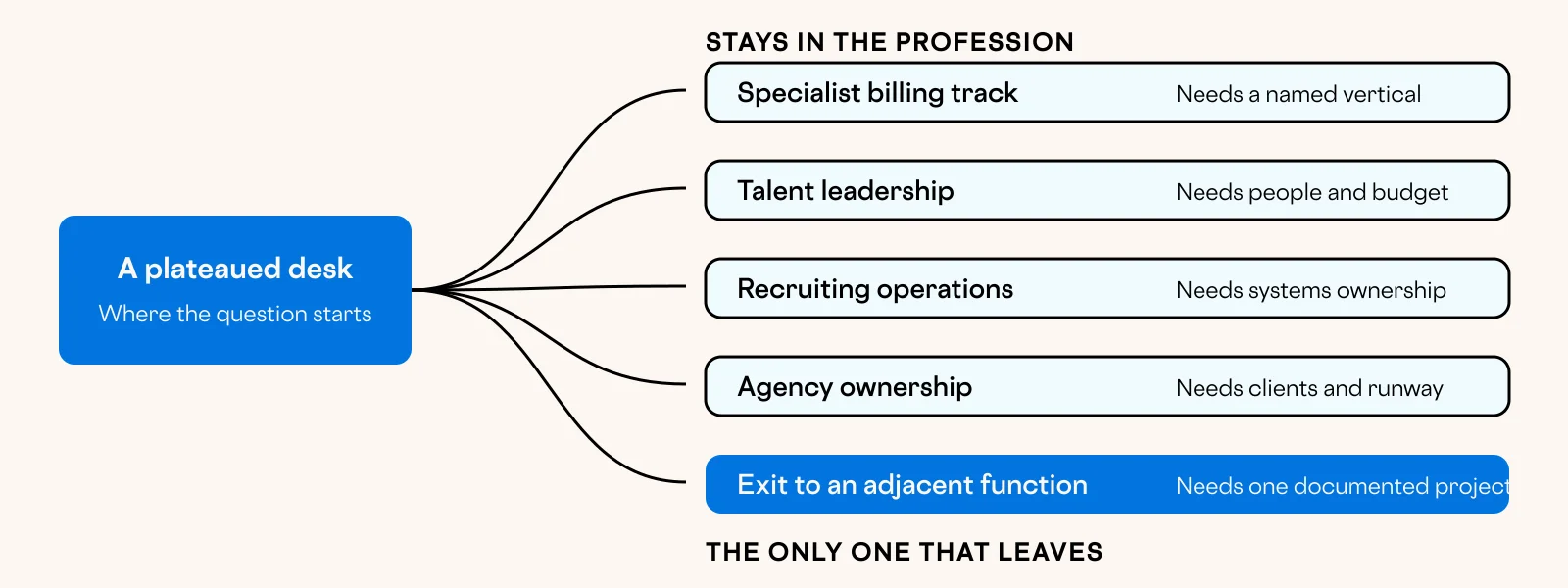
Four of these keep you in the profession. Read the "what it needs" column before the pay column, because that is the part you control.
| Route | What it looks like | What it needs |
|---|---|---|
| Specialist billing track | Executive search, niche technical, regulated sectors. Fewer placements, much higher fees. | A vertical you can name and a client list you own |
| Talent leadership | Talent acquisition manager, head of talent, VP of talent | Managing people and defending a budget, not just billing |
| Recruiting operations | Process design, systems ownership, hiring data and reporting | Administrator access to an ATS and one report nobody else built |
| Agency ownership | Your own desk, your own margin, your own risk | Portable clients and roughly a year of runway |
| Exit to an adjacent function | Operations, project management, customer success, human resources | One documented non-recruiting project and a translated resume |
The first four are covered in more depth in the recruiter career path guide and the guide to getting promoted as a recruiter. The fifth is covered in the career change guide linked at the end of this piece.
Is it the profession or your desk?
Run this diagnostic honestly. Score one point for each yes.
- Has your billing target risen in the last two years while your split, tooling, or support stayed the same?
- Is there a role above you that is genuinely reachable within 24 months?
- Can you name a skill, system, or number you acquired in the last 12 months?
- Would a competitor in your market pay you more than 15% above your current package?
- Do you still like the work on a good day?
Three or more yes answers, and the problem is your employer rather than the profession, which is a much easier problem to solve. Two or fewer, and the honest read is that you have outgrown the configuration you are in. Zero yes answers on the last question specifically, and the answer is a career change rather than a job change. The signs it's time to leave recruiting piece goes deeper on that distinction, and if exhaustion is the dominant feeling, recruiter burnout is worth reading before you make any decision at all.
What to do in the next 90 days
- Benchmark yourself. Find out what your role pays elsewhere in your market. Most people who feel stuck are also underpaid, and they conflate the two. The recruiter salary report is the fastest way to check.
- Acquire one piece of evidence. A system you administer, a process you redesigned, a report you built, a vertical you opened. One thing that is not a placement.
- Test the market properly. Not a passive scroll. Apply to four roles that would represent a genuine step up and see what comes back. Live recruiter jobs, remote recruiter roles, and the company directory will tell you more about your options in an afternoon than a year of wondering.
Frequently asked questions
Is recruiting still a good career in 2026?
Yes, with conditions. The occupational category is projected to grow 6% through 2034 with about 81,800 annual openings, and industry payrolls have been rising since late 2025. The conditions are that the easy-market era of 2021 and 2022 is not coming back, and that career progression now requires deliberate specialization rather than time served. There is a fuller answer in is recruiting a good career.
What jobs are considered dead-end jobs?
The common definition is a role with no defined progression, no skill accumulation, and no pay growth beyond inflation. Recruiting fails that test on skill accumulation, because the commercial, stakeholder, and process skills you build do transfer. It can meet it on progression, which is why the configuration you are in matters more than the profession.
Will AI replace recruiters?
It is already replacing parts of the job. Screening, scheduling, and first-pass sourcing are being automated fastest, which is why coordinator and high-volume sourcing roles carry the most risk. The parts that are holding up are the ones requiring judgment and persuasion: closing a reluctant candidate, managing a hiring manager who wants the impossible, and pricing a search. Build toward those.
How long do most people stay in recruiting?
Turnover is high in the first two years and drops sharply after that, which is a pattern common to commission-based professions. The people who leave early usually leave the pressure. The people who leave at year eight or ten are usually leaving the ceiling, and they are the ones this question is really about.
Can you make good money in recruiting long term?
Yes, on two specific tracks. Specialist billing, where fewer, larger placements replace volume, and ownership, where you keep the margin instead of a split. A salaried in-house path without a leadership route tops out around the 90th percentile for human resources specialists, which was $128,720 in May 2025.
What should I do if I feel stuck but don't want to leave recruiting?
Change the configuration rather than the profession. Move from contingency to retained, from generalist to a named vertical, from agency to in-house or the reverse, or into recruiting operations. Each one changes the economics of the job without discarding a decade of domain knowledge.
So, is recruiting a dead end job?
Recruiting is not a dead end job. It is a profession with a short title ladder, a bad three years behind it, and a market that stopped falling in late 2025. Those three facts get confused with each other constantly, and the confusion is what produces the forum threads.
The version that genuinely is a dead end is narrow and identifiable: a plateaued desk with no equity, no management route, and no new skill in two years. If that describes you, the fix is a different configuration, not a different career, in four cases out of five.
Start by finding out what you are actually worth. Then pick one route from the table above and acquire the single piece of evidence it needs. If the honest answer after that is still that you want out, the career change from recruiting guide maps every realistic exit with the pay attached.