
Recruiter Burnout: How to Recognize It and Recover

You used to love the deal. The sourcing, the pitch, the close. Now you stare at your pipeline on Monday morning and feel nothing. The phone feels heavier than it should. You rehearse candidate calls in your head before dialling, not because you are preparing, but because you are procrastinating. You have started saying "I'll start sourcing after lunch" every single day, and lunch keeps getting later.
If any of that resonated, you may be experiencing recruiter burnout, and this article is for you. Not the motivational version of recruiter burnout advice where someone tells you to take a bubble bath and journal about gratitude. The real version, written for recruiters by people who understand what recruiter burnout actually looks like, what causes it, and what you can do about it before it costs you your career, your health, or both.
Recruiter burnout is not a character flaw. It is a predictable outcome of a profession that combines high rejection, revenue pressure, emotional labour, and an always-on culture into a single role. The question is not whether it will show up. The question is whether you will recognize it when it does, and what you will do about it.
For the full picture of what recruiter life looks like, including the highs and the community that makes it worth it, read our pillar guide on the real recruiter life.
Why Recruiting Burns People Out: The Specific Triggers
Recruiter burnout is not just "being tired." It is the clinical term for chronic workplace stress that has not been successfully managed, as defined by the World Health Organization. In recruiting, the triggers are specific and structural.
The Rejection Volume
Most professionals experience occasional rejection. Recruiter burnout starts here because recruiters experience rejection as a default state. Agency recruiters making 60 to 100 outreach attempts per day might get 5 to 10 positive responses. That is a rejection rate north of 90%, sustained across weeks, months, and years. Cold calls that go to voicemail. InMails that get ignored. Candidates who ghost after three rounds of interviews. Hiring managers who change the spec after you have already submitted a shortlist.
The human brain is not built to absorb this volume of "no" without it affecting self-perception. Even the most resilient recruiters describe periods where the constant rejection starts to feel personal, even when they know intellectually that it is not.
Target Pressure and the Reset
In agency recruiting, your billing counter resets every month, quarter, or year. You closed $300K last quarter? Congratulations. You are now at zero. The psychological effect of perpetual resetting is more damaging than most people appreciate. You never arrive. You never feel secure. The treadmill does not stop, and the speed only goes up.
KPIs compound recruiter burnout. Activity targets (calls made, CVs sent, meetings booked) measure effort, not quality, which means even a recruiter doing brilliant strategic work can be flagged for "low activity" if their approach does not generate the right numbers on the dashboard.
Emotional Labour
Recruiting is one of the few professions where emotional labour is constant and unacknowledged. You are a career counsellor to candidates, a therapist to anxious hiring managers, a salesperson to prospects, and a cheerleader for your team, often in the same hour. You absorb other people's career anxiety, their disappointments, their frustrations with the job market, and you do it while managing your own pipeline stress.
The Recruitment & Employment Confederation found that emotional exhaustion is the single largest predictor of recruiter attrition, ahead of even compensation dissatisfaction.
The Always-On Culture
Candidates can only talk at 7 AM before work or 7 PM after work. Clients in different timezones need updates at odd hours. Your manager expects the weekly report before 8 AM. The nature of recruitment means the boundaries between work and personal time dissolve gradually, and most recruiters do not notice until they are checking emails in bed at 11 PM on a Saturday and wondering when that became normal.
The 7 Warning Signs You Are Burning Out
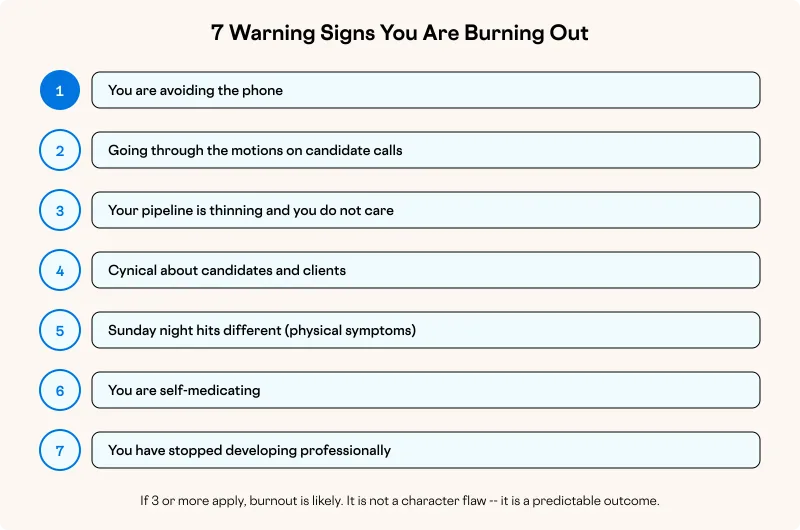
Generic articles about recruiter burnout list "feeling tired" and "loss of motivation." Those are real, but they are too vague to be useful for recruiters. Here are the recruiter-specific signals that experienced professionals recognise in hindsight.
1. You Are Avoiding the Phone
Not just dreading calls. Actively finding reasons not to pick up the phone. You check email instead. You update candidate notes that do not need updating. You volunteer for admin tasks you used to delegate. The phone, once your primary tool, now feels like a source of dread rather than opportunity.
2. You Are Going Through the Motions on Candidate Calls
You are saying all the right things, but you are not listening. The candidate is telling you about their career goals and you are thinking about your billing target. Your screening calls, which used to feel like genuine conversations, have become scripts you recite on autopilot.
3. Your Pipeline Is Thinning and You Do Not Care
A healthy recruiter sees a thin pipeline and feels urgency. Recruiter burnout means seeing a thin pipeline and feeling resignation. If your response to an empty desk has shifted from "I need to source harder" to "what's the point," that is a signal worth paying attention to.
4. You Are Cynical About Candidates and Clients
You used to give people the benefit of the doubt. Now every candidate is "probably going to ghost" and every client is "going to change the spec anyway." When cynicism replaces curiosity, it is not just a mood. It is one of the three clinical dimensions of recruiter burnout as identified by Maslach and Leiter's research.
5. Sunday Night Hits Different
Everyone dislikes Sunday evenings to some degree. But if your Sunday anxiety has escalated from mild dread to physical symptoms (insomnia, stomach issues, racing thoughts about Monday's pipeline), you have crossed from normal work stress into something more serious.
6. You Are Self-Medicating
This one is harder to admit. Recruiting culture, especially agency culture, often normalises drinking. The post-work pub. The deal-closing celebration. The "rough week" Friday session. If you have noticed that your relationship with alcohol, or anything else you use to decompress, has shifted from occasional to habitual, that is worth examining honestly.
7. You Have Stopped Developing
You used to read about new sourcing techniques. You used to be curious about different markets. You used to ask questions in team meetings. Now you do the minimum. Professional stagnation is both a symptom and an accelerant of recruiter burnout. The less you invest in growing, the more the job feels like a treadmill rather than a career.
The Numbers Behind Recruiter Burnout
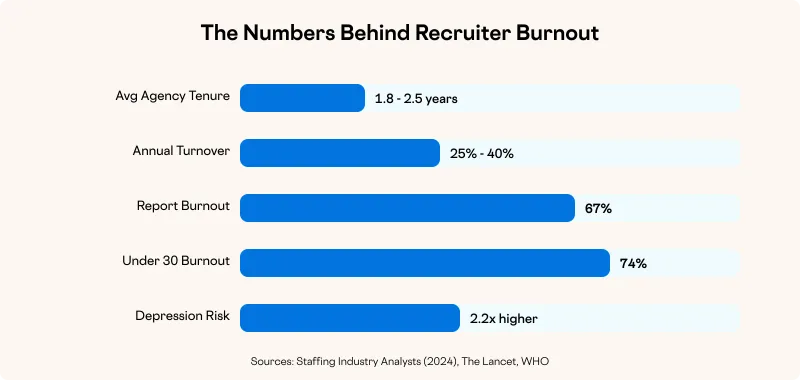
The recruiter burnout data confirms what most recruiters already feel.
- Average tenure at recruitment agencies: 1.8 to 2.5 years. This is not because recruiters are flaky. It is because the environment is structurally difficult to sustain long-term without deliberate management support.
- Annual agency turnover: 25% to 40%, depending on market and firm size. Some agencies accept this as cost of doing business rather than addressing root causes.
- Burnout prevalence: A 2024 Staffing Industry Analysts survey found that 67% of agency recruiters reported experiencing burnout symptoms in the previous 12 months. For recruiters under 30, the figure was 74%.
- Mental health impact: Chronic workplace stress is associated with a 2.2x increase in risk of depression and a 1.8x increase in risk of anxiety disorders, according to research published in The Lancet.
- Stress ranking: Recruiting consistently ranks in the top 10 most stressful professions in surveys by career platforms. The combination of sales pressure, emotional labour, and income volatility is nearly unique to this profession.
These recruiter burnout numbers are not designed to discourage you. They are designed to normalise what you are feeling. If you are burned out, you are not weak. You are having a rational response to an irrational set of demands.
How to Recover Without Quitting
Not every case of recruiter burnout means you need to leave the profession entirely. Sometimes the environment is the problem, not the work itself. Here are strategies that experienced recruiters have used to recover while staying in the industry.
Restructure Your Desk
If your current specialisation is draining you, consider switching sectors or verticals. A recruiter who is burned out placing junior developers might find new energy in executive search. Someone exhausted by high-volume contingency work might thrive in a retained or RPO model. The work is still recruiting, but the rhythm, the relationships, and the pace are fundamentally different.
Negotiate Your Working Conditions
This sounds obvious, but most burned-out recruiters never actually have the conversation with their manager. Before you quit, try being direct: "My current workload is not sustainable. Here is what I need to change." Some managers will dismiss this. Others will make accommodations. You will not know until you ask.
The strongest negotiating position comes with data. Track your billings, your conversion rates, and your activity levels. A recruiter who can say "I billed $400K last year and I need to reduce my call targets to maintain that quality" is harder to dismiss than one who says "I'm tired."
Switch Environments
This is the most common and most effective recovery strategy. Agency to in-house. Large firm to small firm. Corporate to startup. Remote recruiter roles are increasingly available and can fundamentally change your relationship with the work by removing commute stress and open-office fatigue.
Changing your environment is not quitting recruiting. It is quitting the specific conditions that are burning you out. There is a significant difference. For a full comparison of what each model actually looks like day to day, read our day in the life of a recruiter breakdown.
Set Boundaries and Enforce Them
Stop taking candidate calls after 7 PM unless it is genuinely urgent. Stop checking emails on weekends. Stop saying yes to every req that comes across your desk. Boundaries in recruiting feel impossible because the culture rewards availability. But the recruiters who build long careers are uniformly the ones who learned to protect their time.
Invest in Non-Work Identity
Recruiting has a tendency to become your entire personality. Your social circle is recruiters. Your conversations are about deals and candidates. Your stress is about your pipeline. Building interests, relationships, and identity outside of work is not a luxury. It is a sustainability strategy.
When It Is Time to Make a Change
Recovery is the right move for most recruiter burnout. But not all of it. Sometimes the honest answer is that recruiting, or at least your version of it, is not working anymore.
Here is how to tell the difference.
It is the environment, not the profession, if:
- You still get a spark from placing candidates, even if it is buried under exhaustion
- You can identify specific conditions (your manager, your firm, your niche) that are driving the burnout
- The idea of recruiting at a different company or in a different model sounds appealing
- You have not tried switching environments yet
It is the profession, not the environment, if:
- You have worked in multiple settings (agency, in-house, different firms) and the burnout follows you
- The core activities of recruiting (sourcing, selling, negotiating) no longer interest you, even in theory
- You have been feeling this way for more than 12 months, regardless of how good or bad your desk is
- You find yourself drawn to career paths that have nothing to do with recruiting
If the second list resonates, that is OK. There is no shame in outgrowing a profession, and recruiters have some of the most transferable skill sets in the business world. Our guide on how to get out of recruiting walks through the transition practically, and our career change guide for recruiters covers the paths that work best.
Building a Recruiting Career That Avoids Recruiter Burnout
If you have decided to stay, the question becomes: how do you build a career that does not end in recruiter burnout every 2 to 3 years?
Choose your environment deliberately. Research culture before you join. Ask in interviews: What is the average tenure on the team? What happens when someone misses target for a quarter?
Specialise. Generalist recruiters burn out faster from constant context-switching. Niche recruiters build relationships and knowledge that compound. The sourcing gets easier. The work becomes more interesting rather than more repetitive.
Build your pipeline before you need it. The worst recruiter stress comes from desperation. Fifteen minutes of sourcing per day, every day, changes the emotional texture of the job more than any wellness programme.
Find your people. Build relationships with recruiters outside your company. Having people who understand the work without needing the jargon explained is genuinely protective against burnout.
Know your number. Understand what financial security looks like for you. An emergency fund and a commission structure you understand completely will not eliminate stress, but they will reduce the existential quality of it.
The recruiters who last are not the ones who push through burnout. They are the ones who build careers that prevent it.
If you are ready to explore what is out there, browse recruiter roles and see the full market in one place. Sometimes the best recovery strategy is a better role.
FAQ
Why is recruiting so stressful?
Recruiting combines elements that are individually manageable but collectively overwhelming: high rejection rates (90%+ on cold outreach), revenue-based compensation that resets periodically, emotional labour from managing candidate and client expectations, long hours driven by timezone differences, and minimal job security in economic downturns. Few other professions bundle all of these stressors into a single role.
How do I deal with recruiter burnout?
Start by identifying whether the burnout is environmental (your specific firm, desk, or manager) or professional (the core work of recruiting). If environmental, switching settings from agency to in-house, from one firm to another, or to remote work is often the most effective recovery strategy. If professional, consider a career transition using the transferable skills recruiting gave you. In either case, setting firm boundaries around hours and workload is the most immediate action you can take.
Is recruiter burnout worse in agency or in-house?
Agency burnout tends to be more acute: higher intensity, faster onset, driven by revenue pressure and commission resets. In-house burnout tends to be more gradual: driven by bureaucracy, stakeholder frustration, and the slow erosion of autonomy. Neither is universally "worse," but they feel different. Agency burnout peaks and crashes. In-house burnout simmers.
When should I leave recruiting entirely?
If you have worked in multiple environments and the burnout follows you, if the core activities of the job no longer interest you even when conditions are good, and if you have felt this way consistently for 12 or more months, those are signals that the profession itself may not be the right fit anymore. That is not failure. It is self-awareness.
Can you have good mental health and avoid recruiter burnout?
Yes, but it requires intentional effort. The recruiters who report the best mental health tend to have three things in common: clear boundaries around working hours, a specialised niche that provides depth rather than constant context-switching, and a supportive community of peers outside their immediate workplace. Recruiter burnout is not inevitable, but the profession does not automatically protect your mental health. You need to build that protection yourself.