
The Real Recruiter Life: What Nobody Tells You

Nobody gets into the recruiter life because they read a job description and thought "yes, that sounds like a stable, well-understood career path." Most recruiters fell into it. A friend mentioned there was money in it. A careers advisor had never heard of it. An agency offered you a role straight out of university because you seemed like you could handle the phones.
And then you stayed. Or you left. Or you are somewhere in between right now, trying to figure out which one you should do.
This is not a "how to become a recruiter" article. This is about what recruiter life is really like. If you want that, we have a complete guide to becoming a recruiter. This is the article you send to someone when they ask "so what's it actually like?" It is the honest version of recruiter life. The one that covers the placement high and the burnout low. The commission cheque and the Sunday-night dread. The reasons people leave, and the reasons they come back.
Recruiter life is not what LinkedIn posts make it look like. It is weirder, harder, more rewarding, and more draining than any job description will ever capture. Here is what it actually feels like.
The Recruiting High
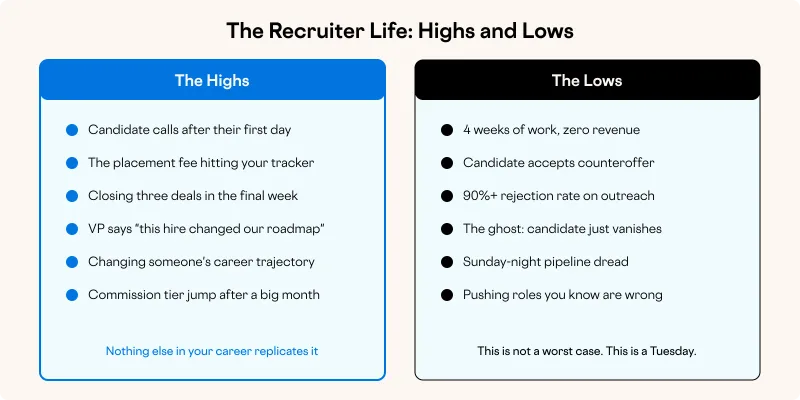
There is a moment in the recruiter life that nothing else in your professional career will replicate. The candidate calls you after their first day. They are nervous and excited. They tell you the team was great, the manager walked them through everything, they already feel like they belong. And you made that happen.
Or the placement fee hits your tracker after months of working a difficult search. The hiring manager who ghosted you for three weeks finally signed the offer letter. The candidate who nearly took a counteroffer stuck with their decision. Everything aligned, and the fee is real, and for about 48 hours you remember exactly why you chose this career.
Agency recruiters know the billing high. That month where you close three deals in the final week and jump a commission tier. The adrenaline of negotiating an offer while simultaneously managing the candidate's counteroffer, the client's budget constraints, and your own manager's expectations. It is high-stakes, fast-paced, and when it works, it feels like nothing else.
In-house recruiters get a different version of it. You filled the engineering role that had been open for six months. The VP of Product sends you a message saying "this hire changed our roadmap." You built the interview process that actually works. You are not just filling roles; you are building the company, and people notice.
Freelance recruiters get the purest form: every placement is your placement. No split. No desk fee. No manager taking credit. Just you, your network, and a fee that goes directly into your business. For more on that path, see our guide to freelance recruiting.
The recruiter life high is real. And if you have felt it, you know why it keeps people in this industry long after the rational part of their brain has started making spreadsheets about alternative careers.
The Recruiting Low
Here is the other side of recruiter life. The side that shows up on r/recruitinghell and in the group chats that your non-recruiter friends would not understand.
You spent four weeks sourcing for a role. You screened 80 candidates. You submitted 12. The hiring manager interviewed 6. Liked 3. Offered 1. The candidate took a counteroffer. The hiring manager is now "re-evaluating the role." Four weeks of work. Zero revenue. Zero recognition. This is not a worst-case scenario. This is a Tuesday.
The rejection rate in the recruiter life is staggering. Agency recruiters making 60 to 100 cold calls a day might get 5 meaningful conversations. In-house recruiters sending 200 InMails a week might get 15 responses. The math is brutal: you will hear "no" more times before lunch than most professionals hear in a month.
Then there is the ghost. The candidate who sailed through interviews, accepted the offer, confirmed their start date, and then simply vanished. No call, no email, no LinkedIn message. Just silence. You have to call the client and explain, and you have to do it while swallowing the fact that you did everything right and it still fell apart.
The worst lows are the ones where you feel complicit. Pushing a candidate toward a role you know has a toxic manager because your billing target demands it. Telling a candidate the salary range is "competitive" when you know the client will not go above market median. Those moments sit with you. The good recruiters lose sleep over them.
And then there is the pipeline dread. The feeling on a Sunday night when you know your pipeline is thin, your desk is cold, and Monday morning means starting from scratch. That particular flavour of anxiety is uniquely recruiting. It is the emotional equivalent of a commission structure with no floor.
If you are in a low right now and it has been lasting longer than a few weeks, read our piece on recruiter burnout. It might be more than a bad quarter.
What a Typical Day Actually Looks Like
People outside the recruiter life imagine a lot of phone calls and LinkedIn scrolling. They are not entirely wrong, but they are missing about 80% of the picture.
A typical day in the recruiter life is a chaos sandwich held together by caffeine and calendar management. Morning starts with pipeline review: who is in process, who needs follow-up, which offers are pending, which clients have gone quiet. Then the calls start. Candidate screens, client check-ins, interview debriefs, reference calls, and the occasional cold outreach that you have been putting off since last Wednesday.
Between calls, you are sourcing. Boolean strings on LinkedIn Recruiter. Scrolling through job boards in reverse (looking at who is applying to similar roles). Checking your ATS for passive candidates who might be ready to move. This is the part that looks like browsing from the outside but is actually the core skill of the profession.
Afternoons tend to be administrative: updating your CRM, writing candidate summaries, prepping interview briefs, responding to the 47 emails that came in while you were on calls. If you are in agency, there is BD mixed in. If you are in-house, there are hiring manager syncs and calibration meetings.
The day rarely ends when the clock says it should. That candidate can only talk at 6:30 PM. The client in a different timezone needs a debrief at 7. Your manager wants the weekly report before tomorrow morning.
For the full hour-by-hour breakdown across agency, in-house, and freelance models, read our day in the life of a recruiter comparison.
The Things Nobody Warns You About
The recruiter life has a set of occupational quirks that nobody mentions in training. Here are the ones that hit hardest.
You Become Everyone's Therapist
Candidates tell you things. Real things. They tell you they are leaving because their manager bullied them. They tell you they need this offer because their partner just lost their job. They tell you about their anxiety, their visa situation, their divorce. You are not qualified for any of this. But you listen, because that is what decent recruiters do, and then you go back to your desk and pick up the next call.
The emotional labour of the recruiter life is almost never discussed. You carry other people's career stress on top of your own, and the industry offers zero support for the toll that takes. According to research from the Recruitment & Employment Confederation, emotional exhaustion is the single biggest driver of turnover in recruitment, ahead of even financial dissatisfaction.
Your Friends Think You Are in HR
You are not in HR. You will spend an unreasonable amount of energy explaining this at dinner parties. HR manages employee relations, compliance, benefits, and policy. You find people and convince them to take jobs. The skill sets overlap about as much as a dentist and an orthodontist. Adjacent, sure. The same thing? Not even close.
For the definitive breakdown, point them to our article on talent acquisition vs recruitment.
Job-Hunting as a Recruiter Is Deeply Awkward
When the recruiter life involves looking for your own new role, the irony is suffocating. You spend your career helping other people find jobs, and now you are updating your own CV feeling like a mechanic whose car broke down. Your network assumes you can "just find something." Your current employer might find out because recruiters talk to other recruiters and the industry is smaller than anyone realises.
This is why platforms like Recruiter Roles exist. Dedicated spaces where recruiters can search without the weird energy of applying through generic job boards alongside the candidates they normally source.
The Money Is Unpredictable
The recruiter life in agency can mean extraordinary money. A top biller at a well-run agency can pull in $150K to $250K+ in a good year. But the "good year" qualifier is doing a lot of work. A bad quarter can cut your take-home in half. A hiring freeze at your biggest client can wipe out months of pipeline overnight.
The financial volatility of the recruiter life, especially in agency, creates a specific kind of stress that salaried professionals do not experience. Your income is not just tied to your effort; it is tied to the decisions of hiring managers, candidates, and entire market cycles that are completely outside your control.
For a full breakdown of what recruiters actually earn, see the recruiter salary guide.
The Desk Politics Are Real
Every agency has unspoken rules about desk ownership, lead allocation, and who gets the good reqs. If you have ever had a colleague swipe a candidate from your pipeline or watched a manager reassign a warm client to their favourite biller, you know exactly what this means. The politics are not a bug; they are a structural feature of commission-based environments.
We wrote a whole piece on this: the unwritten rules of recruiting.
The Burnout Question
Let's talk about the elephant in the room. The recruiter life has a burnout problem, and pretending otherwise is dishonest.
Industry data tells a grim story. Average tenure at recruitment agencies hovers around 1.8 to 2.5 years. Annual turnover rates at agencies run between 25% and 40%, depending on the market and the source. A 2024 survey by Staffing Industry Analysts found that 67% of agency recruiters reported experiencing burnout symptoms in the previous 12 months.
The causes are structural, not personal. Recruiting combines high rejection rates, commission-based pressure, emotional labour, long hours, and minimal job security into a single role. That is not a recipe for sustainable wellbeing. It is a recipe for exactly what the turnover data shows.
But burnout in recruiting is complicated. Sometimes it is the profession. Sometimes it is the company. Sometimes it is the desk. Sometimes it is temporary, tied to a bad quarter or a difficult client. And sometimes it is a genuine signal that you have hit a wall and need to make a change.
If burnout is something you are dealing with right now, do not just push through it. Read our full guide on recruiter burnout: how to recognize it and recover. It covers the specific warning signs, the recovery strategies that actually work, and how to tell the difference between "I need a break" and "I need a new career."
Agency vs In-House vs Freelance: How the Recruiter Life Differs
The phrase "recruiter life" means three very different things depending on which model you work in. The emotional texture of each day, the stressors, the rewards, and the culture are distinct enough that switching between them often feels like changing careers entirely.
Agency Recruiter Life
Agency recruiting is the startup of the recruiting world. Fast-paced, high-pressure, high-reward, high-turnover. Your day is structured around revenue generation: BD calls, candidate submissions, client meetings, offer negotiations. The culture is sales-floor energy. Bells ring when deals close. Leaderboards track billings. The camaraderie is intense because everyone is in the same trench.
The upside: uncapped earning potential, rapid skill development, and an energy that introverts find exhausting but extroverts find addictive. The downside: everything mentioned in the burnout section above, multiplied by the pressure of commission-based pay.
In-House Recruiter Life
In-house talent acquisition is the corporate cousin. The pace is slower but the complexity is higher. You are managing stakeholder relationships across departments, navigating internal politics, building employer brand, and trying to improve processes that were probably broken before you arrived. The stress is different: less about volume and revenue, more about influence and alignment.
The upside: salary stability, benefits, a seat at the table when hiring strategy is discussed, and the satisfaction of building something over years rather than billing in quarters. The downside: corporate bureaucracy, the frustration of being seen as a "service function" rather than a strategic partner, and the reality that your career progression often depends on someone else leaving.
Browse talent acquisition roles if you are curious about what is available in-house right now.
Freelance Recruiter Life
Freelance recruiting is the solo founder of the recruiting world. Maximum autonomy, maximum risk. You control your schedule, your clients, your niche, and your income. There is no manager, no KPI dashboard, no Monday morning pipeline review. There is also no safety net, no team, no IT support, and no one to celebrate with when you close a deal.
The recruiter life as a freelancer is defined by the tension between freedom and isolation. The best freelance recruiters build networks, communities, and routines that replace what the office environment used to provide. The rest find that "working for yourself" can become "working by yourself," and the distinction matters more than you think.
Read our full freelance recruiter guide for the practical breakdown.
Why Recruiters Stay (Despite the Recruiter Life Being This Hard)
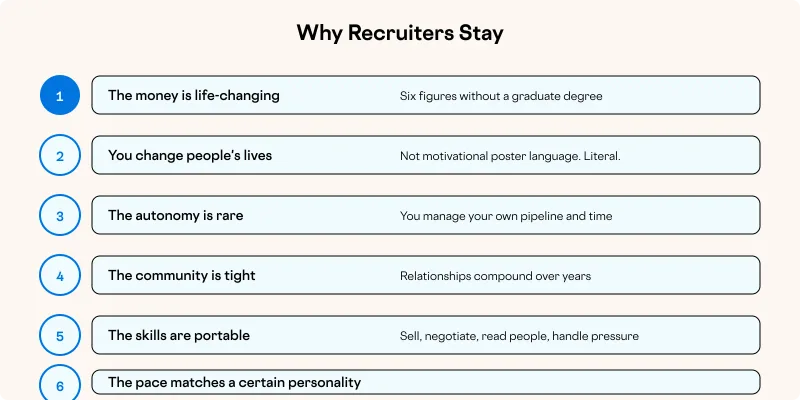
Given everything above, the question that outsiders always ask is: why would anyone stay in the recruiter life? Here is the honest answer.
The money, when it works, is genuinely life-changing. There are not many professions where someone without a specialised degree or advanced certifications can earn six figures within a few years. Recruiting is one of them. The earning potential, especially in agency, is real.
You change people's lives. This is not motivational poster language. It is literal. The candidate who was stuck at a dead-end job for three years, who you placed into a role that doubled their salary and gave them career trajectory: that person exists, and you made it happen. That moment never gets old, no matter how cynical the industry makes you.
The autonomy is rare. The recruiter life offers something unusual: even in structured agency environments, most recruiters have significant control over their day. You manage your own pipeline, your own relationships, your own time. The micromanagement exists, but the fundamental nature of the work requires independence, and that attracts people who cannot stand being told exactly how to spend every hour.
The community is surprisingly tight. Recruiting is a small world. The person you worked with at your first agency shows up at your client company five years later. The candidate you placed in 2019 refers you business in 2026. The relationships compound over time, and the recruiter community, when it is good, is one of the most supportive professional networks out there.
The skills are genuinely portable. Even recruiters who eventually leave the profession acknowledge that recruiting taught them how to sell, negotiate, read people, manage rejection, and operate under pressure. Those skills transfer to virtually any business role. Knowing that your career is not a dead end, even if you leave, provides a security that many professions lack.
The pace matches a certain personality. Some people wilt under pressure. Others come alive. If you are the kind of person who thrives in fast environments, who gets bored by routine, who needs variety in their day, recruiting provides that in abundance. The same chaos that burns some people out is the exact thing that keeps others energised for decades.
Is This Career Right for You?
If you are reading this trying to decide whether life as a recruiter is the right path, the honest answer is: it depends on who you are and what you are optimising for.
Recruiting rewards resilience, social intelligence, competitiveness, and the ability to handle rejection without taking it personally. It punishes people who need predictability, who struggle with ambiguity, and who are uncomfortable with the fact that their income depends on variables they cannot fully control.
The best way to evaluate it is not to read articles (including this one). It is to talk to recruiters. Not the LinkedIn thought leaders. The ones actually on the desk. Ask them what their worst week looked like. Ask them what their best month felt like. Ask them if they would do it again.
If you are still evaluating, our article is recruiting a good career? walks through the decision framework in detail, with salary data, career path analysis, and an honest assessment of who thrives and who struggles.
And if you have already decided? Browse recruiter roles on Recruiter Roles and see what is out there. One search, every role.
FAQ
How long do most recruiters last in the industry?
Average tenure at agencies is around 1.8 to 2.5 years, though this skews heavily. Many people leave within their first year, while others stay for decades. In-house recruiters tend to have longer tenures, averaging 3 to 5 years in a role. The recruiters who build long careers typically either find a niche they love, move into management, or go independent.
Is agency or in-house recruiting less stressful?
Neither is stress-free, but the stress is different. Agency stress comes from revenue pressure, high-volume activity targets, and income volatility. In-house stress comes from stakeholder management, internal politics, and being measured on outcomes you do not fully control (like hiring manager availability). Most recruiters who switch from agency to in-house report lower overall stress but occasionally miss the energy and earning potential of agency.
Why do so many recruiters burn out?
The combination of high rejection rates, commission pressure, emotional labour, and an always-on culture creates conditions where burnout is almost structural rather than individual. Add in the fact that most agencies promote top billers into management without any leadership training, and you get environments where burnout is normalised rather than addressed. See our full burnout guide for recognition and recovery strategies.
What is the recruiter community like?
Surprisingly tight. Recruiting is a small enough industry that reputation matters and relationships compound. Online communities on Reddit, LinkedIn, and Discord are active and generally supportive. Industry events and conferences tend to have a more casual, social atmosphere than you would find in most professions. The shared experience of a difficult job creates strong bonds between recruiters, even ones at competing firms.
Can you have a good work-life balance in the recruiter life?
Yes, but it requires intentional choices. In-house and freelance models offer more control over hours. Agency recruiters can achieve balance too, but it usually requires seniority, a strong pipeline, and a firm that does not equate physical presence with productivity. The recruiters with the best balance tend to be the ones who learned to set boundaries early and chose employers who respect them.
Is the recruiter life worth it?
For the right person, it is one of the best careers available. High earning potential, genuine impact on people's lives, portable skills, and a community that feels like it belongs to you. For the wrong person, the recruiter life is a relentless grind with no safety net. The difference usually comes down to environment (the right company), specialisation (a niche you care about), and self-awareness (knowing what you need to sustain your energy). For the full evaluation, read is recruiting a good career?.