
Day in the Life of a Recruiter: Agency vs In-House vs Freelance

Ask three recruiters about a day in the life of a recruiter and you will get three completely different answers. An agency recruiter will describe something that sounds like a trading floor. An in-house recruiter will describe something that sounds like project management with a heavy dose of stakeholder diplomacy. A freelance recruiter will describe something that sounds like running a one-person business, because that is exactly what it is.
The phrase "day in the life of a recruiter" gets searched about 50 times a month, mostly by people considering the profession or by recruiters curious about how their daily grind compares to the other models. Most content about a day in the life of a recruiter is either a single recruiter's vlog (sample size of one) or a generic job description that describes "what a recruiter does" without capturing what a recruiter's day actually feels like.
This day in the life of a recruiter does something different. Three parallel timelines, running through a single Tuesday, showing what agency, in-house, and freelance recruiting actually look like hour by hour. Not the polished version. The real one, including the parts that do not make it into job postings or LinkedIn content.
For the bigger picture on what the profession is really like beyond a single day, read our pillar piece on the real recruiter life.
A Day in the Life of a Recruiter: Agency
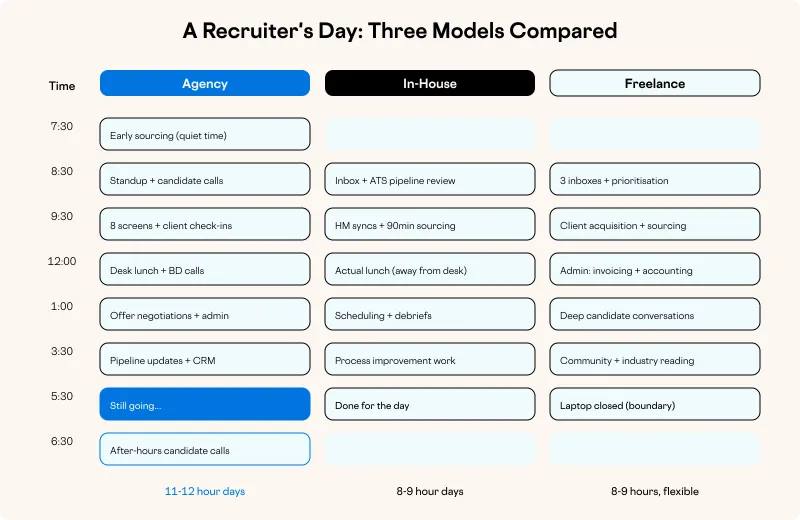
The setting: A mid-size recruitment agency specialising in technology placements. Open-plan office. The energy shifts between library-quiet (morning sourcing) and trading-floor-loud (afternoon when calls stack up). There is a bell on the wall for closed deals. It rings about twice a week.
7:30 AM: The Early Start
You arrive before the team because the first 90 minutes of quiet are the most productive sourcing time you will get all day. Coffee in hand, you open LinkedIn Recruiter, your ATS, and three job boards. You scan applicants on your live roles (two software engineering positions and a DevOps lead) and flag the ones worth screening. A candidate in a different timezone has come back with salary expectations 15% above the client's range. You draft a careful response while you wait for the standup.
8:30 AM: Pipeline Review and Calls
The 15-minute standup. Each recruiter gives a 60-second update. Your manager asks about the DevOps search that has been open for six weeks. You explain the market is thin and the client's salary band is below median. Your manager suggests you "try harder." You suppress the urge to explain supply and demand.
Then the calls begin. Eight candidate screens before noon, plus two client check-ins. A passive candidate you sourced last week agreed to chat but says they are "not really looking." This phrase, as every recruiter knows, means "convince me." Twenty-five minutes later, they agree to be submitted. Small win. Between calls, you respond to candidates in process. One has gone silent since Friday. Counteroffer. You can feel it.
12:00 PM: Lunch, BD, and the Afternoon Hit
You eat at your desk reviewing the afternoon's BD targets. Your manager wants three new client outreach calls before end of day. One goes to voicemail. One is politely noncommittal. The third agrees to a face-to-face meeting next week. That is a win.
Then the afternoon hit: a candidate who was supposed to start next Monday emails to say they accepted a counteroffer. There goes a $15,000 fee. You stare at the wall for 10 minutes before calling the client to deliver the news.
5:30 PM: The Day Should Be Over (But It Is Not)
Two candidate calls at 6:00 and 6:30 with people who can only talk after work. That is a day in the life of a recruiter at an agency. You leave the office at 7:15. On the train home, you check one more email. Tomorrow, you start again.
A Day in the Life of a Recruiter: In-House
The setting: A mid-size tech company (about 800 employees) with a five-person talent acquisition team. You sit with the People team on the fourth floor. The pace is different from agency. There is no bell. There are no leaderboards. There is a lot of Google Calendar.
8:30 AM: Inbox, ATS, and Pipeline
You start later than your agency counterpart because nobody is tracking your arrival time. The inbox: a hiring manager replied at 11 PM wanting to "discuss alignment." The VP of Engineering flagged a new headcount not on the Q2 plan. A candidate sent a thank-you email asking about timeline.
You open the ATS. Fourteen active requisitions across three departments. Two at offer stage, four in interview loops, eight in sourcing. Offer-stage roles get priority because losing a candidate at that point is the most expensive failure in terms of time invested.
9:30 AM: Hiring Manager Syncs and Sourcing
Weekly meeting with engineering hiring managers. This is where in-house recruiting diverges from agency: you are not selling to clients. You are collaborating with colleagues. You have to influence without authority and push back without antagonising.
The senior backend engineer role has been open for 10 weeks. The hiring manager's requirements have shifted twice. You walk through market data showing why their requirements-plus-salary combination is producing a thin pipeline. They push back. You compromise on one requirement. Progress.
After the meeting, you block 90 minutes for sourcing. In-house sourcing is different: you are not pitching a role, you are pitching a company. Your employer brand, team culture, product, Glassdoor reviews. According to LinkedIn's Global Talent Trends report, 75% of candidates research a company's reputation and employer brand before applying. You send 25 personalised outreach messages. By lunchtime, three designers have replied with interest.
12:30 PM: Lunch and Afternoon Coordination
Actual lunch, away from your desk. One genuine perk of in-house. Colleagues ask, as always, whether you know of anyone hiring in their field.
The afternoon is a mix of scheduling, prepping interviewers, and running debriefs. Four interviewers, four opinions on Friday's candidate. One loved them. One had concerns about "culture fit" (often code for "I cannot articulate what bothered me"). You push for specific evidence, and the group decides to move to offer.
3:30 PM: Process Work and Wrap-Up
This part does not exist in agency: process improvement. You update the engineering interview guide. You review careers page copy from a freelancer who used "synergy" three times. You rewrite it.
You leave at 5:30. The hiring manager who emailed at 11 PM wants "five minutes." You respond that you will follow up tomorrow. Boundaries are a skill you have learned to protect.
If the in-house path sounds like your speed, browse talent acquisition jobs to see what is available.
A Day in the Life of a Recruiter: Freelance
The setting: Your home office. A second monitor, a standing desk you bought when the back pain started, and a whiteboard with your current client list. No team. No manager. No commute. Also no IT support, no office banter, and nobody to celebrate with when a deal closes.
8:00 AM: The Flexible Start
You start at 8 today because of a candidate call at 8:30 in a different timezone. Other days it might be 9:30 after a gym session. The flexibility is real, but so is the discipline required. Without a standup or a manager, the only structure is what you create.
You check three inboxes (personal, recruiting brand, split-fee platform) and prioritise. A client needs a search update. The split-fee platform posted a new role in your niche. Staffing Industry Analysts estimates that independent and freelance recruiters now make up roughly 15% of the recruitment market, a figure that has grown steadily since 2020.
9:00 AM: Client Acquisition and Sourcing
This is the part agency and in-house recruiters never do: finding your own work. Today you have a discovery call with a Series A startup that needs a VP of Product. They found you through a referral from a candidate you placed two years ago. This is how freelance recruiting works when it works well: reputation compounds, and placements generate referrals that generate placements.
After the call, you source for two hours. Your advantage is specialisation: you know your niche, you know the people in it, and you know who is likely to move before they update their LinkedIn status. You reach out to seven candidates. No templates. Freelance recruiters live and die by reputation, and generic outreach kills it fast.
12:30 PM: Admin, Then Candidate Conversations
The glamour of self-employment: invoicing last month's placement (30-day payment terms, so you are floating your time for weeks), updating accounting, filing receipts. Read our guide to becoming a freelance recruiter for the full operational picture.
Three candidate calls this afternoon. Your conversations are deeper than agency calls because you are working four searches, not 30. Candidates notice the difference. One is a candidate you placed three years ago who is thinking about moving. They called you first. You do not have a role that fits right now, but you take notes and add them to your "warm bench." This relationship-first approach separates successful freelancers from struggling ones.
4:00 PM: Community, Then Close
Freelance recruiting is isolating. You spend 30 minutes in a Slack community for independent recruiters and 20 minutes reading niche industry news. Staying current is not optional when your authority justifies your fee.
You close your laptop at 5:30 because you have learned that "just one more thing" at 6 PM turns into working until 8. Your day generated zero revenue but moved three searches forward and one client relationship closer to contract. The revenue comes in bursts, not streams, and tolerating the quiet periods is the skill that separates recruiters who make it independently from those who go back to agency.
Side-by-Side Comparison
| Dimension | Agency | In-House | Freelance |
|---|---|---|---|
| Typical hours | 7:30 AM to 7:00 PM | 8:30 AM to 5:30 PM | Flexible, 8-9 hours self-directed |
| Pay structure | Base + commission | Salary + bonus | 100% fee-based |
| Number of active roles | 10 to 30+ | 8 to 20 | 3 to 6 |
| Primary stress | Revenue targets, rejection volume | Stakeholder management, process bottlenecks | Revenue uncertainty, isolation |
| Best part | Earning potential, team energy | Stability, depth of relationships | Autonomy, specialisation |
| Worst part | Commission resets, cold calling | Bureaucracy, slow decision-making | Isolation, inconsistent income |
| Tools | CRM, job boards, LinkedIn Recruiter | ATS, LinkedIn Recruiter, HRIS | LinkedIn Recruiter, CRM, invoicing |
| Career progression | Biller to team lead to director | Specialist to manager to head of TA | Solo to team to agency founder |
| Social interaction | High (team, clients, candidates) | Medium (colleagues, candidates) | Low (candidates, clients, virtual community) |
| BD required | Moderate to heavy | None | Heavy |
Which Environment Suits You?
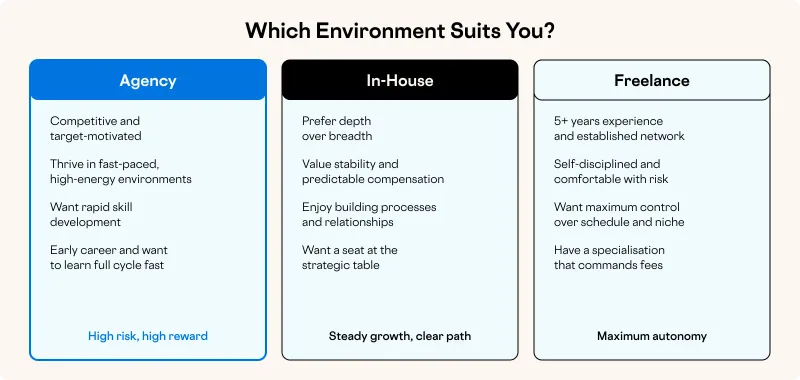
There is no universally "best" day in the life of a recruiter. The right environment depends on your personality, your career stage, and what you are optimising for.
Agency might suit you if:
- You are competitive and motivated by financial targets
- You thrive in fast-paced, high-energy environments
- You want rapid skill development and can tolerate high-pressure cultures
- You are early in your career and want to learn the full cycle quickly
In-house might suit you if:
- You prefer depth over breadth in your work
- You value stability and predictable compensation
- You enjoy building processes and long-term stakeholder relationships
- You want a seat at the strategic table, not just execution
Freelance might suit you if:
- You have 5+ years of experience and an established network
- You are self-disciplined and comfortable with financial uncertainty
- You want maximum control over your schedule, clients, and niche
- You have a specialisation that commands premium fees
Many recruiters experience all three versions of a recruiter's day over the course of their career. Starting in agency, moving in-house for stability and breadth, and eventually going independent once the network and expertise justify it is one of the most common career arcs in the profession.
Whatever your next move looks like, browse recruiter roles on Recruiter Roles to see the full market. And for the insider wisdom that training never covers, read the unwritten rules of recruiting.
FAQ
Which day in the life of a recruiter is least stressful?
None is stress-free, but the stress differs. In-house has the most predictable schedule and income, which many recruiters equate with lower stress. Agency stress is acute (revenue pressure, rejection volume). Freelance stress is existential (income uncertainty, isolation). The "least stressful" model is the one that matches your personality.
Which type of recruiter earns the most?
Agency has the highest ceiling: top billers earn $150K to $250K+ with commission. Freelance can match that but with higher variance. In-house is the most predictable at $60K to $130K depending on seniority, but the ceiling is lower. For detailed breakdowns, see the recruiter salary guide.
Can you switch between agency, in-house, and freelance?
Yes, and most long-tenured recruiters do. Agency to in-house is the most common transition. In-house to freelance requires building a client network first. Each switch requires reframing your experience for the new context, but the core skills transfer.
What does a day in the life of a recruiter actually look like?
Sourcing (finding candidates), screening (evaluating fit), coordinating (managing interviews), and closing (negotiating offers). In agency, add BD. In-house, add stakeholder management and process improvement. Freelance, add client acquisition. Communication occupies the majority of every recruiter's day regardless of model.