
The Unwritten Rules of Recruiting (From Recruiters)

Every profession has unwritten rules that never make it into the training manual. Recruiting has more than most. The industry runs on relationships, reputation, and a set of unwritten rules that nobody explicitly teaches but everyone is expected to know. Break them and you will struggle. Follow them and the job gets significantly easier, if not less chaotic.
These are not tips from a textbook. These are the unwritten rules of recruiting that recruiters learn through experience, usually after making the mistake first. The unwritten rules of recruiting that your manager assumed you would just "pick up" while you were busy trying to figure out how the ATS works and why nobody answers their phone anymore.
Some of these unwritten rules are universal. Some are agency-specific or in-house-specific. All of them came from real recruiters who learned them the hard way. If you are new to the profession, consider these unwritten rules of recruiting a head start. If you have been at it for years, consider this validation that you are not the only one who noticed.
For the full picture of what this career actually feels like, read our pillar guide on the real recruiter life.
The Unwritten Rules Nobody Puts in the Handbook
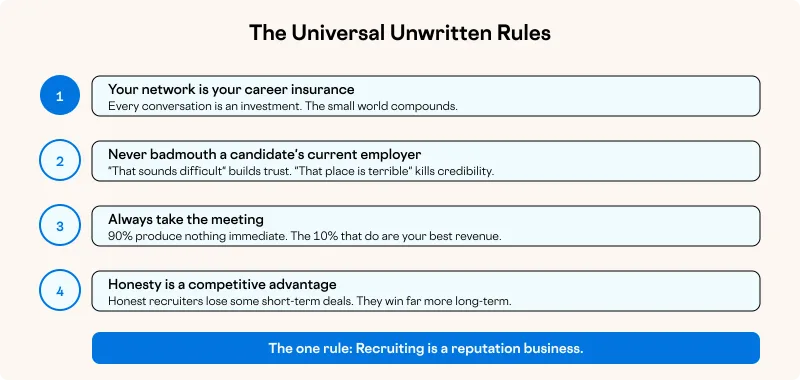
These are the baseline unwritten rules of recruiting. The ones that apply regardless of whether you are sitting on an agency floor, in a corporate TA team, or at your kitchen table working independently.
Your Network Is Your Career Insurance
Your professional network is the single most valuable asset you own. More valuable than your billing track record. More valuable than your LinkedIn Recruiter licence.
The candidate you helped with interview prep but did not place in 2023 becomes the hiring manager who gives you an exclusive search in 2026. The recruiter at a competing agency you bought coffee for refers you a client when they leave the industry. Recruiting is a long game played in a small world.
Never Badmouth a Candidate's Current Employer
A candidate tells you their company is a mess. It feels natural to agree. Do not. You do not know the full story. The industry is small enough that your words will travel. And your role is to help them evaluate options, not validate frustrations. There is a difference between "that sounds like a difficult situation" and "yeah, everyone says that place is terrible." The first builds trust. The second damages credibility.
Always Take the Meeting
A candidate wants to talk even though you do not have a role for them right now. Take the meeting. A client wants a general chat about the market even though they are not hiring yet. Take the meeting. A junior recruiter wants career advice even though there is nothing in it for you. Take the meeting.
This is one of the most important unwritten rules of recruiting: ninety percent of these conversations will not produce immediate revenue. But the 10% that do will produce the best revenue you have ever earned, because they come from relationships rather than cold outreach. The recruiters who "don't have time" for conversations that are not immediately billable tend to plateau after a few years, unable to figure out why their pipeline keeps drying up.
Honesty Is a Competitive Advantage
The recruiter who tells a candidate "this role is not right for you" earns more trust than the one who submits them anyway and hopes for the best. The recruiter who tells a client "your salary range is below market and you will not attract the talent you want at this number" earns more respect than the one who takes the brief and delivers a weak shortlist.
Among the unwritten rules of recruiting, honesty pays the most dividends. Honest recruiters lose some short-term deals. They win far more long-term business. The profession has enough people willing to tell clients and candidates what they want to hear. The ones who tell them what they need to hear build the relationships that generate repeat business year after year.
Agency Unwritten Rules
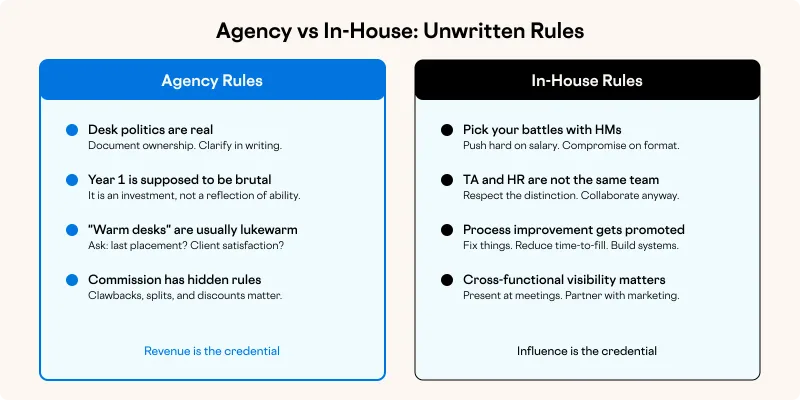
The agency environment has its own set of unwritten rules, many of which are driven by the commission-based, competitive nature of the work.
Desk Politics Are Real and You Need to Navigate Them
One of the most impactful unwritten rules: every agency has an unofficial hierarchy that has nothing to do with the org chart. The top biller gets the best reqs. The manager's favourite gets first pick of new clients. The recruiter who has been there longest has unspoken ownership of certain accounts, even if no one formally assigned them.
You will not change desk politics. Understanding these unwritten rules means learning to navigate them. Document your candidate ownership. Clarify client assignments in writing. When a grey area emerges (and it will), address it early and directly rather than letting resentment build. The worst desk conflicts are the ones that simmer for months before exploding in a commission dispute.
Your First Year Is Supposed to Be Brutal
The first 12 to 18 months in agency are objectively difficult because you are building everything from scratch: skills, candidate network, client relationships, desk knowledge. Every experienced biller went through this. Most hated it.
Among the unwritten rules of recruiting, this is critical: your first year is an investment, not a reflection of your ability. The billers who make it past month 18 disproportionately go on to have successful careers. The ones who quit at month 6 often did not give the compounding effects enough time to kick in.
The "Warm Desk" Is Usually Lukewarm at Best
When an agency offers you a "warm desk" during the interview process, treat the claim with healthy scepticism. A warm desk implies you will inherit existing client relationships and active requisitions. In reality, warm desks are often left behind by recruiters who left for a reason: the clients were difficult, the candidates had dried up, or the accounts were in worse shape than the surface numbers suggest.
Ask specific questions: How many active reqs? When was the last placement? What is the client satisfaction like? Who left this desk and why? The answers will tell you more than the job description ever will.
Commission Structures Have Hidden Rules
One of the most costly unwritten rules: the published commission structure is rarely the full story. What happens if a candidate falls off during the guarantee period? How are fees split on roles sourced by one recruiter but managed by another? What is the clawback policy? Full fee or net fee after discounts?
These details determine your actual earnings far more than the headline percentage. Ask during the offer stage, not after you discover your $20K placement nets you $1,500 because of a discount and a split arrangement nobody mentioned.
For detailed compensation benchmarking, see the recruiter salary guide.
In-House Unwritten Rules
In-house recruiting operates on a different set of unwritten rules, driven by corporate culture and stakeholder dynamics rather than commission structures.
The Hiring Manager Is Not Always Right (But You Need to Pick Your Battles)
Hiring managers often come to you with a job spec that describes a unicorn: 10 years of experience, expertise in three niche technologies, willing to work onsite five days a week, at a salary 20% below market. Part of your job is to calibrate these expectations. But one of the key unwritten rules of recruiting is: you cannot win every fight.
Choose your battles strategically. Push back hard on the issues that will make or break the search (salary range, must-have vs nice-to-have skills). Compromise on the issues that matter less (interview format preferences, minor role title concerns). The in-house recruiters who try to win every disagreement with every hiring manager quickly develop a reputation as difficult, and that reputation limits their influence far more than any single compromise would.
TA and HR Are Not the Same Team
In many companies, talent acquisition sits under HR. This creates identity tension. TA is outward-facing and market-driven. HR is inward-facing and compliance-focused. They share an org chart but not a mindset. The unwritten rule: respect the distinction without being combative. Collaborate with HR without surrendering your strategic identity.
Process Improvement Is How You Get Promoted
In agency, you get promoted by billing. In-house, you get promoted by fixing things. Reduce time-to-fill by 30%? You get noticed. Implement a structured scorecard? You get promoted. Build an employer brand strategy? You get a seat at the leadership table. In-house recruiting rewards system-thinkers more than individual billers.
Career Unwritten Rules
These are the long-term unwritten rules that govern how recruiting careers develop, regardless of which model you work in.
The Two-Year Itch Is Real
Most recruiters hit a restless point around the two-year mark. The role feels routine. The grass looks greener. This is normal. The unwritten rules of recruiting say: use the itch as a diagnostic, not an automatic trigger to leave. Before you jump, ask whether you are running toward something or away from something. The answer changes the strategy.
Your Reputation Follows You Everywhere
According to ERE Media's recruiting industry analysis, recruiters change companies more frequently than almost any other profession, which means the people you encounter at one firm will reappear at another. The candidate you treated poorly at Agency A will be the hiring manager at Company B. Reputation in recruiting is not abstract. It determines which candidates return your calls, which clients give you exclusives, and which companies want to hire you.
If you are evaluating agencies by reputation, the company directory can help you research firms before committing.
Know When to Walk Away From a Client
The unwritten rules of recruiting extend to client management: not every client is worth the revenue. The hiring manager who changes the spec every week. The company that consistently lowballs offers after lengthy interview processes. The client who treats you as a CV-pushing service rather than a strategic partner.
Firing a client feels counterintuitive, especially when you need the billings. But bad clients consume disproportionate time, damage your candidates' experiences, and erode your motivation. The hours you free up by dropping a toxic client will almost always generate more revenue when redirected to better relationships.
The Real Relationship Between BD and Recruiting
Business development and recruitment delivery are presented as two halves of the 360 model. The unwritten truth: they are different disciplines that happen to coexist in one job. Some recruiters are natural sellers. Others are natural sourcers. The 360 model forces everyone to do both, which means most people spend significant time on the half they are worst at.
If you are struggling in a 360 role, it might not be recruiting that is the problem. It might be that you are a great recruiter doing mediocre sales, or a great salesperson doing mediocre recruiting. Knowing which half is your strength changes how you think about your career path.
Client and Candidate Unwritten Rules
The day-to-day interactions with candidates and clients have their own set of unwritten rules.
The Art of the Honest "No"
Saying no to a candidate is one of the hardest skills in recruiting. Telling someone they did not get the job, or that you cannot represent them, or that their salary expectations are unrealistic, requires a blend of directness and empathy that takes years to develop.
The unwritten rule: deliver bad news quickly, clearly, and with enough context that the person does not feel dismissed. "The client went with a candidate who had more direct experience with their specific tech stack" is better than "they went another direction." Specificity shows respect. Vagueness signals that you do not care enough to explain.
Counteroffers Are Almost Always a Bad Sign
Research from the Society for Human Resource Management consistently shows that 50% to 80% of candidates who accept counteroffers leave within 12 months anyway. The underlying reasons for wanting to leave have not changed; only the compensation has.
The unwritten rule: prepare your candidates for the counteroffer before it happens. During offer stage, walk them through the scenario. "If your current employer offers more money to stay, what would you do? And what does it say about them that they only offered it when you were about to leave?" That proactive conversation is the difference between a closed deal and a lost one.
Never Oversell a Role
The recruiter who describes a role as "incredible opportunity, amazing culture" when the reality is "decent mid-level role at a company with 3.2 stars on Glassdoor" is borrowing against their own future. The candidate discovers the gap, files your name under "do not trust," and tells other candidates. The placement fee is dwarfed by the reputational cost.
Underselling and overdelivering is not just ethically right. It is strategically right. The candidate who finds a role better than expected becomes your best referral source for years.
The One Rule That Matters Most
Every one of these unwritten rules of recruiting distils into a single principle: recruiting is a reputation business.
Your fee structure, your ATS, your sourcing techniques: these are tools. Your reputation is the asset. The recruiters who build careers measured in decades rather than years understand this intuitively. They take the meeting with no immediate payoff. They tell the candidate the honest truth. They walk away from the client who wastes their time.
All unwritten rules of recruiting are variations on this theme. Build relationships. Keep your promises. Protect your credibility. Everything else is tactics.
Ready for your next move? Browse recruiter roles on Recruiter Roles and see the full market in one place. If you are feeling the signs of burnout that make these rules harder to follow, read our guide on recruiter burnout and recovery.
FAQ
What is the most important of the unwritten rules for new recruiters?
Build your network before you need it. Every conversation in your first 12 to 18 months, even those that do not lead to a placement, is an investment in relationships that will generate returns for years. The recruiters who treat early-career conversations as transactional plateau quickly.
How do you handle desk politics at an agency?
Document everything, clarify ownership early, and address conflicts directly. Commission disputes almost always stem from ambiguous candidate or client ownership. The best protection: log every engagement in the CRM with a timestamp. This is not paranoia. It is professional practice.
When should you walk away from a client?
When the relationship costs more than it generates in fees, time, energy, and candidate experience. Red flags: consistently changing specs after sourcing investment, lowballing at offer stage, going silent for weeks then demanding urgent shortlists. A pattern of these is your signal to redirect effort.
How do you stay motivated as a recruiter?
Recruiters who sustain motivation tend to share three things: a niche they find genuinely interesting, a community of peers who understand the work, and personal goals beyond billing targets (quality of hire, skill development, candidate satisfaction).
What do you wish you knew before becoming a recruiter?
The money is real but inconsistent. The first year is not representative of the career. The skills transfer to virtually any business role. The industry is smaller than you think, so reputation matters from day one. And the difference between a great recruiting job and a terrible one comes down to the specific company and manager, not the profession itself.