
5 Underrated Careers for Ex-Recruiters Beyond HR & Sales

You have probably already read the standard advice. "Recruiters should go into HR." "Recruiters should go into sales." And yes, those are legitimate paths. We have written full guides on both (recruiter to HR, recruiter to sales) because they work.
But there are careers for ex recruiters that rarely get mentioned. These are careers for ex recruiters that use your skill set in ways that feel fresh and different, not like doing a slightly different version of the same job. These are the roles where ex-recruiters thrive but that nobody includes on the obvious "alternative careers" lists.
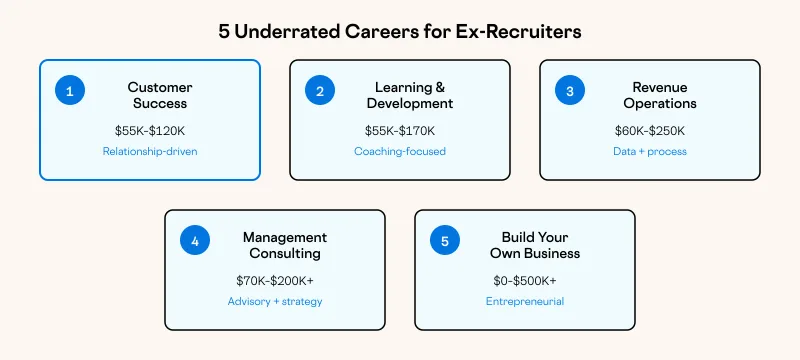
This guide covers five underrated careers for ex recruiters who want something genuinely new. Not HR. Not sales. Something that uses the skills you built on the desk in a context that might actually excite you again.
For a complete overview of all career paths, including the well-known ones, see the definitive guide to jobs recruiters transition into.
1. Customer Success Management
Customer success is one of the best careers for ex recruiters that should be on every recruiter's radar but almost never is. The overlap between what a recruiter does and what a Customer Success Manager (CSM) does is remarkable, and the working conditions address many of the reasons recruiters burn out.
Why Recruiters Excel at Customer Success
As a recruiter, you manage relationships with multiple stakeholders simultaneously. You set expectations, handle objections, deliver difficult feedback, and drive toward outcomes that keep everyone satisfied. You track health signals (candidate engagement, client responsiveness) and intervene when things go off track. You care about outcomes, not just transactions.
That is customer success. Literally.
A CSM manages a portfolio of accounts, ensures they are getting value from the product, identifies risks before they become churn, and expands the relationship over time. You replace "candidate" with "customer" and "placement" with "product adoption," and the core competencies are identical.
What the Role Actually Looks Like
Day-to-day, a CSM spends their time on quarterly business reviews, onboarding new accounts, monitoring usage data, proactively reaching out when engagement drops, and working with product teams to relay customer feedback. You will have a book of accounts rather than a pipeline of candidates. Your metrics shift from placements to retention rate, net revenue retention, and customer health scores.
Salary and Career Path
Entry-level CSM roles pay $55,000 to $75,000 base salary with bonuses tied to retention and expansion. Senior CSMs earn $85,000 to $120,000. The leadership path goes to Director of Customer Success ($130,000-$180,000) and VP of Customer Success ($160,000-$220,000). At SaaS companies with healthy economics, the CS function is growing faster than most departments.
According to Gainsight's State of Customer Success report, the CS profession has grown 300% over the past decade, and demand continues to outpace supply. Companies struggle to hire CSMs with the right combination of relationship skills and commercial instinct. Recruiters have both.
How to Get There
Target companies in HR tech, recruiting technology, or any SaaS vertical where your domain expertise adds value. Frame your resume around relationship management, risk mitigation, and stakeholder advisory. Highlight any experience you have with retention: did you keep clients renewing year over year? Did you manage long-term candidate communities? That is customer success thinking.
2. Learning and Development (L&D)
L&D is one of the most fulfilling careers for ex recruiters who loved coaching junior team members, enjoyed training new hires, or found themselves drawn to the "people development" side of the profession.
Why Recruiters Excel at L&D
Recruiters assess capability gaps constantly. You evaluate candidates against role requirements, identify where skills fall short, and make judgments about development potential. You also communicate complex information (compensation structures, market dynamics, career options) in accessible ways. And if you ever onboarded a new desk member, you already know how to design and deliver training.
L&D professionals do the same work at an organisational level: assess skill gaps, design learning experiences, deliver training, and measure impact on performance.
What the Role Actually Looks Like
L&D roles range from training specialists (designing and delivering specific programmes) to L&D managers (owning the learning strategy for a department or company) to organisational development consultants (advising on broader capability-building initiatives). The work includes needs assessment, programme design, facilitation, coaching, and measuring learning outcomes.
Salary and Career Path
L&D Specialists earn $55,000 to $80,000. L&D Managers earn $80,000 to $120,000. Directors of Learning and Development at mid-market to enterprise companies earn $120,000 to $170,000. If you specialise in leadership development or executive coaching, the ceiling is considerably higher, particularly in consulting.
How to Get There
The most direct path is through your own recruiting organisation. If your company has an L&D function, volunteer to design or deliver training. Build a portfolio of workshops, onboarding programmes, or skills sessions you have created. Consider a certification like ATD (Association for Talent Development) or CIPD Level 5 in Learning and Development (UK). Your biggest asset in interviews will be your ability to assess capability and communicate effectively, both of which you demonstrate daily as a recruiter.
3. Revenue Operations (RevOps)
Revenue operations is one of the fastest-growing careers for ex recruiters in B2B companies, and it is a surprisingly strong fit for the data-minded, process-oriented recruiter.
Why Recruiters Excel at RevOps
If you were the recruiter who fixed the ATS when it broke, built the reports nobody else could be bothered with, created the interview scorecards, optimised the workflow, and generally cared about the systems behind the placements, RevOps is your natural home.
RevOps sits at the intersection of sales, marketing, and customer success. The function manages the tools, data, processes, and reporting that these revenue-generating teams depend on. It is pipeline management, forecasting, process optimisation, and systems administration at a company-wide level.
You already think in pipelines. You already track conversion rates across stages. You already know how to manage a CRM (your ATS is functionally the same technology). The shift is from managing a recruiting pipeline to managing a revenue pipeline.
What the Role Actually Looks Like
RevOps professionals spend their time in CRMs (Salesforce, HubSpot), BI tools (Tableau, Looker), and data platforms. They build dashboards, automate workflows, clean data, optimise handoff processes between teams, and produce forecasts for leadership. The work is analytical, process-oriented, and deeply satisfying for people who like making systems work better.
Salary and Career Path
RevOps Analysts earn $60,000 to $85,000. RevOps Managers earn $90,000 to $130,000. Directors of Revenue Operations earn $130,000 to $180,000. VP of Revenue Operations at scaling SaaS companies can earn $170,000 to $250,000. The function is relatively new, which means the leadership path is less crowded than established functions like sales or marketing.
How to Get There
You will need to close a skills gap on the tooling side. Learn Salesforce (free Trailhead modules are excellent), basic SQL (for data querying), and a BI tool like Tableau or Looker. These are learnable skills, not complex engineering. A Salesforce Administrator certification significantly strengthens your candidacy. Position your recruiting experience as "pipeline operations," "process optimisation," and "CRM management" rather than recruiting terminology.
4. Management Consulting (Especially HR and Org Design)
Consulting is one of the more ambitious careers for ex recruiters. This one requires more reskilling than the others, but it is achievable and the payoff is significant. Boutique consulting firms that specialise in HR strategy, organisational design, and talent transformation actively value practitioners who have actually done the work, not just studied it.
Why Recruiters Excel at Consulting
Recruiters are natural consultants. You assess needs, propose solutions, manage expectations, and deliver results under time pressure. You advise clients on strategy (hiring plans, market positioning, compensation benchmarking) and you navigate complex organisational dynamics daily. The consulting skill set is already embedded in your work. The difference is that consultants do it across a broader range of problems and for higher fees.
What the Role Actually Looks Like
At boutique HR consulting firms, you might work on projects like designing a talent acquisition strategy for a scaling startup, restructuring a hiring function after a merger, benchmarking compensation across an industry, or advising on employer branding. The work is project-based, varied, and intellectually stimulating in ways that desk-based recruiting rarely is.
At larger firms (Deloitte, McKinsey, PwC), the Human Capital practice hires people with recruiting and TA backgrounds into experienced hire roles. The work is more structured and the hours are longer, but the exposure and the exit opportunities are exceptional.
Salary and Career Path
Consultants at boutique firms earn $70,000 to $110,000. Senior consultants and managers earn $100,000 to $160,000. Partners and directors at established firms earn significantly more. At Big Four firms, experienced hires in the Human Capital practice typically start at $90,000 to $130,000 depending on level, with clear progression to Manager ($120K-$160K), Senior Manager ($150K-$200K), and Director/Partner ($200K+).
How to Get There
Build a portfolio of advisory work you have already done. Every time you advised a client on hiring strategy, challenged their salary expectations with market data, or restructured a recruitment process, you were consulting. Document those engagements. Consider a formal qualification in organisational development (there are certificate programmes from Cornell, Wharton, and others available online). Network specifically with HR consultants and attend industry events like the SHRM Annual Conference or Unleash.
5. Building Your Own Business
Entrepreneurship is not a single career; it is a category of careers for ex recruiters that encompasses several paths. It belongs on this list because an outsized number of ex-recruiters end up building businesses, and the recruiting skill set is uncommonly well-suited to entrepreneurship.
Why Recruiters Excel at Starting Businesses
You know how to sell, which is the single most important skill for any entrepreneur. You know how to find people and build relationships. You know how to operate under financial pressure and without a safety net. You have a network. You understand revenue cycles. You have managed your own pipeline as if it were a small business within a business for years.
The Most Common Paths
Independent recruiting. The most direct path. You take your network, your niche expertise, and your client relationships, and you start placing candidates under your own brand. The economics are compelling: a single retained search fee ($30K-$50K for a mid-senior role) can fund months of operation. For a comprehensive guide to going solo, read our freelance recruiter guide.
Career coaching and outplacement. You understand the job market, the interview process, and the psychology of career transitions. Packaging that knowledge into a coaching practice is a viable business for recruiters with strong communication skills. Career coaches charge $100 to $500 per session, with package pricing ranging from $1,000 to $10,000.
HR consulting. You start by advising small businesses on their first hires, then expand into broader people strategy. Many ex-recruiters build fractional HR practices that serve startups and SMBs who need people expertise but cannot justify a full-time hire. Fractional HR consultants charge $150 to $400 per hour.
Recruiting technology. If you were the recruiter frustrated by your tools, building the tool you wished existed is a well-trodden path. Several successful HR tech companies were founded by ex-recruiters who understood the problem from the practitioner side.
Salary and Career Path
Income varies wildly. Independent recruiters in their first year often earn less than they did as employees. By year two or three, successful independents typically exceed their previous compensation. Established independent recruiters with a strong niche and a referral-based practice can earn $200,000 to $500,000 annually. Consulting income scales with reputation and niche specialisation.
How to Get There
Start while you are still employed. Build your brand, grow your personal network, and test your concept on the side before going all-in. Save 6-12 months of living expenses before making the leap. Talk to recruiters who have already gone independent. Most are generous with their time because they remember how uncertain the first step felt.
Choosing the Right Path
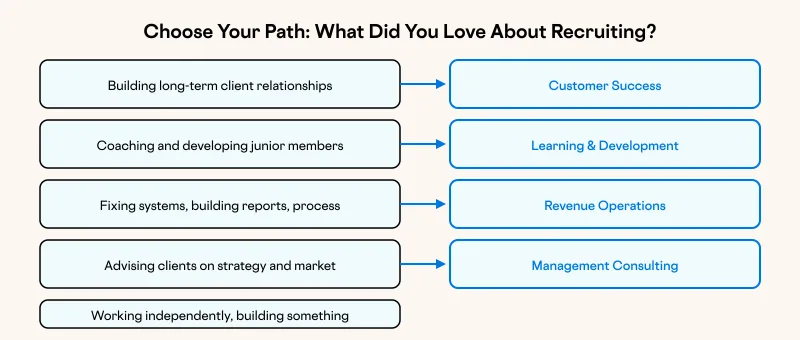
Each of these careers for ex recruiters rewards a different aspect of the recruiter skill set. Here is a quick mapping to help you narrow your focus:
| If You Loved This About Recruiting | Consider This Career |
|---|---|
| Building long-term relationships with clients | Customer success management |
| Coaching and developing junior team members | Learning and development |
| Fixing systems, building reports, optimising processes | Revenue operations |
| Advising clients on strategy and market dynamics | Management consulting |
| Working independently and building something of your own | Starting your own business |
| Managing complex stakeholder relationships | Any of the above |
For a skills-based approach to choosing your direction, the recruiter transferable skills guide maps every recruiter competency to the roles and functions where it applies most directly.
The Career Change Toolkit
Whichever of these careers for ex recruiters you choose, the mechanics of the transition are similar:
- Identify your target. Pick one path, not five. Scattered effort produces scattered results.
- Close the gap. Every transition has a skills gap. Be specific about yours and address it directly.
- Reframe your experience. Stop describing yourself as a recruiter. Start describing yourself in terms of the skills your target role values.
- Network into the function. Connect with people who do the job you want. Ask them how they got there and what they wish they had known.
- Set a deadline. Open-ended career exploration becomes permanent career indecision. Give yourself 90 days to choose a direction and 6 months to execute.
The complete career change from recruiting guide covers each of these steps in detail, including specific timeline recommendations and resume rewriting frameworks.
One More Option: A Different Kind of Recruiting Role
Before committing to one of these careers for ex recruiters, consider one thing: have you explored the full range of what recruiting can look like?
Executive search feels nothing like agency volume recruiting. In-house TA at a mission-driven company feels nothing like contract staffing. Independent recruiting feels nothing like working for a large firm. The profession is broader than most people appreciate, especially people who have only experienced one corner of it.
Browse recruiter roles across every specialisation and see if anything shifts your perspective. If nothing does, you have your confirmation. If something catches your eye, maybe the career change you need is smaller than you thought.
Frequently Asked Questions
What are the best careers for ex recruiters who do not want to do sales?
Among careers for ex recruiters, customer success management is the strongest option for recruiters who enjoy the relationship-building side of the work but want nothing to do with cold outreach or quota pressure. L&D is ideal if you prefer coaching and development over commercial targets. Both leverage core recruiter skills without requiring you to sell.
Can I pursue RevOps as one of the careers for ex recruiters with no technical background?
Yes, but you will need to invest in learning the tools. Salesforce Trailhead is free and excellent. Basic SQL can be learned in 2-4 weeks through online courses. The conceptual foundation (pipeline management, process optimisation, data-driven decision-making) is already part of your recruiter skill set. The technical skills are a gap you close through self-study, not a barrier that requires a degree.
How much do careers for ex recruiters pay compared to recruiting?
It varies by path and level. Customer success and L&D starting salaries are comparable to mid-level recruiter base salaries ($55K-$80K) but with more stability and less reliance on commission. RevOps pays well from the start ($60K-$85K) and scales quickly. Consulting and entrepreneurship have the highest ceilings but the most variable early-stage income. See the specific salary breakdowns in each section above.
Is it harder to pursue careers for ex recruiters after 10+ years?
It can feel harder psychologically because your identity and network are deeply rooted in the profession. But practically, 10+ years of recruiting experience translates to a more impressive set of transferable skills: senior stakeholder management, strategic advisory, commercial acumen, and resilience. Experienced recruiters often land more senior roles in their new function than less-experienced colleagues do.
What if I want to stay close to recruiting but not on a desk?
Consider roles in recruiting operations, talent analytics, employer branding, recruitment marketing, or recruitment technology sales. These positions sit at the edge of the recruiting profession and let you use your domain expertise without the day-to-day grind of requisition management. Talent acquisition positions often include these adjacent roles.
Can I test careers for ex recruiters before fully leaving?
Absolutely. Freelance consulting engagements, volunteer L&D projects within your current company, or part-time customer success advisory work can all be explored while you are still employed as a recruiter. Testing before committing reduces risk and gives you real data about whether a career path suits you.