
Recruiter to HR: How to Make the Transition in 2026

Moving from recruiter to HR is the most common career transition in the profession, and it makes sense on paper. You already work in the "people" space. You understand compensation, hiring processes, employment law basics, and candidate experience. HR feels like a natural next step.
But here is what catches most recruiters off guard: the recruiter to HR transition is not as simple as applying for HR generalist jobs with a recruiting resume. HR and recruiting overlap in vocabulary but diverge significantly in day-to-day work, skill requirements, and how success is measured. Recruiters who walk into HR expecting more of the same are often the ones who walk back out within 18 months.
This guide covers the reality of the switch. Which HR roles actually suit which recruiter backgrounds. What the skills gap looks like and how to close it. Which certifications carry weight and which are resume decoration. And the salary and career implications you need to understand before making the move.
Why Recruiters Move Into HR
The recruiter to HR pipeline is well-worn for good reasons. Understanding the common motivations will help you figure out if they match yours.
Stability. HR roles are more insulated from economic cycles than recruiting roles. When companies freeze hiring, recruiters get cut. HR teams shrink, but core functions like employee relations, compliance, and compensation still need people. If you have lived through recruiting layoffs, the relative stability of HR is genuinely appealing.
Scope. Recruiting is one part of the employee lifecycle. HR covers the entire thing: onboarding, development, performance, compensation, employee relations, offboarding, and organizational design. If you feel limited by only working on the "front door" of talent, HR gives you the full picture.
Pace. Agency recruiting in particular runs at a relentless pace. 80 calls a day. Pipeline reviews every Monday. Monthly billing targets. HR has its own pressures, but the day-to-day tempo is fundamentally different. If you want to think more strategically and move less frenetically, HR provides that.
The people work. Many recruiters got into the profession because they genuinely enjoy helping people. But recruiting, especially at agencies, often feels more like sales than service. HR roles like HR Business Partner or Employee Relations let you do deeper people work without the constant revenue pressure.
Which HR Roles Suit Which Recruiter Backgrounds
Not all HR roles are created equal, and not all recruiter backgrounds prepare you equally for each one. Here is the honest mapping.
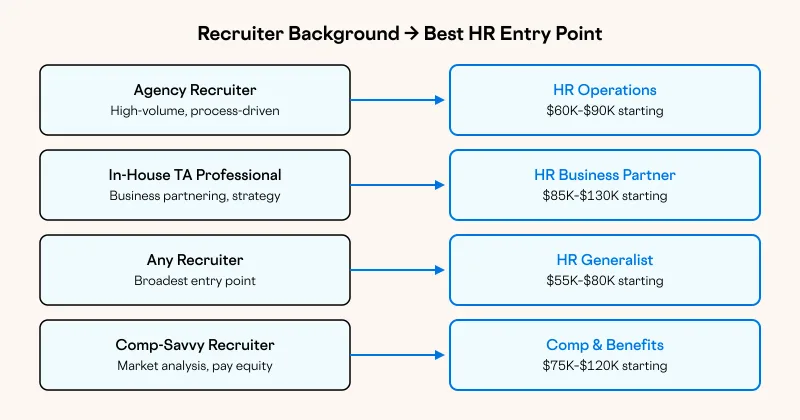
Agency Recruiter to HR Operations
If you ran a high-volume desk and were good at process, systems, and data, HR Operations is your strongest entry point. HR Ops manages HRIS systems, automates people processes, tracks compliance, and runs the operational backbone of the HR function. Your experience managing ATS platforms, building reports, and optimising workflows transfers directly.
Salary range: $60,000 to $90,000, depending on company size and location. You may take a hit on total compensation if you were a strong agency biller, but the base salary floor is higher and more predictable.
In-House TA Professional to HR Business Partner
If you worked as an in-house recruiter or talent acquisition specialist, you already understand business partnering. You sat in intake meetings with hiring managers. You advised on org design. You influenced headcount decisions. The HRBP role extends that partnership across the full employee lifecycle.
This is the most competitive HR transition because HRBP roles are desirable and typically require HR experience, not just TA experience. You will likely need a stepping-stone role (HR generalist or HR coordinator at a smaller company) unless you can demonstrate broad people experience beyond just hiring.
Salary range: $85,000 to $130,000 for experienced HRBPs at mid-market to enterprise companies.
Any Recruiter to HR Generalist
The HR generalist role is the broadest entry point and the most accessible for recruiters. Generalists handle a bit of everything: onboarding, benefits administration, employee relations, compliance, and sometimes recruiting. At smaller companies (under 200 employees), the HR generalist often IS the entire HR function.
This is the most common recruiter to HR transition path because it lets you build breadth quickly. The trade-off is that generalist roles at smaller companies tend to pay less and involve a fair amount of administrative work that may not feel like a step forward.
Salary range: $55,000 to $80,000, with significant variation by company size and geography.
Recruiter to Compensation and Benefits
If you were the recruiter who actually understood comp structures, ran market analyses to benchmark offers, and could talk intelligently about pay equity, compensation and benefits is a specialist path worth considering. This function requires analytical skills and attention to detail, both of which strong recruiters possess.
Salary range: $75,000 to $120,000. Compensation specialists at larger companies can earn significantly more, particularly in tech.
The Real Skills Gap (And How to Close It)
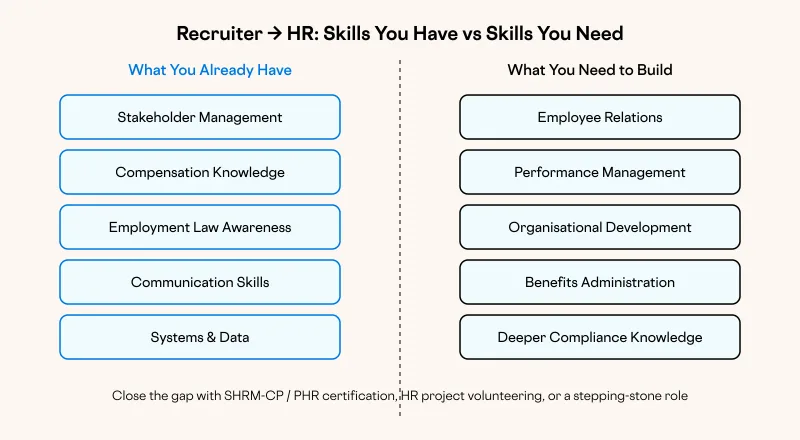
Here is the part that most "recruiter to HR" articles gloss over. There are genuine skill and knowledge gaps between recruiting and broader HR, and pretending they do not exist sets you up for failure.
What You Already Have
Your recruiting background gives you a head start in several areas:
- Stakeholder management. You have been managing hiring manager expectations for years. That translates directly to HR business partnering.
- Compensation knowledge. You understand market rates, offer structuring, and compensation negotiation. That is a real advantage.
- Employment law awareness. You know the basics of fair hiring practices, discrimination law, and compliance. You need more depth, but you are not starting from zero.
- Communication skills. Delivering difficult feedback to candidates, managing expectations, and navigating sensitive conversations are things you already do.
- Systems and data. If you managed an ATS, you can manage an HRIS. The specific platform changes, but the competency is the same.
What You Need to Build
- Employee relations. Handling grievances, disciplinary processes, performance improvement plans, and terminations is fundamentally different from recruiting. This is the biggest gap for most recruiters and the area where HR professionals feel most strongly that recruiters are "not one of us."
- Performance management. Understanding how to design and facilitate performance review cycles, calibration sessions, and development planning. Recruiting gives you almost zero exposure to this.
- Organisational development. Change management, culture initiatives, succession planning, and org design. These are strategic HR functions that require specific knowledge and frameworks.
- Benefits administration. Health insurance, retirement plans, leave policies, FMLA compliance. This is detail-heavy operational work that recruiters rarely touch.
- Deeper compliance knowledge. You know hiring compliance. You need to know employment compliance: wage and hour law, ADA, FMLA, workers' comp, COBRA, and more depending on your jurisdiction.
Closing the Gap
Option 1: Certification. The SHRM-CP from SHRM or the PHR from HRCI are the two credentials that carry the most weight with HR hiring managers. Both require study (150-200 hours typically) and cover the full breadth of HR knowledge. If you are serious about the recruiter to HR transition, one of these certifications significantly improves your credibility.
Option 2: Volunteering for HR projects. If your current company has an HR team, ask to participate in non-recruiting HR work. Sit in on employee relations cases (with appropriate permissions). Help with the benefits open enrollment process. Join the performance review calibration sessions. Real exposure beats textbook learning.
Option 3: Stepping-stone role. A role like "HR Coordinator" or "People Operations Coordinator" at a small-to-mid-size company gives you hands-on experience across the full HR spectrum. It may feel like a step backward. It is actually a step sideways that positions you for an HRBP or HR Manager role within 12-24 months.
Salary Trade-Offs: What the Numbers Actually Look Like
Let us be specific about the financial implications of moving from recruiter to HR.
| Transition | Typical Recruiter Comp | Typical HR Starting Comp | Year 2-3 HR Comp |
|---|---|---|---|
| Agency recruiter to HR generalist | $70K-$120K OTE | $55K-$75K base | $70K-$90K |
| Agency recruiter to HR ops | $70K-$120K OTE | $60K-$80K base | $80K-$100K |
| In-house TA to HRBP | $75K-$110K base | $80K-$100K base | $100K-$130K |
| In-house TA to HR generalist | $65K-$90K base | $55K-$75K base | $70K-$90K |
| Recruiter to comp specialist | $65K-$100K total | $75K-$95K base | $95K-$120K |
For agency recruiters, the honest truth is that you will likely take a total compensation hit in year one. If you are billing $150K or more, even a senior HR role will not match that immediately. The trade-off is stability, predictability, and a career ceiling that extends much further. HR Directors and VPs of People at mid-market companies earn $150K-$250K. Chief People Officers at larger organisations earn $200K-$400K. The long-term economics of HR can exceed recruiting, but the ramp is slower.
For in-house recruiters, the financial transition is often neutral or slightly positive, because TA and HR base salaries at the same company are comparable.
For detailed salary data across the recruiting profession, see the recruiter salary guide.
Step-by-Step Transition Plan
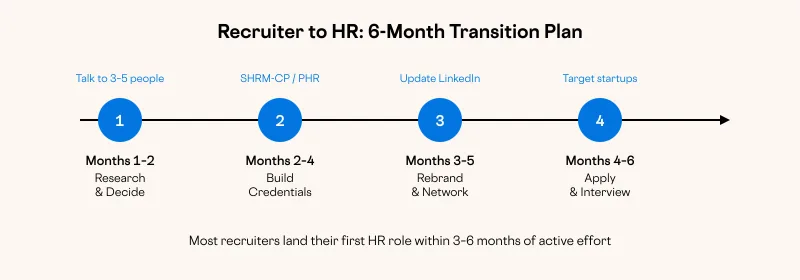
Here is the practical roadmap for moving from recruiter to HR.
Months 1-2: Research and Decide
Pick your target HR function (generalist, HRBP, ops, comp). Talk to 3-5 people who have made the transition. Join the SHRM community and attend a local chapter meeting. Read job descriptions for your target role and honestly assess where your gaps are.
Months 2-4: Build Credentials
Start studying for SHRM-CP or PHR. Volunteer for HR projects at your current company. Build a reading habit around HR topics: employee relations case studies, performance management frameworks, compensation benchmarking. Follow HR thought leaders who are practitioners, not influencers.
Months 3-5: Rebrand and Network
Update your LinkedIn headline and summary to reflect your HR direction. Frame your recruiting experience using HR language: "talent strategy" not "sourcing," "people operations" not "pipeline management," "stakeholder advisory" not "client management." Start networking specifically with HR professionals and recruiters who have already made the switch.
Months 4-6: Apply and Interview
Target companies where your recruiting background is an asset, not a liability. Startups and high-growth companies often value recruiters transitioning into HR because they understand the hiring pain points intimately. Smaller companies where the HR function needs building are ideal because they need someone who can hire AND do broader HR work.
Month 6+: Succeed in the Role
Once you land the role, resist the urge to retreat to what is comfortable. You will want to spend all your time on recruiting-adjacent tasks because that is where you feel competent. Force yourself into the uncomfortable HR work: your first employee relations case, your first performance calibration, your first benefits enrollment cycle. That is where the growth happens.
Common Mistakes Recruiters Make in the Transition
Applying for HR roles with a recruiting resume. If your resume leads with "Filled 45 roles in Q3" and "Built pipeline of 200+ candidates," you are speaking a language HR managers do not prioritise. Reframe around stakeholder management, process improvement, compliance, and strategic advisory. For specific language, see the recruiter transferable skills guide.
Underestimating the employee relations gap. This is the number one thing that separates recruiters from HR professionals in the eyes of HR leaders. If you cannot speak intelligently about handling a grievance, managing a PIP, or navigating a termination, you will not be taken seriously for senior HR roles.
Skipping the certification. Yes, certifications are imperfect. Yes, some great HR professionals never got certified. But for a recruiter trying to cross into HR, the SHRM-CP or PHR signals commitment and fills a knowledge gap. Skip it and you are giving hiring managers a reason to say no.
Aiming too high initially. Going from Senior Recruiter to HR Director is not a one-step move. Expect to lateral or even step down slightly in title for your first HR role, then move up from there. The investment pays off within 2-3 years.
Is the Recruiter to HR Switch Right for You?
Moving from recruiter to HR is the right decision if you want broader scope, more stability, and deeper involvement in the employee lifecycle. It is the wrong decision if you are just trying to escape the grind, because HR has its own grind, one that involves more bureaucracy, more compliance documentation, and more difficult conversations than recruiting.
The recruiters who thrive in HR are the ones who are genuinely curious about people problems beyond hiring. If you find yourself thinking about retention, development, culture, and organisational design, not just filling requisitions, HR is probably where you belong.
If you are still evaluating your options, the complete career change from recruiting guide covers all the paths available to you. And if you are considering staying in recruiting but want a better role, explore talent acquisition positions that sit at the intersection of recruiting and HR.
Frequently Asked Questions
Can I move from recruiting to HR without a certification?
Yes, but it is harder. Smaller companies and startups are more likely to hire based on experience and potential. Larger organisations typically want to see SHRM-CP, PHR, or equivalent on your resume. The certification is not a hard requirement, but it removes a common objection.
How long does the recruiter to HR transition take?
Most recruiters land their first HR role within 3-6 months of active effort. The full timeline depends on your target role, your existing experience, and your willingness to take a stepping-stone position. Going from agency recruiter to HRBP typically requires an intermediate step and may take 12-24 months total.
Will I be bored in HR after recruiting?
The pace is different, not necessarily slower. Employee relations crises, organisational restructurings, and performance cycles create their own intensity. But the adrenaline of closing placements and chasing commissions is not part of HR. If that is what you thrive on, HR may not be the right fit. Sales might be a better match.
Is the recruiter to HR pathway the same in the UK and US?
The fundamentals are the same, but the certifications differ. In the US, SHRM-CP and PHR are the standard. In the UK, CIPD qualifications (Level 5 or Level 7) are the equivalent. Employment law differences also mean the compliance knowledge you need to build varies by jurisdiction.
What is the best first HR role for an experienced recruiter?
HR Generalist at a company with 50-200 employees. You will get exposure to the full HR function, your recruiting skills will be valued because the company still needs someone who can hire, and the breadth of experience positions you for an HRBP or HR Manager role within 1-2 years.