
Recruitment Marketing 101: Attract Better Candidates

For most of recruiting history, finding candidates meant going out and finding them. You sourced, you cold-called, you worked your network. The candidates did not come to you. You went to them.
Recruitment marketing flips that model. Instead of chasing every candidate, you build systems that attract qualified candidates to your pipeline before you even have a specific role to fill. It is the difference between hunting and farming, and the best recruiters in 2026 do both.
If you are an experienced recruiter who has always relied on outbound sourcing and job board postings, this guide is your introduction to recruitment marketing. We will cover what it is, why it matters, and how to implement it practically, whether you work in-house or agency-side. No theory without action. Every section ends with something you can do this week.
What Is Recruitment Marketing (And Why Should Recruiters Care?)
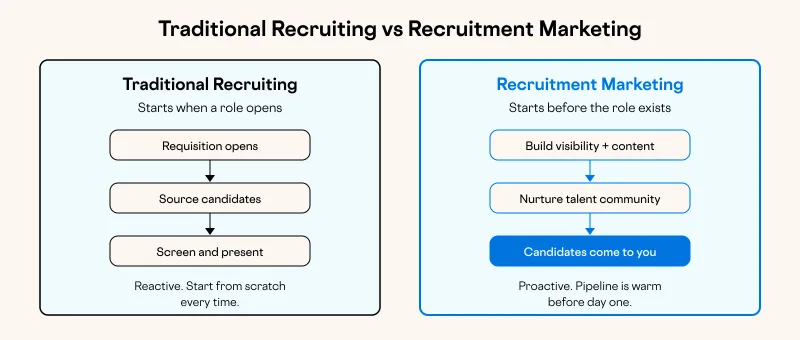
Recruitment marketing is the application of marketing strategies to attract and engage potential candidates before they enter your hiring pipeline. It sits upstream of traditional recruiting: where recruiting starts when a requisition opens, recruitment marketing starts long before.
Think of it this way. Traditional recruiting asks: "I need to fill this role. Where do I find candidates?" Recruitment marketing asks: "How do I build a pool of engaged, qualified people so that when a role opens, I already have candidates interested?"
The shift matters because the sourcing landscape has changed fundamentally. LinkedIn InMail response rates have dropped as candidates are bombarded with outreach. Job board postings generate volume but decreasing quality. The candidates you want, the ones who are good at their jobs and not actively looking, are harder to reach through traditional channels.
Recruitment marketing gives you an alternative channel. Instead of competing for attention in a crowded inbox, you build visibility and credibility that makes candidates come to you. According to Gartner's HR research, organizations that invest in recruitment marketing see 2-3x improvement in quality of hire and significant reductions in cost per hire.
This is one of the core pillars covered in our recruitment best practices playbook, and it works in conjunction with strong employer branding. Employer branding defines the message. Recruitment marketing delivers it.
Writing Job Ads That Actually Attract Good Candidates
The job advert is the most overlooked piece of recruitment marketing. Most recruiters post whatever the hiring manager wrote, maybe add a line or two, and call it done. Yet the job ad is often the first touch point a candidate has with the opportunity. It is marketing content, and it should be treated that way.
Lead with what candidates care about, not what you need. The traditional job ad structure (company description, responsibilities, requirements, benefits) puts the company first and the candidate last. Flip it. Open with what the candidate gets: compensation range, growth opportunity, team culture, the challenge they will solve. Then cover what you need from them.
Be specific about compensation. Job ads that include a salary range receive 30% more applications than those that do not, according to LinkedIn hiring data. In an era of pay transparency, hiding compensation is a candidate attraction failure. It signals either that the pay is not competitive or that the company is not transparent, neither of which attracts top talent.
Cut the requirements list. The classic 15-bullet requirements list kills candidate interest. Research consistently shows that women and underrepresented candidates are less likely to apply when they do not meet every stated requirement. Keep requirements to the genuine must-haves (5-7 bullets maximum) and separate them from nice-to-haves.
Write like a human. "We are seeking a dynamic, results-oriented professional to join our fast-paced team" is noise that repels good candidates. "You will own the entire customer onboarding process for our 50 largest accounts. The team is seven people, the budget is real, and the CEO actually listens to customer feedback" is copy that attracts them.
Action for this week: Take your three most active job postings and rewrite them using these principles. Track application quality before and after.
Social Recruiting: LinkedIn, Beyond LinkedIn, and What Actually Works
Social recruiting is the most accessible form of candidate attraction, and the most commonly done poorly. Posting a job link with "We're hiring!" is not social recruiting. It is advertising. Social recruiting is building relationships and visibility on social platforms so that candidates engage with you proactively.
LinkedIn (Still the Foundation)
LinkedIn remains the primary social recruiting platform for most recruiters. But using it effectively means going beyond job postings and InMail.
Build a content presence. Share industry insights, hiring trends, and genuine career advice. Recruiters who post regularly on LinkedIn build an audience of passive candidates who see them as trusted professionals, not just another person selling a role. You do not need to go viral. You need to be consistently visible to the professionals in your niche.
Engage in discussions. Comment thoughtfully on posts by industry leaders, candidates, and hiring managers. Each comment puts your name in front of potential candidates. Over time, this builds recognition that no amount of InMails can achieve.
Use LinkedIn Articles for evergreen content. A well-written article about salary trends in your niche, career path options in your industry, or interview preparation tips positions you as an authority. Candidates who read your content and then see a message from you about a role respond at dramatically higher rates.
Beyond LinkedIn
Depending on your niche, other platforms offer recruitment marketing opportunities that most recruiters ignore.
GitHub and Stack Overflow for technical roles. Engaging with developer communities, sponsoring open-source projects, or contributing to technical discussions builds visibility where developers actually spend their time.
Industry-specific forums and communities. Every niche has its gathering places: Slack communities, Discord servers, subreddits, professional associations. Being a helpful, visible presence in these communities is candidate attraction at its most effective.
TikTok and Instagram for early-career and creative roles. The fastest-growing recruitment marketing channels for Gen Z candidates are visual platforms. Short-form content about company culture, day-in-the-life videos, and authentic behind-the-scenes content performs well for employers targeting younger professionals.
Action for this week: Post one piece of genuine career content on LinkedIn (not a job ad). Track the engagement and note which connections interact with it.
Building a Talent Pipeline That Fills Itself
The ultimate goal of recruitment marketing is a talent pipeline that generates qualified candidates on an ongoing basis, not just when you post a job.
Talent communities. Build an email list or LinkedIn group of professionals in your niche. Share valuable content regularly: salary benchmarks, industry trends, career advice, and job market updates. When a relevant role opens, you have a warm audience to announce it to. A talent community of 500 engaged professionals in your specialty is more valuable than 10,000 LinkedIn connections.
Content marketing. Create content that your ideal candidates search for. Salary guides, career path articles, interview preparation tips, and industry analysis pieces attract organic search traffic from professionals in your niche. Every visitor is a potential candidate who found you because you provided something useful.
If you are looking for ideas on where to post recruiter-specific content, check our roundup of the best job boards for recruiters.
Referral nurturing. Treat referral generation as a systematic recruitment marketing activity, not a one-time ask. Contact placed candidates at 30, 60, and 90 days to check in and ask for referrals. Build a referral tracking system so you can measure which sources generate the best referral candidates.
Event-based pipeline building. Host or participate in industry events (virtual or in-person) related to your niche. Webinars, panel discussions, and networking events position you as a connected professional and generate candidate relationships that convert over months, not days.
Action for this week: Identify the top 10 candidates you have placed in the last year and send each one a check-in message with a referral ask.
Recruitment Marketing for Agency Recruiters
Agency recruiters face a unique recruitment marketing challenge: you are marketing multiple clients' opportunities simultaneously, and your personal brand needs to drive candidate engagement across all of them.
Your personal brand IS your recruitment marketing. Agency recruiters do not have a single employer brand to lean on. Instead, your reputation as a knowledgeable, trustworthy recruiter in your niche is the brand that attracts candidates. Invest in building that reputation through consistent content, genuine market knowledge, and reliable follow-through.
Niche specialization amplifies your efforts. A generalist agency recruiter struggles with recruitment marketing because the audience is too broad. A recruiter who specializes in fintech engineering, healthcare leadership, or legal hiring has a defined audience that is easier to reach and more responsive to targeted content.
Job ad quality is your differentiator. When multiple agencies are working the same role, the quality of your job advert determines which one attracts the strongest candidates. Invest time in writing compelling, specific, honest job ads that stand out from the generic postings your competitors are running.
Market intel as a marketing tool. Share salary benchmarks, hiring trends, and market analysis with your candidate pool. "Here is what the market looks like for senior engineers in your area this quarter" provides genuine value and keeps you top of mind.
For freelance recruiters building their own desk, recruitment marketing becomes even more critical. See our guide to marketing your freelance recruiting desk for specific strategies.
Measuring Your Recruitment Marketing Efforts
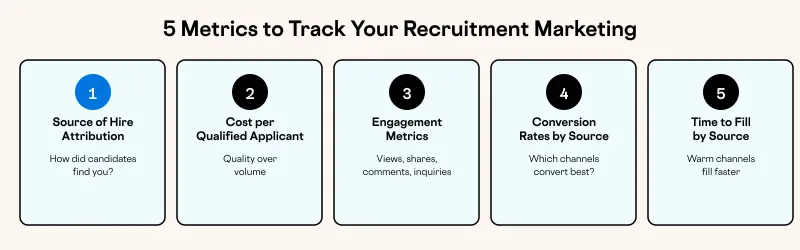
Recruitment marketing, like all marketing, must be measured to be improved. Here are the metrics that matter.
Source of hire attribution. Track how candidates found you. Did they come through a job posting, a social media post, a referral, a content piece, or a direct application to your talent community? This data tells you which recruitment marketing channels are working.
Cost per qualified applicant. Not cost per applicant, cost per qualified applicant. A channel that generates 100 unqualified applicants at $5 each is less effective than one that generates 10 qualified applicants at $30 each. Quality matters more than volume.
Engagement metrics. For content-based recruitment marketing, track views, shares, comments, and follow-up inquiries. A LinkedIn post that generates 50 comments from people in your target audience is more valuable than one with 500 generic likes.
Pipeline conversion rates by source. Compare how candidates from recruitment marketing channels convert through your pipeline versus other sources. If talent community candidates have a 40% interview-to-offer rate versus 15% from job boards, your investment in the community is clearly paying off.
Time to fill by source. Candidates from warm recruitment marketing channels (talent communities, referrals, content-driven applications) typically result in faster time to fill because they are already engaged and partially qualified.
Connect these metrics with your broader recruitment metrics dashboard to see how recruitment marketing drives your overall performance.
Recruitment marketing and direct sourcing techniques work best as complementary strategies. Marketing builds the inbound pipeline. Sourcing fills the gaps. Together, they create a resilient candidate generation engine.
Looking to put your recruitment marketing skills to work? Browse recruiting positions on Recruiter Roles or post a recruiter job to reach candidates who take their craft seriously.
FAQ
What is recruitment marketing vs traditional recruiting?
Traditional recruiting starts when a role opens: you source, screen, and present candidates. Recruitment marketing starts before the role exists. It builds awareness, engagement, and relationships with potential candidates so that when a role opens, you already have an interested pool to draw from. The best recruiters combine both approaches.
Do I need a budget for recruitment marketing?
Not necessarily. The most effective recruitment marketing tactics, LinkedIn content, referral nurturing, job ad optimization, and community engagement, are free or low-cost. Paid options like sponsored job posts, recruitment advertising, and event hosting can amplify results but are not required to get started.
How is recruitment marketing different from employer branding?
Employer branding defines the perception of a company as a place to work. Recruitment marketing uses channels and tactics to communicate that brand and attract candidates. Think of employer branding as the message and recruitment marketing as the delivery mechanism. Both are essential, and they are most effective when aligned.
What is the best social media platform for recruitment marketing?
LinkedIn remains the most effective platform for professional roles across industries. However, the best platform depends on your candidate audience. Technical roles benefit from GitHub and Stack Overflow presence. Creative roles respond well to Instagram and TikTok. Healthcare and education roles may require industry-specific communities. Go where your candidates spend time.
How long before I see results from recruitment marketing?
Quick wins, like rewriting job ads and optimizing your LinkedIn profile, can show results within weeks. Content-based strategies and talent community building typically take 3-6 months to generate consistent pipeline. Like all marketing, recruitment marketing compounds over time. The recruiter who starts today will have a significant advantage over competitors a year from now.