
How to Improve Candidate Experience (From a Recruiter's Perspective)

Every article about candidate experience is written for HR directors designing strategy. This one is written for the recruiter in the trenches who knows that candidate experience is not a corporate initiative. It is what happens when you pick up the phone, send that update, or decide whether a rejected candidate walks away respecting you or resenting you.
Here is the truth most candidate experience content avoids: recruiters do not deliver bad experiences because they do not care. They deliver bad experiences because they are juggling 30 open requisitions, their client has gone silent, and they are staring at a to-do list that makes responding to every candidate physically impossible without cutting into sourcing time.
That tension is real. This guide acknowledges it and works within it. You will find practical, time-efficient strategies for improving candidate experience without adding hours to your week. Because the recruiters who build a reputation for treating candidates well do not work harder. They build systems that make good communication the default, not the exception.
Why Candidate Experience Is a Recruiter Problem, Not Just an HR Problem
The phrase "candidate experience" gets tossed around in HR strategy decks and employer branding workshops. But the person who delivers, or fails to deliver, a good candidate experience is the recruiter. Every time.
A candidate's experience is shaped by specific, tangible moments: how quickly you responded, whether you prepared them for the interview, how you delivered bad news, and whether you followed up after they were rejected. These are recruiter actions, not corporate policies.
The business case is straightforward. According to Talent Board's Candidate Experience Research, candidates who report a positive experience are 38% more likely to accept a job offer and significantly more likely to refer others, regardless of whether they personally got the job. For agency recruiters, that translates directly to referrals and repeat placements. For in-house recruiters, it means a stronger employer brand and a warmer pipeline.
Poor candidate experience also has a cost that compounds. One bad experience does not just lose one candidate. It loses every person that candidate tells. In a connected industry like recruiting, word travels fast. Your reputation on the candidate side is as important as your reputation with clients.
Every best practice in this article ties back to the pillar guide on recruitment best practices, where candidate experience sits as one of the core pillars of a high-performing recruiting process.
The 5 Moments That Make or Break the Candidate Experience
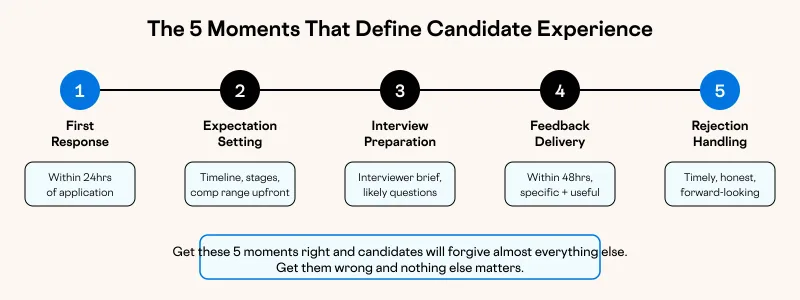
Candidate experience is not a continuous state. It is determined by a handful of critical moments. Get these right and candidates will forgive almost everything else. Get them wrong and nothing else you do matters.
Moment 1: First Response
The clock starts ticking the moment a candidate applies or responds to your outreach. Every hour of silence increases their anxiety and decreases their engagement.
The standard: Acknowledge every application or expression of interest within 24 hours. For candidates you have directly sourced, respond within the same business day. This does not need to be a detailed conversation. A brief message confirming receipt and outlining next steps is enough.
The system: Set up automated acknowledgment emails in your ATS for inbound applications. For sourced candidates, use a template that you personalize in 30 seconds. The goal is making first response automatic so it never falls through the cracks.
Moment 2: Expectation Setting
Candidates handle uncertainty poorly. Not because they are unreasonable, but because they are making career decisions with incomplete information. The recruiter who sets expectations clearly upfront eliminates the majority of frustration candidates feel during the process.
What candidates need to know early:
- Expected timeline from application to decision
- Number of interview stages and their format
- Who they will be speaking with and at what level
- What the compensation range looks like (if you can share it)
- When they will hear back and through what channel
Cover these in your first substantive conversation. It takes two minutes and prevents weeks of anxious follow-ups.
Moment 3: Interview Preparation
Preparing candidates for interviews is one of the highest-value activities a recruiter performs. It improves the candidate's performance, increases the hiring manager's satisfaction with the shortlist, and demonstrates to the candidate that you are genuinely invested in their success.
Effective preparation includes:
- Briefing on each interviewer's role, style, and priorities
- Common questions the interviewer asks and what they are looking for
- Specific areas where the candidate should prepare examples
- Logistics: format (video, phone, in-person), duration, dress code
- What to expect after the interview and when feedback will come
Agency recruiters who prepare candidates well consistently report higher interview-to-offer ratios. The candidate who walks in confident and well-briefed performs better. That reflects directly on the recruiter who prepared them.
Moment 4: Feedback Delivery
Feedback is where most recruiters fall down, not out of malice but out of discomfort and time pressure. Delivering negative feedback is awkward. Waiting until you have "definitive" news feels safer than sharing partial updates. But silence is the enemy of good candidate experience.
The rules:
- Deliver feedback within 48 hours of an interview. If the client has not provided feedback, tell the candidate that and give them a date by which you will follow up regardless.
- Be specific. "You were not selected" tells the candidate nothing. "The hiring manager was impressed by your technical depth but felt your experience managing cross-functional teams was lighter than the other finalist" gives them something useful.
- Deliver bad news by phone when possible. An email rejection after a face-to-face interview feels impersonal and disrespectful.
Moment 5: Rejection Handling
How you handle rejection is the ultimate test of your candidate experience. A well-handled rejection builds your professional reputation. A poorly handled one, or worse, no communication at all, destroys it.
What good rejection looks like:
- Timely. Within 48 hours of the decision, not after the new hire has started.
- Personal. Use their name. Reference something specific from their interactions.
- Honest. Give the real reason, framed constructively.
- Forward-looking. Offer to keep them in mind for future roles if you mean it. If you do not mean it, do not say it.
- Grateful. Thank them for their time. They invested hours in your process.
The candidates you reject today are the referral sources, repeat applicants, and industry connections of tomorrow. Treat every rejection as a long-term relationship investment.
Communication Templates That Do Not Sound Robotic
Templates get a bad reputation because most of them sound like they were generated by an ATS with no human oversight. Good templates save time while leaving room for personalization.
The key principle: Template the structure, personalize the details. Every communication should have a standardized format (greeting, purpose, next steps, sign-off) with personalized elements (their name, specific role details, individual feedback).
Status update template (when there is no news):
"Hi [Name], Wanted to give you a quick update on the [Role Title] position. The hiring team is still reviewing candidates from the latest round and I am expecting feedback by [specific date]. I will be in touch as soon as I hear anything. In the meantime, please do not hesitate to reach out if you have any questions. Best, [Your name]"
This takes 30 seconds to send and prevents the candidate from wondering whether they have been forgotten. The key element is the specific date commitment. It creates accountability for you and certainty for them.
Post-interview feedback template (positive):
"Hi [Name], Great news from your interview with [Interviewer Name]. They were particularly impressed by [specific thing]. The next step is [next step] which we are looking to schedule for [timeframe]. I will send you prep details once confirmed. Quick question before then: [relevant question about their timeline, competing offers, etc.]"
Post-interview feedback template (rejection):
"Hi [Name], I wanted to follow up on your interview with [Company]. Unfortunately, they have decided to move forward with another candidate. The feedback was [specific, constructive feedback]. This does not reflect on your capabilities. [Optional: genuine reason such as 'they went with someone who had direct experience in X']. I would genuinely like to keep you in mind for future roles in [relevant area]. I will reach out when something relevant comes up. Thank you for your time throughout this process."
Handling Bad News Without Burning Bridges
The moments when candidate experience matters most are the moments when things go wrong. Roles get put on hold. Clients change requirements mid-search. Offers get pulled. Budgets get cut. These are the situations that test your communication skills and determine your reputation.
When a role goes on hold: Call the candidate directly. Explain that the role is on hold (you do not need to explain internal politics) and give them a realistic assessment of whether it is likely to reopen. Do not string them along with "it should reopen soon" if you have no reason to believe that.
When requirements change and the candidate no longer fits: Be honest. "The role has shifted in scope and the requirements have changed. Based on what they are now looking for, I would not be putting you forward because [specific reason]. However, I think you would be an excellent fit for [alternative], and I would like to keep working with you."
When a client ghosts you (and therefore the candidate): This is the hardest scenario because you are delivering someone else's poor behavior. Be transparent: "I have been pushing for feedback and have not received it yet, which is frustrating. I want to be honest with you that the delay is on their end, not mine. I will escalate and get you an answer by [date]. If I cannot, I will let you know that too."
Honesty in difficult moments builds more trust than polished communication during easy ones. Candidates do not expect a perfect process. They expect a recruiter who respects their time and keeps them informed.
Measuring Candidate Experience on Your Desk
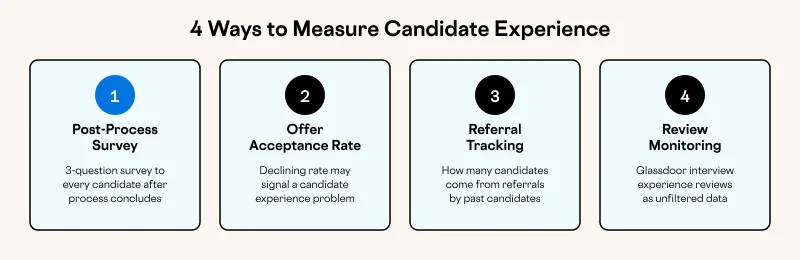
You cannot improve candidate experience without measuring it. The good news is that measurement does not require elaborate surveys or expensive tools.
Simple measurement approaches:
Post-process survey. Send a 3-question survey to every candidate after the process concludes (whether they were hired or rejected). Questions: How would you rate your overall experience? (1-5) Would you recommend this process to a colleague? (Yes/No) What could we have improved?
Offer acceptance rate as a proxy. Your offer acceptance rate reflects, in part, how well candidates were treated during the process. A declining acceptance rate may signal a candidate experience problem.
Referral tracking. Track how many candidates come from referrals by previous candidates. A healthy referral rate from past candidates is a strong signal that your candidate experience is working.
Glassdoor and review monitoring. For in-house recruiters, monitor interview experience reviews on Glassdoor. These are unfiltered candidate experience data.
Connect your candidate experience metrics with your broader recruitment metrics dashboard to see how experience correlates with outcomes.
The recruiter who treats candidate experience as a measurable, improvable system rather than a vague aspiration will consistently outperform. It is not about being "nice." It is about building a reputation that generates referrals, repeat business, and a pipeline of candidates who want to work with you.
If ghosting is the opposite of good candidate experience, understanding why it happens is essential. Read our honest take on why recruiters ghost candidates and how to stop.
Looking for a role where candidate experience is valued, not just talked about? Browse recruiter roles hiring now on Recruiter Roles.
FAQ
How do I improve candidate experience when I am managing 30+ requisitions?
Prioritize the five critical moments outlined above and automate everything else. Use ATS-driven status updates for inbound applicants, template your common communications, and block time specifically for candidate follow-ups. You do not need to give every candidate white-glove treatment. You need to make sure no candidate feels forgotten.
Does candidate experience really affect placement quality?
Yes. Candidates who have a positive experience are more likely to accept offers, less likely to accept counteroffers, and more likely to stay long-term. Talent Board research consistently shows that candidate experience correlates with offer acceptance rate and new hire retention. A great candidate experience is not just good manners. It is a performance driver.
What is the most common candidate experience mistake recruiters make?
Disappearing after rejection. Most recruiters handle the early stages well and then go silent once a candidate is out of the running. That final communication, the rejection, is the last impression you leave. Make it count with timely, honest, and constructive feedback.
How should I handle candidate experience differently for agency vs in-house recruiting?
The principles are identical. The execution differs slightly. Agency recruiters need to manage candidate experience across multiple clients with different processes, which makes templates and systems even more critical. In-house recruiters have more control over the end-to-end process but need to manage the hiring manager relationship to ensure candidates are not kept waiting unnecessarily.
Can automation hurt candidate experience?
Badly implemented automation absolutely can. Candidates receiving a generic "Dear Applicant" email three weeks after applying will not feel valued. But thoughtful automation, timely acknowledgments, stage-appropriate updates, personalized rejection emails, actually improves candidate experience by ensuring consistency. The goal is automation that frees you up for the moments that require a human touch.