
Sourcing Techniques Guide: Find Candidates Others Miss

Every recruiter can search LinkedIn. Type a job title, add a location filter, scroll through results, send some InMails. It works, barely. The problem is that every other recruiter is doing exactly the same thing, which means the strongest candidates are drowning in outreach while the hidden gems are invisible to most searches.
Advanced sourcing techniques separate the recruiters who consistently find great candidates from those who compete over the same overworked LinkedIn results. The right sourcing techniques do not just find more candidates. They find better ones. The techniques in this guide will help you find candidates your competitors miss entirely, and they work whether you are sourcing for technical roles, executive positions, or high-volume hiring.
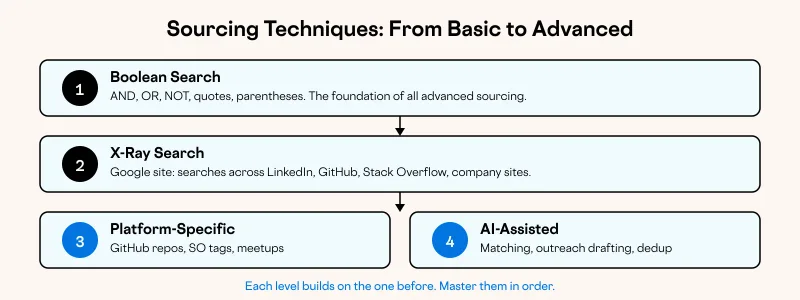
This is not a theoretical overview. Every section includes practical, copy-paste examples you can use immediately. We cover Boolean search fundamentals and advanced patterns, X-ray search across multiple platforms, tech-specific sourcing on GitHub and Stack Overflow, passive candidate outreach that actually gets responses, and AI-assisted sourcing tools that deliver real value versus those that are just hype.
If you are already a strong sourcer, start with the X-ray and platform-specific sections. If Boolean search still feels like a foreign language, start at the beginning. Either way, you will walk away with sourcing techniques you can put to work today. These are the sourcing techniques that top billers use and that most recruiting courses never teach.
Why Good Sourcing Separates Top Billers From the Rest
Before exploring techniques, let us establish why sourcing deserves serious investment.
The average recruiter spends roughly 30% of their time sourcing candidates. That is a significant chunk of your working week. A 20% improvement in sourcing techniques translates directly into more candidates screened, more shortlists submitted, and more placements made, without working longer hours.
More importantly, sourcing quality determines everything downstream. A recruiter who sources 10 mediocre candidates and screens them all spends more time and gets worse results than one who sources 5 excellent candidates through better channels. Top billers do not work harder at sourcing. They work smarter. They use sourcing techniques that surface higher-quality candidates from the start.
The sourcing techniques in this guide connect to the broader recruitment best practices framework as one of the core operational pillars. Get sourcing right and every other metric improves: time to fill decreases, offer acceptance rates increase, and candidate quality goes up.
Boolean Search: The Foundation (With Copy-Paste Examples)
Boolean search is the foundation of all advanced sourcing techniques for recruiters. Despite being decades old, it remains the most powerful sourcing techniques tool in a recruiter's sourcing arsenal because it gives you precise control over search results that no algorithm-based tool can match.
The Core Operators
AND narrows results by requiring both terms. Every term you add with AND makes your results more specific.
OR broadens results by accepting either term. Use OR to capture job title variations, industry synonyms, and alternative terminology.
NOT (or the minus sign -) excludes results. Use NOT to remove irrelevant results that clutter your search.
Quotation marks "" search for an exact phrase. Without quotes, search engines treat each word independently.
Parentheses () group terms together. Critical for complex searches where you combine AND and OR logic.
Practical Boolean Examples for Recruiting
Basic recruiter search on LinkedIn:
"talent acquisition" OR "recruiter" OR "TA manager" AND "SaaS" OR "technology"
This captures multiple job title variations while focusing on the SaaS/tech sector.
Senior engineering search with exclusions:
"senior software engineer" OR "staff engineer" OR "principal engineer" AND "Python" AND "AWS" NOT "manager" NOT "director" NOT "intern"
This targets individual contributors at senior levels with specific tech skills, excluding management roles and interns.
Sales leadership search with company targeting:
"VP Sales" OR "Vice President Sales" OR "Head of Sales" AND "B2B" AND ("Series B" OR "Series C" OR "growth stage") NOT "enterprise" NOT "Fortune 500"
This targets sales leaders at growth-stage companies specifically, excluding enterprise environments.
Healthcare recruiter search:
"healthcare recruiter" OR "medical recruiter" OR "nurse recruiter" OR "clinical recruiter" AND "agency" OR "staffing" NOT "coordinator" NOT "assistant"
This finds experienced healthcare recruiters in agency environments, excluding junior roles.
Advanced Boolean Patterns
The proximity trick (Google): Use AROUND(X) to find terms that appear within X words of each other. This is not available on LinkedIn but works in Google searches.
"machine learning" AROUND(3) "engineer" site: linkedin. com
This finds profiles where "machine learning" and "engineer" appear within 3 words of each other, capturing variations like "machine learning engineer," "engineer focused on machine learning," and similar.
The title-stacking technique: Candidates who have held multiple relevant roles are often the strongest fits. Search for profiles that contain multiple titles:
"software engineer" AND "tech lead" AND ("Python" OR "Java") site: linkedin. com
This finds candidates who have been both a software engineer and a tech lead, suggesting career progression and technical depth.
X-Ray Search: Finding Candidates on Any Platform
X-ray search uses Google to search within specific websites, bypassing those sites' own search limitations. Among all sourcing techniques, X-ray search is one of the most powerful and least used by the average recruiter.
The Basic Formula
site:[website] [search terms]
LinkedIn X-Ray (Bypass Connection Limits)
LinkedIn's free search is limited. X-ray search lets you find profiles you cannot reach through LinkedIn's own search.
site: linkedin. com/in "product manager" AND "fintech" AND "London"
Add additional filters:
site: linkedin. com/in "product manager" AND "fintech" AND "London" AND ("Revolut" OR "Monzo" OR "Starling" OR "Wise")
This finds product managers in London fintech, specifically at major fintech companies.
GitHub X-Ray (For Technical Roles)
GitHub profiles often reveal more about a developer's skills than their LinkedIn ever will. Active contributors show what languages they actually use, what projects they contribute to, and how they communicate.
site: github. com [language] [framework] [location]
Example:
site: github. com "Rust" AND "distributed systems" AND "contributions in the last year"
Or search for specific repository contributions:
site: github. com "kubernetes" AND "contributor" AND ("senior" OR "staff" OR "principal")
Stack Overflow X-Ray
Stack Overflow reputation scores and answer quality reveal genuine technical expertise. A developer with high reputation in a specific technology tag has demonstrated, verifiable skills.
site: stackoverflow. com/users [technology] [location]
Example:
site: stackoverflow. com/users "React" AND "TypeScript" AND "London"
Company Career Page X-Ray
Want to find employees at a specific company? X-ray their website for team pages, about pages, and blog author bios.
site:[company. com] "team" OR "about us" OR "our people" [role keyword]
This surfaces profiles that are not on LinkedIn or that show more detail about the person's role than their LinkedIn profile does.
Sourcing for Tech Roles: GitHub, Stack Overflow, and Beyond
Technical recruiting demands specialized sourcing techniques for finding developers because the best candidates are often the hardest to find through standard channels. They may not have updated their LinkedIn in years, but they are active daily on platforms where they build and share code.
GitHub Deep Sourcing
Go beyond basic profile searches. GitHub's advanced search lets you find contributors to specific repositories, which tells you exactly what technologies a person works with.
Find contributors to popular open-source projects:
Search for contributors to projects relevant to your role. If you are hiring for a Kubernetes role, find people who have contributed to the Kubernetes repository or related CNCF projects. These are verified practitioners, not people who listed a keyword on their resume.
Evaluate code quality. Review a candidate's repositories and contributions. Clean code, comprehensive documentation, and active maintenance signal a professional who takes their craft seriously.
Read the commit messages. How someone writes commit messages tells you about their communication skills and attention to detail. It sounds minor, but hiring managers consistently cite it as a quality signal.
Stack Overflow as a Sourcing Channel
Stack Overflow's job board has evolved, but the community remains a goldmine for sourcing.
Search by tag reputation. Filter users by their reputation in specific technology tags. A user with top-5% reputation in "Python" and "machine learning" has demonstrated expertise through hundreds of answers reviewed by peers.
Developer Stories and profiles. Many developers maintain detailed Stack Overflow profiles with career history, technology preferences, and job search status. These are high-intent candidates when they indicate they are open to opportunities.
Other Technical Sourcing Channels
Dev. to and Hashnode for developers who write about their work. These platforms surface people who communicate well about technical topics, a valuable signal for many roles.
Meetup and conference speaker lists. Speakers at technical conferences are visible, engaged professionals who have demonstrated domain expertise. Conference websites often list speakers with their bios and company affiliations.
Discord and Slack communities. Many technology communities maintain active Discord servers or Slack workspaces. Participating genuinely (not just posting jobs) builds relationships with potential candidates.
For recruiters specializing in tech roles, combining these sourcing techniques with conventional approaches is essential. Explore technical recruiter jobs to find roles where advanced sourcing skills are valued. Understanding the nuances of technical recruiter vs recruiter sourcing differences can also sharpen your approach.
Passive Candidate Outreach That Gets Replies
Finding candidates is only half the battle. Even the best sourcing techniques are useless if your outreach gets ignored. Getting them to respond is the other half. Passive candidates, those not actively looking, receive an average of 5-10 recruiter messages per week. Your outreach needs to stand out.
The Personalization Principle
Generic outreach gets ignored. Personalized outreach gets responses. The data is unambiguous: personalized messages receive 3-5x higher response rates than templates, according to LinkedIn recruiter data.
But "personalized" does not mean spending 20 minutes per message. It means including one specific detail that proves you looked at the person, not just their job title.
Weak personalization: "I noticed your experience in software engineering and thought you might be interested in this role."
Strong personalization: "I saw your contribution to the open-source data pipeline project at [Company]. The architecture decisions you described in your blog post about handling 10M daily events are directly relevant to what our client is building. Worth a conversation?"
The second message takes 60 seconds longer to write and is 5x more likely to receive a response.
The Subject Line
For email outreach, the subject line determines whether your message is opened. Avoid generic subjects like "Exciting Opportunity" or "Job Opening."
Effective subject lines:
- "[Specific Technology] role at [Company type], [Salary range]"
- "Your [specific project/contribution] caught my attention"
- "Quick question about [their area of expertise]"
The First Message Framework
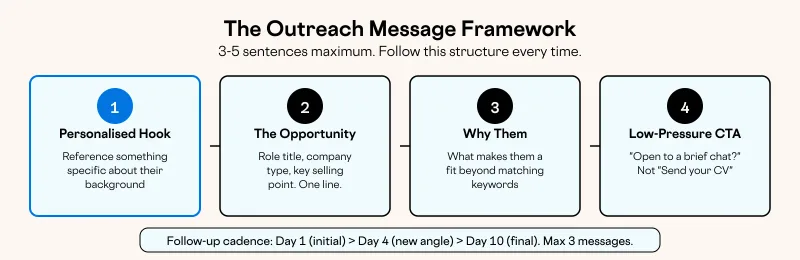
Keep initial outreach short (3-5 sentences maximum) and follow this structure:
- Personalized hook (1 sentence): Reference something specific about their background
- The opportunity in one line: Role title, company type, key selling point
- Why them specifically (1 sentence): What makes them a fit beyond just matching keywords
- Low-pressure CTA: "Would you be open to a brief chat?" not "Please send your CV"
The Follow-Up Cadence
Most recruiters send one message and give up. Data shows that the second and third follow-ups are often more effective than the first. A reasonable cadence:
- Day 1: Initial outreach
- Day 4: Follow-up (different angle or additional information)
- Day 10: Final follow-up (acknowledge you have reached out before, offer an easy out)
Three messages is the maximum. Beyond that, you are pestering, not persisting.
AI-Assisted Sourcing: What Works and What Is Hype
AI-powered sourcing techniques have exploded in the past two years, adding a new dimension to traditional sourcing techniques. Some deliver genuine value. Others are marketing hype wrapped in a subscription fee. Here is how to tell the difference.
What Works
AI-powered candidate matching tools that analyze job descriptions and surface candidates from databases based on skills, experience, and fit signals. These are genuinely useful for high-volume roles where manual sourcing is too slow. The best ones learn from your feedback (candidates you advance vs reject) and improve their recommendations over time.
Automated sourcing across platforms. Tools that search LinkedIn, GitHub, Stack Overflow, and other platforms simultaneously and deduplicate results save significant time. The value is in aggregation and deduplication, not in the AI's judgment of candidate quality.
Outreach personalization at scale. AI tools that pull specific details from a candidate's profile and incorporate them into outreach templates can maintain personalization quality while increasing volume. The output still needs human review, but the drafting time savings are real.
What Is Hype
"AI that replaces sourcing entirely." No current AI tool can replace a skilled sourcer. The tools augment and accelerate human sourcing. Any vendor claiming their AI eliminates the need for sourcers is overselling.
Predictive candidate scoring. Tools that claim to predict which candidates will be interested in your role based on behavioral signals are still too unreliable for high-stakes sourcing. Use them as one signal among many, not as your primary decision tool.
"One-click sourcing." Any tool that promises to find your perfect candidate with a single click is optimizing for ease, not quality. Good sourcing requires iteration: refining search terms, evaluating results, adjusting criteria. Tools that remove this iteration also remove the quality control.
The Right Approach to AI Sourcing
Use AI tools for what they are good at: speed, scale, and pattern recognition across large datasets. Use human judgment for what it is good at: evaluating cultural fit, reading between the lines of a resume, and crafting outreach that resonates with a specific person.
The recruiters who will thrive are not those who adopt every AI tool. They are the ones who combine AI efficiency with human-driven sourcing techniques, instincts, and relationship-building skills that no algorithm can replicate.
These advanced sourcing techniques complement the inbound approach covered in our recruitment marketing guide. The strongest recruiters build both muscles: outbound sourcing for immediate needs and inbound marketing for long-term pipeline.
Looking for a role where advanced sourcing skills are genuinely valued? Browse recruiter roles on Recruiter Roles to find your next opportunity.
FAQ
What is the most effective sourcing technique for hard-to-fill roles?
Boolean X-ray search combined with platform-specific sourcing (GitHub for tech, industry forums for niche roles) consistently outperforms standard LinkedIn sourcing for hard-to-fill positions. The key is going where your specific candidates spend time, which is rarely just LinkedIn. Combine this with highly personalized outreach that demonstrates genuine understanding of the candidate's background.
How do I learn Boolean search quickly?
Start with the three core operators: AND, OR, and quotation marks. Build a basic search for a role you are currently working and test it on Google and LinkedIn. Then add NOT to exclude irrelevant results and parentheses to group terms. Within a week of daily practice, you will be comfortable writing complex Boolean strings from scratch.
Is LinkedIn still the best sourcing platform?
LinkedIn is still the most comprehensive professional profile database, but it is not always the best starting point. For technical roles, GitHub and Stack Overflow often surface stronger candidates. For executive roles, industry publications, conference speaker lists, and board directories can be more effective. The best sourcers use LinkedIn as one tool among several, not their only channel.
How many sourcing channels should I use per search?
For standard searches, 2-3 channels are sufficient: LinkedIn plus one or two niche sources relevant to the role. For difficult-to-fill or senior roles, expand to 4-5 channels including X-ray search, platform-specific sourcing, and referral outreach. The law of diminishing returns applies: beyond 5 channels, you are typically spending more time searching than screening.
How do I improve my InMail response rate?
Personalization is the single biggest driver of InMail response rates. Reference something specific about the candidate's background that goes beyond their job title. Keep the message under 100 words. Include the key selling point of the role (usually compensation or a unique challenge). End with a low-pressure call to action. These sourcing techniques for outreach consistently deliver 20-30% response rates versus the 10-15% industry average.
Can I use the same sourcing techniques for agency and in-house recruiting?
The core sourcing techniques are identical. The difference is in scale and context. Agency recruiters typically source across multiple roles and clients simultaneously, so efficiency tools and Boolean templates that can be quickly adapted matter more. In-house recruiters source deeper for fewer roles and can invest more time in relationship-building and talent community approaches.