
Why Do Recruiters Ghost Candidates? And How to Stop

If you have ever applied for a job, had a great conversation with a recruiter, maybe even gone through multiple interviews, and then heard absolutely nothing: you are not alone. The question "why do recruiters ghost" is one of the most common complaints candidates have about the hiring process, and they are right to be frustrated by it.
But here is something most articles about why recruiters ghost will not tell you: the problem is not that recruiters are terrible people. Most recruiters who ghost candidates feel genuinely bad about it. The problem is systemic. The structures and incentives in recruiting, particularly in agency environments, create conditions where ghosting becomes the path of least resistance.
This article is an honest insider take on why recruiters ghost candidates. We are going to break down the systemic reasons and the no-excuse reasons, and then give recruiters a practical framework for stopping. If you are a candidate, this will help you understand what is happening on the other side. If you are a recruiter, this will help you build a communication system that prevents ghosting from happening on your desk.
The Uncomfortable Truth About Recruiter Ghosting
Let us start with a number that should bother every recruiter: according to a Indeed survey on ghosting in hiring, 77% of job seekers report being ghosted by a prospective employer since the onset of 2020. That is not a fringe complaint. That is the overwhelming majority of job seekers having a negative experience, and recruiters are the face of that experience.
Here is the uncomfortable part: many of those ghosted candidates were ghosted by recruiters who consider themselves good at their job. Understanding why recruiters ghost starts with acknowledging that this is not something only bad recruiters do. It is something that happens when the system breaks down, and the system breaks down regularly.
The question "why do recruiters ghost" deserves an honest answer, not a defensive one. So let us break it down.
Why It Happens: The Systemic Reasons
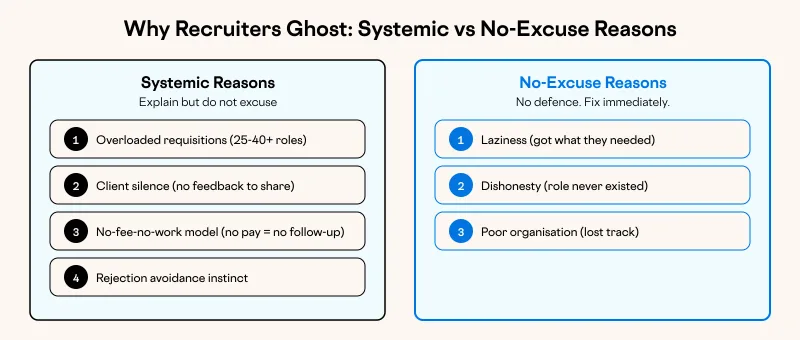
When people ask why do recruiters ghost, these are the reasons that do not excuse the behavior but explain how well-intentioned recruiters end up doing it anyway.
Overloaded Requisitions
The average agency recruiter manages 15-25 open roles simultaneously. Some manage 40+. When you are sourcing, screening, scheduling, and closing across that many searches, communication with every candidate at every stage becomes mathematically challenging.
Consider the numbers: 25 open roles, an average of 8-10 candidates in various pipeline stages per role. That is 200+ people who may be waiting to hear from you. Even a 2-minute status update for each candidate is nearly 7 hours of communication, more than an entire working day spent on updates alone.
The recruiters who manage this successfully are the ones with systems: templates, scheduled communication blocks, and ATS automation. Understanding why recruiters ghost at scale means understanding that the ones who do it are often those without those systems, drowning in a volume they cannot manage manually.
Client Silence
This is the most frustrating cause of ghosting for agency recruiters. You submit a shortlist, the hiring manager goes quiet for two weeks, and you are left with candidates asking for updates you cannot provide.
Many recruiters stop communicating with candidates when they have no news to share. They wait for "something to tell them." That wait can stretch from days to weeks to forever. The candidate perceives this as ghosting. The recruiter perceives it as "waiting for the client."
The fix is simple in theory, difficult in practice: communicate the absence of news. "I do not have an update yet, but I am following up with the client and will be in touch by Friday" takes 30 seconds and prevents weeks of candidate anxiety.
The No-Fee-No-Work Model
Agency recruiting on a contingency basis means you do not get paid until a placement is made. When a role is filled by another agency, goes on hold, or gets cancelled, every hour you spent on it was unpaid work. The economic incentive is to move immediately to the next viable role, not to circle back and close out candidates on dead searches.
This model is a central reason why recruiters ghost candidates in agency settings. It creates a perverse dynamic where the candidates who are most likely to be ghosted are the ones in processes that did not result in a placement. The recruiter has no financial incentive to follow up, and their time is better spent (from a billing perspective) on active roles.
The Rejection Avoidance Instinct
Delivering bad news is inherently uncomfortable. Telling a candidate they did not get the role, especially one who was enthusiastic and well-qualified, is one of the least pleasant parts of recruiting. The human instinct to avoid awkward conversations leads many recruiters to simply... not have them.
This is the most personal reason why recruiters ghost after an interview, and it is ultimately about discipline. But it is also the most common. Most ghosting starts with "I will call them tomorrow" and ends with "it has been three weeks, I cannot call now."
Why It Happens: The No-Excuse Reasons
Some reasons why recruiters ghost are understandable. Others are not. Here are the ones that have no defense.
Laziness
Some recruiters ghost because they simply cannot be bothered. They got what they needed from the candidate (a submission, a referral, market intelligence) and have no further use for the relationship. This is short-sighted, unprofessional, and far more common than the industry likes to admit.
Dishonesty
Some recruiters submit candidates to roles that do not exist or are already filled, using the candidate's CV to test whether a client will engage. When no engagement happens, the recruiter disappears. The candidate never had a real opportunity, and the recruiter never planned to follow up.
Poor Organization
Some recruiters ghost not out of malice but out of genuine disorganization. They lose track of where candidates are in the process, forget to log conversations, and eventually have no idea who they owe a call. By the time they realize, too much time has passed.
This is fixable. A well-used ATS, a daily task list, and a weekly pipeline review eliminate organizational ghosting entirely. If your system is the problem, fix the system.
What It Costs You as a Recruiter
Now that we have covered why recruiters ghost, let us look at what it costs. If the moral argument for not ghosting is insufficient, consider the business case.
Lost referrals. Every ghosted candidate is a referral source you have burned. The average professional has a network of hundreds of potential candidates. Ghost one person and you lose access to their entire circle.
Reputation damage. Recruiting is a small world, especially within verticals. Your reputation follows you. Candidates talk to each other. Hiring managers who were once candidates remember how they were treated. The recruiter with a ghosting reputation will find doors closing that they did not even know existed.
Repeat candidate loss. The best candidates are repeat candidates. Someone you placed once who comes back for their next move is the highest-quality pipeline source available. Ghost them after an unsuccessful search and they will never come back.
Glassdoor and public reviews. Candidates increasingly leave reviews about their interview experience. Ghost enough people and your client's Glassdoor profile (or your agency's) will reflect it. That damages your employer branding and makes future recruiting harder for everyone.
Personal wellbeing. Carrying the low-level guilt of unresolved candidate communications is a genuine source of stress for many recruiters. The relief of a clean pipeline where everyone has been contacted is underrated.
If you find yourself wondering whether the stress of ghosting is part of a bigger problem, it might be worth reflecting on whether recruiting is still a good career for you.
How to Stop Ghosting: A Practical Communication Framework
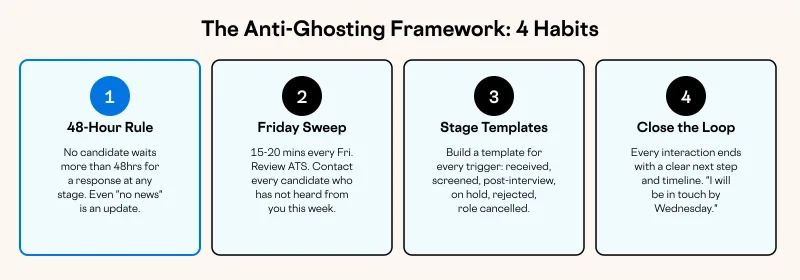
Understanding why do recruiters ghost is one thing. Stopping ghosting is not about willpower. It is about building a system that makes communication the default rather than the exception.
The 48-Hour Rule
Make a personal commitment: no candidate waits more than 48 hours for a response at any stage. If you do not have news, send an update saying you do not have news. If a process has stalled, communicate the stall. If a role is dead, tell them.
This single rule, followed consistently, eliminates 90% of ghosting.
The Friday Pipeline Sweep
Every Friday, spend 15-20 minutes reviewing your ATS. Identify every candidate who has not heard from you in the past week. Send each one a status update. This takes a fixed amount of time regardless of how busy your week was, and it ensures nothing slips through.
Stage-Based Templates
Build a template for every communication trigger:
- Application received: Auto-send via ATS
- Screening scheduled: Personal outreach
- After screening (moving forward): Phone call or personal email
- After screening (not moving forward): Template email with personalized opening
- Post-interview update: Phone call within 48 hours
- Process on hold: Personal email or call
- Role filled (candidate not selected): Personal email with feedback
- Role cancelled: Brief, honest email
Templates do not make you impersonal. They make you consistent. Personalize the key details, but let the structure handle the cadence.
The "Close the Loop" Habit
Every candidate interaction should end with a clear next step and timeline. "I will be in touch by Wednesday with feedback" gives both you and the candidate a specific expectation. If Wednesday comes and you have no feedback, you know you owe them a call. Without that commitment, candidates drift into limbo and you drift into ghosting.
Automation for Scale
If you are managing a high-volume desk, use ATS automation for status updates at standardized stages. Automated messages at key pipeline stages ensure candidates are never in the dark, even when you are buried in other tasks. Save personal communication for the moments that matter: interview prep, offer discussions, and rejections.
What to Do When YOUR Client Ghosts You
Agency recruiters often find themselves in the middle of someone else's ghosting. The client stops responding, and suddenly you are the one with no update for the candidate.
Do not absorb the silence. When candidates ask why do recruiters ghost after interview rounds, the answer is often that the recruiter is waiting on a client who went quiet. When that happens, communicate it to the candidate. You do not need to throw the client under the bus, but you should be transparent: "I have followed up with the hiring team and am waiting on their feedback. I will chase again on Wednesday and have a definitive update for you by Thursday."
Set deadlines with clients. "If I do not hear from you by Friday, I will let the candidates know we are moving on." This creates urgency on the client side and gives you a clear commitment to the candidate.
Know when to cut. If a client has been unresponsive for 10+ business days despite your follow-ups, close the search with candidates. "I have not been able to get a response from the hiring team and I do not want to waste your time. I would like to keep your details for future roles with other clients who respect the process."
That last sentence is powerful. It positions you as the candidate's advocate, maintains the relationship, and signals to the client (if they ever re-engage) that their behavior has consequences.
This communication discipline is part of the broader set of recruitment best practices that separate consistently good recruiters from those who burn through relationships.
Building a strong candidate experience is fundamentally about doing the opposite of ghosting: communicating consistently, setting expectations, and treating every candidate interaction as a long-term relationship investment.
If you are a recruiter who takes communication seriously and wants to work somewhere that values it, browse recruiter positions on Recruiter Roles.
FAQ
Why do recruiters ghost after an interview?
Post-interview ghosting usually happens because the recruiter is waiting on client or hiring manager feedback that never comes. Rather than communicating the delay, the recruiter waits for "something to say." Days become weeks, and eventually the silence feels too long to break. The fix is simple: communicate the absence of news rather than waiting for news to communicate.
Is recruiter ghosting getting worse?
Data suggests yes. The combination of higher requisition loads, tighter labor markets, and increased use of automation (which paradoxically can make personal follow-up feel less urgent) has contributed to an increase in ghosting since 2020. However, awareness of the problem is also increasing, and more recruiting organizations are building anti-ghosting practices into their processes.
What should candidates do when a recruiter ghosts them?
Send one follow-up email after a week of silence. If you get no response after two follow-ups, move on. Do not take it personally. It almost certainly reflects the recruiter's system (or lack of one) rather than your candidacy. Consider leaving a constructive Glassdoor review about the interview experience if the company was involved.
How do I stop ghosting if I am genuinely overwhelmed?
Start with the Friday Pipeline Sweep. Spend 15-20 minutes every Friday contacting every candidate who has not heard from you in the past week. This single habit will prevent most ghosting. If your requisition load makes even basic communication impossible, that is a capacity conversation to have with your manager, not a reason to ghost candidates.
Can ATS automation solve the ghosting problem?
It can solve part of it. Automated stage-based updates ensure candidates know where they stand in the process. But the high-stakes moments, rejection calls, process delays, offer discussions, still require human communication. Automation is the foundation, not the complete solution.
Does ghosting hurt agency recruiters' billings?
Yes. Ghosted candidates do not return when you have a role that fits them perfectly six months later. They do not refer their connections. They may leave negative reviews that hurt your client's employer brand and your agency's reputation. The short-term time saved by ghosting is far outweighed by the long-term cost in lost relationships and damaged reputation.