
Employer Branding for Recruiters: How to Sell Roles Better

Most employer branding content is written for CMOs and TA directors. It talks about employer value propositions, brand audits, and multi-channel campaigns that require a marketing team and a six-figure budget. None of that helps the recruiter who needs to fill three roles this month and is struggling to get candidates excited about the company.
This guide is written for you. The recruiter who IS the employer brand in every candidate conversation. Whether you are selling your own company's brand in-house or representing a client's brand on the agency side, you are the person who makes or breaks a candidate's perception of the opportunity.
Employer branding is not about careers pages and Instagram accounts. For recruiters, it is about knowing how to articulate what makes a role and a company compelling in a way that resonates with the specific candidate sitting in front of you. It is about authenticity, specificity, and the ability to answer the question every good candidate is really asking: "Why should I work there instead of somewhere else?"
The stakes are high. LinkedIn research shows that companies with a strong employer brand see a 50% reduction in cost per hire and attract 50% more qualified applicants. For individual recruiters, a well-communicated employer brand is the difference between chasing candidates and having them come to you.
What Employer Branding Actually Means for Recruiters (Not HR)
Strip away the corporate strategy language and employer branding comes down to a simple question: What is the honest, compelling story about working at this company?
Notice the word "honest." Employer branding is not about spinning a narrative or hiding the downsides. Candidates in 2026 are sophisticated. They check Glassdoor. They search Reddit. They message current and former employees on LinkedIn. Any gap between your pitch and reality will be discovered, and it will cost you credibility.
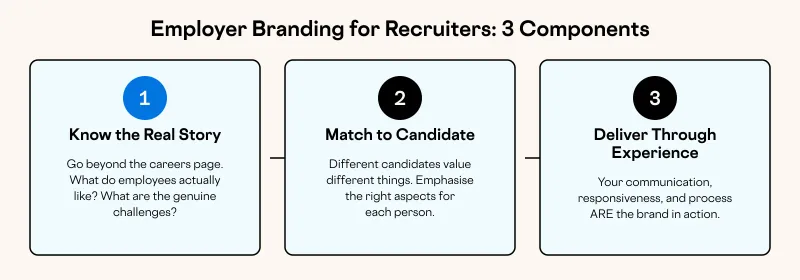
For recruiters, employer branding breaks down into three practical components:
Know the real story. Before you can sell a company's brand, you need to understand it beyond the careers page. What do employees actually like about working there? What are the genuine challenges? What is the management style? What does the day-to-day look like? The recruiter who can answer these questions with specificity and honesty is infinitely more credible than the one reading from a job description.
Match the brand to the candidate. Different candidates value different things. A senior engineer cares about technical challenges and autonomy. A mid-career recruiter cares about commission structure and desk quality. A marketing director cares about budget and team size. Effective employer branding is not one message for everyone. It is knowing which aspects of the brand to emphasize for each candidate.
Deliver the brand through experience. Your communication style, responsiveness, and professionalism are part of the employer brand. A company that claims to be "innovative and fast-moving" but takes three weeks to schedule a first interview is contradicting its own brand through the recruiting process. As the recruiter, you are responsible for making the candidate's experience consistent with the brand promise.
This connects directly to the broader recruitment best practices framework, where employer branding is one of the core pillars of a high-performing recruiting function.
Agency Recruiters: Selling Someone Else's Brand
Agency recruiters face a unique employer branding challenge: you are selling a brand you do not own. You cannot change the company's Glassdoor reviews, redesign their careers page, or restructure their interview process. But you can become the most credible voice on what it is actually like to work there.
Do your homework. Before taking on a new client or a new role, spend 30 minutes building a genuine understanding of their employer brand. Read their Glassdoor reviews (all of them, not just the 5-star ones). Check LinkedIn for employee posts and engagement. Look at their social media presence. Search for press coverage. This research pays for itself in every candidate conversation.
Ask your client the hard questions. The best agency recruiters interview their clients about culture, not just requirements. Ask: "If I am talking to a strong candidate who has two other offers on the table, what is the honest reason they should choose you?" The client's answer, or their struggle to answer, tells you everything about whether the employer brand is defined or vague.
Build case studies from your placements. Every successful placement is an employer branding data point. Follow up with placed candidates after 90 days and ask: "What has surprised you about working here? What matched what we discussed during the process?" Use these insights (with permission) in future candidate conversations. A recruiter who can say "I placed someone in this team six months ago and here is what they told me about the experience" has a powerful employer branding tool.
Be honest about the downsides. If you know the company has a long interview process, say so upfront. If their Glassdoor reviews mention issues with work-life balance, acknowledge it and explain what the company is doing about it (or not). Candidates trust recruiters who are transparent about challenges. They distrust those who pretend everything is perfect.
In-House Recruiters: Becoming the Brand Ambassador
In-house recruiters have more control over employer branding, but that control comes with responsibility. You are not just representing the brand. You are shaping it through every candidate interaction.
Partner with your marketing team. If your company has employer branding content, use it. But go beyond the polished assets. Work with marketing to develop recruiter-specific materials: talking points for different candidate segments, honest answers to common Glassdoor complaints, and employee stories that illustrate culture rather than just claiming it.
Create content that candidates find. The most effective in-house recruiters build their own content presence. Write LinkedIn posts about what your team is working on. Share behind-the-scenes glimpses of company culture. Comment on industry discussions. When a candidate Googles you (and they will), they should find evidence that you are a genuine insider, not just a corporate mouthpiece.
Close the feedback loop. Track where candidates mention your employer brand in conversations. What aspects of the brand resonate? What concerns do they raise? This data is gold for your marketing and leadership teams, and it positions you as a strategic partner rather than a requisition filler.
Own the candidate experience. For in-house recruiters, the candidate experience IS the employer brand in action. Every scheduling delay, every unanswered email, every poorly prepared interviewer undermines the brand message. Improving candidate experience is the most impactful employer branding activity an in-house recruiter can undertake.
Employer Branding on a Budget
You do not need a dedicated employer branding team or a six-figure budget to build a compelling employer brand. The most effective employer branding strategies for recruiters are free or low-cost.
Employee stories over stock photos. A 3-minute video of a real employee talking about their experience is more compelling than any polished corporate video. Even a text-based employee Q&A shared on LinkedIn is more authentic than a branded careers page. Ask employees to share their genuine experiences. Do not script them. Real beats polished every time.
Glassdoor response management. If your company has negative Glassdoor reviews, respond to them thoughtfully. Acknowledge concerns, explain what has changed (if anything), and thank the reviewer. Candidates read the responses as much as the reviews. A company that engages honestly with criticism demonstrates more about its culture than any marketing campaign.
LinkedIn employee advocacy. Encourage employees to share their work experiences on LinkedIn. This does not need to be a formal program. Simply asking team members to post about projects, team achievements, or company events creates organic employer branding content that candidates trust.
Recruiter personal brand. Your own LinkedIn presence is part of the employer brand, especially for in-house recruiters. Candidates evaluate the recruiter as a proxy for the company. A recruiter who shares thoughtful content about their industry, engages in genuine discussions, and presents themselves professionally is selling the employer brand without ever mentioning it explicitly.
Referral-driven branding. Your best employer branding asset is your existing employees and placed candidates. When a placed candidate refers a friend, they are essentially endorsing the employer brand. Build referral mechanisms that make it easy for happy employees and candidates to spread the word.
How to Talk About Culture Without Sounding Like a Brochure
"We have a great culture" is the most meaningless sentence in recruiting. Every company claims great culture. No candidate is persuaded by it.
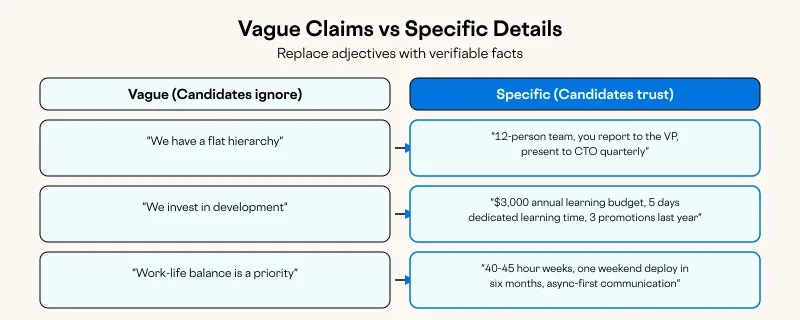
Effective employer branding replaces vague claims with specific, verifiable details:
Instead of "We have a flat hierarchy": "The team has 12 people, your manager is the VP of Engineering, and you will present directly to the CTO quarterly. Most decisions happen in a weekly team standup where everyone has equal input."
Instead of "We invest in development": "Every engineer gets a $3,000 annual learning budget and 5 days of dedicated learning time. Last year, three people on the team were promoted. The typical path from mid-level to senior takes 18-24 months."
Instead of "Work-life balance is a priority": "The standard work week is 40-45 hours. There has been one weekend deployment in the last six months. The team uses async communication for most decisions, so you are not in meetings all day."
Instead of "We have a diverse and inclusive team": "The engineering team is 40% women. The company publishes its pay equity data annually. The ERGs have actual budget and executive sponsorship, not just a Slack channel."
Specificity is the heart of effective employer branding. Candidates trust numbers, examples, and verifiable details. They distrust adjectives. Every time you are tempted to describe a company's culture with an adjective, replace it with a specific fact.
Understanding the relationship between employer branding and talent acquisition vs recruitment can also help you position the story more strategically, especially when speaking with senior candidates who understand the distinction.
Employer Branding Examples That Work
Let us look at employer branding approaches that top recruiters use effectively, broken down by scenario.
Competing against a higher-paying offer: "The base at [Company] is $115K versus the $125K you have from [Competitor]. Here is why that gap might not matter: the equity package vests over 3 years and at the current valuation that is worth $40K. The promotion cycle is 12 months versus [Competitor]'s 18-24 months. And the team you would join shipped three products last year, which gives you portfolio material that accelerates your career beyond either salary number."
Overcoming a negative Glassdoor reputation: "You have probably seen the Glassdoor reviews. Here is the context: the company went through a rough restructuring 18 months ago and most of those reviews are from that period. Since then, they have brought in a new VP of People, restructured the engineering org, and reduced attrition from 25% to 12%. The three people I placed there in the past year are all still there and positive. I can connect you with one of them if you want an unfiltered perspective."
Selling a lesser-known company: "You have not heard of them because they are B2B infrastructure. Not flashy, but the engineering problems are genuinely hard. They process 2 billion API calls a day, the team is 15 engineers, and they are profitable. No layoff risk. The last three engineers who joined came from [Well-Known Company] and stayed because the autonomy and technical depth are better."
Each of these examples uses specifics, acknowledges reality, and tells a compelling story. That is employer branding in practice.
Measuring Whether Your Employer Branding Efforts Work
Employer branding can feel intangible, but its impact is measurable.
Inbound application quality. Track the ratio of qualified to unqualified inbound applicants. Strong employer branding increases the proportion of qualified applicants because the brand message self-selects the right candidates.
Offer acceptance rate. Candidates who believe in the employer brand are more likely to accept offers, even when competing offers have slightly better compensation. Track acceptance rate alongside your employer branding efforts.
Source of hire from branded channels. Are candidates citing your LinkedIn posts, employee content, or Glassdoor profile as how they found you? Track these attribution data points.
Time to fill. Strong employer branding reduces time to fill by creating a warmer candidate pool. If your time to fill decreases as you invest in employer branding, the correlation is meaningful.
Candidate referral rate. The percentage of candidates who came through referrals from existing employees or past candidates is a proxy for employer brand strength. People refer to companies they genuinely believe in.
Connect these measures with your broader recruitment metrics dashboard to see how employer branding drives your overall performance.
Recruitment marketing is the natural complement to employer branding. Once you know what story to tell, recruitment marketing is how you tell it at scale across channels.
If you are looking for a role where you can put these employer branding skills to work, explore talent acquisition roles or browse all recruiter positions on Recruiter Roles. For employers looking to attract top recruiting talent, post a recruiter role with us.
FAQ
Is employer branding the recruiter's job or marketing's job?
Both, but the recruiter is on the front line. Marketing may create the assets, define the EVP, and run campaigns. But the recruiter delivers the employer brand in every candidate conversation, interview prep session, and rejection email. A recruiter who waits for marketing to "fix" the employer brand will be waiting a long time. Take ownership of how you communicate the brand in your own interactions.
How do I build an employer brand for a client I do not work at?
Research is everything. Read every Glassdoor review. Talk to employees (including people you have placed there). Ask the hiring manager detailed questions about culture, team dynamics, and growth opportunities. Visit the office if you can. The goal is building enough first-hand and second-hand knowledge to speak authentically about the employer brand, not just read from a brief.
What is the biggest employer branding mistake recruiters make?
Overselling. Recruiters who paint an unrealistically positive picture of a company create a trust gap that damages the candidate experience, increases early attrition, and hurts their own reputation. The best employer branding is honest, specific, and balanced. Acknowledging challenges while framing the genuine strengths is always more credible than pretending everything is perfect.
How long does it take to build a strong employer brand?
Employer branding is a compounding investment. You will see early results, better candidate engagement, improved offer acceptance, within 3-6 months of consistent effort. A truly differentiated employer brand that candidates actively seek out takes 12-18 months. The key word is consistent. Sporadic efforts produce sporadic results.
Can a small company compete with big-brand employers on employer branding?
Absolutely. Smaller companies can often win on specifics that large companies cannot offer: direct access to leadership, faster promotion paths, broader responsibilities, visible impact, and less bureaucracy. The employer branding strategy for a small company should lean into these advantages rather than trying to compete on perks and brand recognition. Candidates who value autonomy and growth over brand names will self-select, which is exactly what you want.
What is the difference between employer branding and recruitment marketing?
Employer branding is the perception candidates have of a company as a place to work. It is the "what": the story, the reputation, the employee experience. Recruitment marketing is the "how": the channels, tactics, and campaigns used to communicate that brand and attract candidates. Employer branding defines the message. Recruitment marketing delivers it.