
How to Start a Recruitment Company From Home

You do not need an office to start a recruitment company from home. You need a phone, a laptop, an internet connection, and the ability to bill. Everything else is optional.
Starting a recruitment company from home is the leanest path to agency ownership. No commercial lease. No office furniture budget. No commute eating into your billing hours. Recruiters who start a recruitment company from home have exploded in popularity since 2020, and the stigma that once existed around not having a "proper office" has all but disappeared. Clients care about your results, not your address.
This guide covers the practical specifics of how to start a recruitment company from home: the workspace setup, the legal requirements, the technology, the client acquisition, and the honest challenges you will face working from your spare bedroom. If you want the comprehensive guide to starting a recruiting business of any model, read our full how to start a recruiting business guide. This article focuses specifically on the home-based path.
Setting Up Your Home Office
When you start a recruitment company from home, your office needs to be functional, professional, and separate from the rest of your life. That last point is not just about productivity. It has tax implications.
The Essentials
- Dedicated workspace: A room with a door you can close. Not the kitchen table, not the sofa, not a shared space. You need somewhere you can take client calls without background noise and distractions.
- Professional backdrop: For video calls with clients and candidates, your background matters. A clean, uncluttered wall, a bookshelf, or a professional virtual background. Invest in this: first impressions over Zoom are real.
- Reliable internet: Minimum 50 Mbps download speed. Video calls, cloud-based ATS, LinkedIn Recruiter, and sourcing tools all demand bandwidth. If your home internet is unreliable, upgrade it before you start.
- Quality audio: A good headset or USB microphone. You are on calls 4-6 hours a day. Laptop speakers and built-in microphones sound unprofessional and cause fatigue. Budget $100-$200 for a proper setup.
- Ergonomic setup: A proper desk and chair. You will be sitting for long hours. Invest in ergonomics now or pay for it later with back problems.
The Home Office Tax Deduction
In the US, you can deduct home office expenses if the space is used "regularly and exclusively" for business. This means a dedicated room or clearly defined workspace.
The simplified method allows a deduction of $5 per square foot (up to 300 square feet, or $1,500). The actual expense method lets you deduct a percentage of your rent/mortgage, utilities, and insurance based on the proportion of your home used for business. Consult a tax professional to determine which method saves you more. The IRS home office deduction guide has the specifics.
Legal and Business Setup
Whether you start a recruitment company from home or from an office, the legal requirements are the same. The home-based model does not change what you need to register and insure.
Business Formation
To start a recruitment company from home, register an LLC in your state. The SBA's guide to choosing a business structure is a good starting point. An LLC protects your personal assets and provides a professional business entity for contracts and invoicing. Cost: $50-$500 depending on your state.
Use your LLC's legal name on all contracts, invoices, and terms of business. You can register a DBA (Doing Business As) if you want a different brand name from your LLC name.
Business Address
You need a professional business address that is not your home address. Options:
- Virtual office service: Companies like Regus, WeWork, and local providers offer business addresses with mail handling for $50-$150/month. Some include access to meeting rooms.
- PO Box: Functional but less professional than a street address. Some clients and vendors do not accept PO Boxes.
- Registered agent service: Required for your LLC registration anyway, many offer mail forwarding as an add-on.
A virtual office address gives you a professional presence in a desirable business district without the cost of actual office space. It also keeps your home address off public business filings.
Insurance
The same insurance requirements apply whether you work from home or an office:
- Professional liability (E&O): $1,000-$3,000/year
- General liability: $500-$1,000/year
- Cyber liability (recommended): $500-$1,500/year: particularly important when handling candidate data from a home network
Check your homeowner's or renter's insurance policy. Most standard policies do not cover business equipment or business-related liabilities. You may need a rider or separate business property policy.
Technology for Home-Based Recruiting
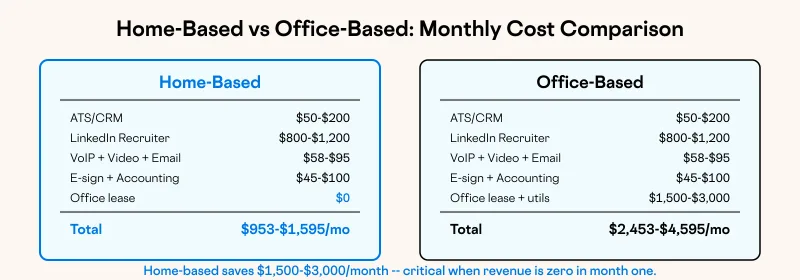
Your tech stack is even more critical when you start a recruitment company from home because technology replaces the infrastructure that an office provides.
Core Stack
| Tool | Purpose | Monthly Cost |
|---|---|---|
| ATS/CRM (Loxo, Recruit CRM) | Pipeline management | $50-$200 |
| LinkedIn Recruiter | Sourcing and networking | $800-$1,200 |
| VoIP phone system (RingCentral, Dialpad) | Professional phone presence | $30-$50 |
| Video conferencing (Zoom Pro) | Client and candidate meetings | $13-$20 |
| Email (Google Workspace) | Professional communication | $15-$25 |
| E-signature (DocuSign, PandaDoc) | Contracts and terms | $15-$30 |
| Accounting (QuickBooks, Xero) | Invoicing and financials | $30-$70 |
Total monthly cost: $953-$1,595
That is your entire business infrastructure for under $1,600/month. Compare that to a small office lease ($1,500-$3,000/month before utilities, furniture, and commuting costs) and the advantage of running a recruitment company from home is obvious.
Security Considerations
When handling candidate and client data from your home network, you need to take security seriously:
- VPN: Use a business VPN for all work activity. $5-$15/month.
- Password manager: LastPass, 1Password, or Bitwarden for secure credential management.
- Two-factor authentication: Enable on every business account.
- Secure Wi-Fi: WPA3 encryption, strong password, separate network from personal devices if possible.
- Data backup: Automated cloud backups of your ATS data and business documents.
Clients increasingly ask about data security practices, even from small agencies. Having a clear answer demonstrates professionalism.
Landing Clients Without an Office
This is the question every recruiter who wants to start a recruitment company from home asks: will clients take me seriously without an office?
The short answer: yes. The slightly longer answer: they care about your results, your expertise, and your professionalism: not your real estate.
Building Credibility
- Professional online presence: A clean, professional website that communicates your niche expertise and value proposition. You do not need an expensive site, a well-designed single-page site on Squarespace or WordPress is sufficient.
- LinkedIn profile: Your LinkedIn profile is your storefront. Optimise it for your niche. Publish content regularly that demonstrates your market knowledge.
- Client references: After your first successful placements, ask for testimonials and references. Social proof from satisfied clients eliminates any concern about your business model.
- Video meetings: Always offer video as the default for client meetings. It builds rapport and demonstrates professionalism. For initial meetings where clients prefer in-person, book a meeting room at a co-working space ($25-$50 per session).
Client Acquisition Strategy for Home-Based Firms
Your client acquisition follows the same playbook as any new recruiting business, with a few adjustments:
- Warm network: Your existing relationships are your biggest asset. Reach out personally to every hiring manager and client contact from your agency career.
- Niche positioning: Position yourself as a specialist, not a generalist. "I run a healthcare staffing firm specialising in travel nursing" is more compelling than "I'm a freelance recruiter."
- Content marketing: Share market insights and salary data in your niche via LinkedIn. This builds authority and generates inbound interest without requiring an office or a marketing budget.
- Referrals: Build a systematic referral process. Every placement should generate at least one warm introduction to another potential client.
When you start a recruitment company from home, you actually have an advantage in client acquisition: lower overhead means you can invest more time in business development without the pressure of covering a lease payment.
The Honest Challenges of Working From Home
Running a recruitment company from home is not all upside. Here are the real challenges and how to manage them:
Isolation
Recruiting is a social profession. Working alone from home, particularly if you live alone, can be genuinely isolating. The casual desk conversations, the shared wins, the collective energy of a billing floor: these are real things you will miss.
Solutions: Schedule regular video calls with other independent recruiters. Join a co-working space 1-2 days a week for social contact. Attend industry events and networking groups actively. Consider a peer group or mastermind with others who start a recruitment company from home.
Discipline and Structure
Without a commute, a manager, and colleagues, your days can lose structure. The flexibility that makes home-based work attractive can also undermine productivity.
Solutions: Set fixed working hours and stick to them. Create a morning routine that signals "work mode." Use time-blocking to dedicate specific hours to sourcing, client calls, and business development. Track your daily activity metrics religiously: calls made, candidates submitted, client meetings held.
Perception Issues
Some clients, particularly in traditional industries, may initially have concerns when you start a recruitment company from home. This is becoming rarer, but it still exists.
Solutions: Never lead with "I work from home." Lead with your expertise, track record, and results. If the question comes up, frame it positively: "We operate a lean, remote-first model that keeps our overhead low and our focus on results." A virtual office address with a professional meeting room option handles any remaining concerns.
Scaling Limitations
Running a recruitment company from home works well for solo operators and very small teams. If you plan to hire multiple recruiters, you will eventually need either a shared office space or a fully remote operating model with the management infrastructure to support it.
Solutions: If you plan to scale beyond 2-3 people, build remote-first processes from day one. Documentation, communication tools, and clear performance metrics become essential when your team is not in the same room.
How to Start a Staffing Agency With No Money
If you want to start a recruitment company from home with minimal capital, this lean model is your best option. Here is the absolute minimum investment:
- LLC formation: $50-$200 (varies by state)
- Professional liability insurance: $1,000/year (can pay monthly)
- LinkedIn Recruiter Lite: $170/month (upgrade to full Recruiter when revenue allows)
- Free ATS (Recruit CRM free tier, or spreadsheet initially): $0
- Google Workspace: $7/month
- VoIP phone: $15-$30/month (Grasshopper or Google Voice)
Minimum monthly operating cost: Under $250/month after initial setup.
The challenge with starting on a shoestring is that your tools limit your productivity. LinkedIn Recruiter Lite has significantly fewer InMails and search capabilities than the full version. A free ATS will limit your scale. But if your alternative is not starting at all, beginning lean and upgrading as revenue comes in is a viable path.
Your first placement fee (typically $10,000-$20,000 for a mid-level professional role) funds a significant upgrade to your tech stack. The key is getting to that first placement as quickly as possible.
Choosing the Right Niche for a Home-Based Firm
Not every staffing niche works equally well when you start a recruitment company from home. The best niches for starting a recruitment company from home share these characteristics:
- Remote-friendly hiring processes: Niches where clients and candidates are comfortable with virtual interviews and communication.
- High enough fees to support a solo operator: Permanent placement niches with average fees of $15,000+ make solo recruiting sustainable.
- Strong online candidate pools: Niches where top candidates are active on LinkedIn and other platforms, reducing the need for in-person networking.
- Repeat hiring demand: Niches where clients hire regularly, not just once a year, building a sustainable revenue base.
Strong niches for home-based firms include technology staffing, healthcare recruiting, finance and accounting, and remote-first companies (which are naturally comfortable working with remote recruiters).
Browse remote recruiter jobs to see what remote recruiting opportunities exist if you want to test the model before going fully independent. And explore the freelance recruiter path as another way to work independently.
For the full context on evaluating agencies before deciding to go independent, review our ranking of the best staffing agencies to work for. And if you are ready to write a proper plan for your home-based firm, our recruitment agency business plan template will help you get the numbers right.
FAQ
Can you really run a staffing agency from home?
Yes. Thousands of recruiters run profitable staffing agencies from home offices. The model works particularly well for permanent placement recruiting, where the work is relationship-driven and can be conducted entirely via phone, video, and email. Clients care about your results and expertise, not your office address. The pandemic permanently normalised remote business operations, and most clients are now entirely comfortable working with home-based recruiting firms.
How much does it cost to start a recruitment company from home?
To start a recruitment company from home, the minimum investment is under $2,000 for basic setup (LLC formation, insurance, essential technology). A more comfortable launch budget is $5,000-$10,000, which covers a full technology stack, professional website, virtual office address, and 3 months of operating expenses. Compare this to $25,000-$50,000+ for an office-based startup, and the financial advantage of the home-based model is clear.
How do you start a staffing agency with no money?
Start with the absolute minimum: form an LLC ($50-$200), use LinkedIn Recruiter Lite ($170/month), a free ATS tier, and a basic phone setup. Your total monthly cost can be under $250. The limitation is slower productivity due to restricted tools. Focus everything on getting your first placement: a single mid-level permanent placement fee ($10,000-$20,000) funds a meaningful tech stack upgrade. Network aggressively, use your existing contacts, and reinvest every dollar of revenue into your business.
Do clients care if you work from home?
Most clients in 2026 do not care where you work. They care about the quality of candidates you present, the speed of your process, and your market knowledge. If you present yourself professionally, good technology, clear communication, demonstrated expertise, your office location is irrelevant. For the rare client who values a physical presence, a virtual office address and bookable meeting rooms at a co-working space handle the requirement at minimal cost.
What is the biggest challenge of running a recruiting business from home?
Isolation is the most commonly cited challenge. Recruiting is inherently social, and working alone from home can be lonely, particularly in the early months when you are building your pipeline. The second biggest challenge is maintaining discipline and structure without the external accountability of an office environment. Both challenges are manageable with intentional strategies: co-working days, peer groups, fixed schedules, and activity tracking.
Is it better to start from home or rent an office?
Start from home unless you have a specific reason not to. The financial advantage is significant. You save $1,500-$3,000/month in office costs alone, which is critical when your revenue is zero in the first few months. You can always add an office later once your billings justify the expense. Many successful recruiting firms that started from home never move to a traditional office, instead investing in technology and talent rather than real estate.