
How Do Recruiters Get Paid? Commission & Fee Guide

The question "how do recruiters get paid" gets asked by two very different groups. Job seekers want to know whether working with a recruiter will cost them anything (it will not). Recruiters themselves want to understand how compensation works across different models so they can evaluate their own pay.
Both questions have the same starting point: understanding how do recruiters get paid and how money flows in recruiting. Agency recruiters, in-house recruiters, and freelance recruiters get paid through fundamentally different mechanisms. The model you work under determines not just how much you earn, but when you earn it, how stable your income is, and what happens when a placement falls through. Understanding how recruiters get paid starts with understanding these models.
Here is how each model works.
How Agency Recruiters Get Paid
Understanding how do agency recruiters get paid starts here. Agency recruiters work for staffing firms or recruitment agencies that charge clients a fee for each successful placement. The recruiter's compensation comes from a combination of base salary and commission on those fees.
The Fee Structure
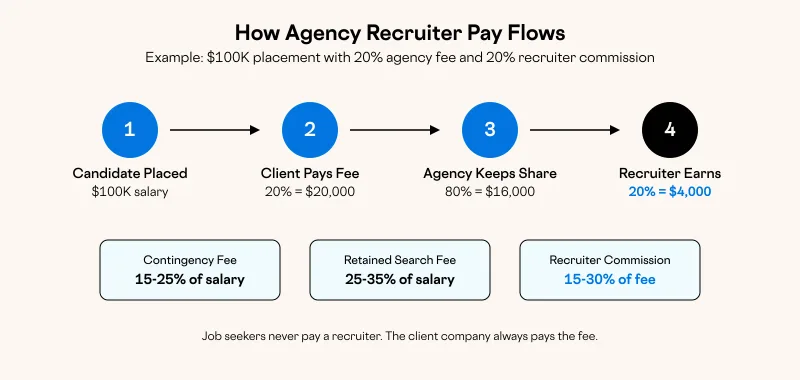
When a company hires a recruitment agency to fill a role, the agency charges a fee based on the placed candidate's first-year salary. The standard fee structure breaks down like this:
- Contingency recruitment: 15 to 25% of the candidate's first-year salary, paid only when a placement is made. This is the most common model for mid-level and junior hires.
- Retained search: 25 to 35% of first-year salary, paid in installments (typically one-third upfront, one-third at shortlist, one-third at placement). Used primarily for executive and senior leadership roles.
- RPO (Recruitment Process Outsourcing): Monthly management fees plus per-hire fees. The recruiter works as an embedded extension of the client's TA team.
On a $100,000 placement using contingency recruitment at a 20% fee, the agency earns $20,000. On a $250,000 executive placement using retained search at 30%, the agency earns $75,000. The American Staffing Association reports that the average contingency fee has remained stable at approximately 20% over the past decade, though competitive pressure has pushed some high-volume accounts to 15 to 18%.
How the Recruiter Gets Their Cut
The agency keeps the fee and pays the recruiter a percentage as commission. This is where it gets complicated, because commission structures vary wildly between agencies. The most common models:
Flat-rate commission: The recruiter earns a fixed percentage of every fee, typically 15 to 30%. On that $20,000 placement fee, the recruiter earns $3,000 to $6,000.
Tiered commission: The percentage increases as the recruiter bills more. For example: 15% on the first $200,000 in annual billings, 20% on $200,000 to $400,000, 25% on everything above $400,000. This rewards top performers disproportionately.
Revenue share/desk split: The recruiter keeps 40 to 60% of fees after the agency deducts overhead costs. Common at smaller, independent agencies.
For the complete breakdown of commission mechanics, including draws, clawbacks, and how to compare commission plans across agencies, see our detailed guide to recruiter commission structures.
The Draw System
Most agency recruiters receive a "draw" against future commission. This works like a guaranteed minimum payment. If your draw is $4,000 per month and your commission for the month is $2,000, you still receive $4,000 but carry a $2,000 negative balance into the next month.
Draws can be recoverable (you owe the difference back) or non-recoverable (the agency absorbs the loss). Non-recoverable draws are essentially a base salary. Recoverable draws can create a debt cycle during slow periods that makes it difficult to catch up.
How Do In-House Recruiters Get Paid
How do in-house recruiters get paid? They work directly for a single company and are compensated through a salary-plus-bonus model, similar to most corporate roles.
Base Salary
In-house recruiter base salaries range from $55,000 to $105,000 depending on experience, company size, and location. The base is the primary component of in-house recruiter compensation, typically representing 80 to 95% of total pay.
Bonus Structure
Most in-house recruiters receive an annual bonus of 5 to 20% of base salary, tied to individual performance metrics and/or company performance. Common bonus triggers include:
- Time-to-fill targets: Filling positions within target timelines
- Quality-of-hire metrics: Retention rates of placed candidates at 6 and 12 months
- Hiring volume: Meeting or exceeding requisition targets
- Cost-per-hire: Keeping recruitment costs below budget
- Hiring manager satisfaction: Internal NPS or feedback scores
Some companies offer per-hire bonuses for particularly difficult-to-fill roles ($500 to $2,000 per placement), but this is less common than a structured annual bonus.
Equity and Stock
At tech companies and startups, equity is a meaningful part of in-house recruiter compensation. RSU (restricted stock unit) grants typically vest over 4 years and can add $15,000 to $50,000+ annually to total comp at public tech companies. At pre-IPO startups, equity is a bet on the company's future value.
Benefits
In-house recruiter roles generally come with stronger benefits than agency positions: health insurance, 401(k) matching, paid time off, parental leave, professional development budgets, and sometimes perks like gym memberships or commuter benefits. The total value of benefits can add $15,000 to $30,000 to the compensation package.
How Do Freelance and Contract Recruiters Get Paid
Freelance recruiters get paid differently from their employed counterparts. They operate independently, either filling roles directly for clients or providing contract recruiting support.
Hourly/Daily Rate
Contract recruiters hired on an hourly or daily basis earn $40 to $100+ per hour, depending on specialization and market. A mid-level contract recruiter working full-time at $65/hour earns roughly $135,000 annually before taxes and expenses.
Per-Placement Fee
Some freelance recruiters negotiate per-placement fees directly with clients. These fees range from $5,000 to $25,000 per successful hire, depending on the role's level and difficulty. The freelance recruiter keeps the entire fee (minus business expenses) rather than splitting it with an agency.
Retainer Arrangements
Experienced freelance recruiters sometimes secure monthly retainer agreements with clients, providing ongoing recruiting support for a fixed monthly fee of $3,000 to $10,000+. Retainers provide income stability that neither hourly nor per-placement models offer.
For more on going independent, check out our freelance recruiter guide.
How Do Recruiters Get Paid by Clients? (The Client's Perspective)
Job seekers never pay a recruiter directly. The client company pays the fee. Here is what companies pay for recruiting services:
| Recruitment Model | Fee Structure | Typical Cost |
|---|---|---|
| Contingency (Agency) | % of first-year salary | 15-25% ($15K-$25K on a $100K hire) |
| Retained Search | % of first-year salary | 25-35% ($62K-$87K on a $250K hire) |
| RPO | Monthly fee + per-hire | $5K-$15K/mo + $3K-$8K per hire |
| Contract/Temp Staffing | Hourly markup | 25-75% markup on worker's hourly rate |
| Freelance Recruiter | Per-placement | $5K-$25K per hire |
The industry standard for contingency recruitment has been 20% for decades, though competitive pressure has pushed some agencies to offer 15 to 18% on high-volume accounts. Retained search firms command higher percentages because they dedicate resources exclusively to the search and guarantee delivery.
Do Recruiters Get Paid if the Candidate Quits?
This is one of the most common questions about how recruiters get paid, and the answer is: it depends on timing.
During the guarantee period (typically 60-90 days): Most agency contracts include a guarantee clause. If the placed candidate leaves within this period, the agency must either refund the fee (full or partial) or provide a replacement candidate at no additional charge. The recruiter's commission is clawed back accordingly.
After the guarantee period: The fee is fully earned. The candidate can quit on day 91 and the agency keeps the full fee. The recruiter keeps their commission.
For in-house recruiters: Candidate departures do not directly affect compensation, though retention metrics may influence bonus calculations.
The guarantee period creates real financial risk for agency recruiters. A $15,000 commission that gets clawed back three months later can create a significant income shortfall. This is why experienced agency recruiters stay in touch with their placements during the guarantee period, ensuring onboarding goes smoothly.
How Do Recruiters Get Paid Across Different Models
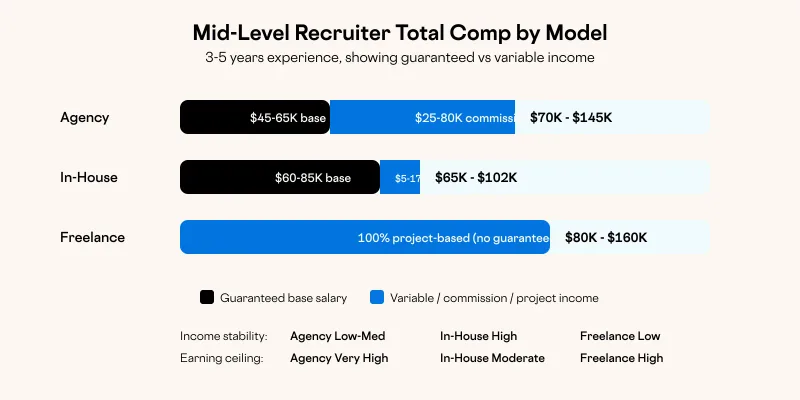
Here is a direct comparison of total compensation for a mid-level recruiter (3 to 5 years experience) across all three models:
| Factor | Agency | In-House | Freelance |
|---|---|---|---|
| Base/Guaranteed Income | $45,000-$65,000 | $60,000-$85,000 | $0 (project-based) |
| Variable Income | $25,000-$80,000 | $5,000-$17,000 | Project-dependent |
| Total Comp Range | $70,000-$145,000 | $65,000-$102,000 | $80,000-$160,000 |
| Income Stability | Low-Medium | High | Low |
| Benefits | Varies | Strong | Self-funded |
| Earning Ceiling | Very High | Moderate | High |
For the full picture of what recruiters earn across all these models, by experience level and specialization, see the comprehensive recruiter salary guide for 2026.
How to Evaluate Your Own Pay Structure
Now that you understand how do recruiters get paid across models, here is how to assess whether your compensation is competitive:
For Agency Recruiters
- Calculate your effective commission rate: total commission earned divided by total billings. If it is below 18%, your plan may be below market.
- Compare your OTE (base + realistic commission) against the benchmarks in our salary guide, not just base.
- Understand your draw terms. A recoverable draw with aggressive thresholds can turn a seemingly good comp plan into a trap.
- Factor in desk quality. A warm desk with existing client relationships is worth more than a higher commission rate on a cold desk.
For In-House Recruiters
- Add base + annual bonus + equity value + benefits value for your true total comp.
- Compare against the BLS data for your metro area using the Occupational Employment and Wages data.
- If your bonus is more than 20% discretionary, push for documented performance metrics so you know exactly what triggers full payout.
For Freelance Recruiters
- Calculate your effective hourly rate after expenses (tools, insurance, marketing, downtime between contracts).
- If your effective rate is below $50/hour after expenses, you may earn more as an employed recruiter with benefits.
- Build retainer clients for income stability alongside per-placement work for upside.
FAQ: How Do Recruiters Get Paid?
Does it cost anything to use a recruiter as a job seeker?
No. Legitimate recruiters never charge candidates a fee. The client company pays the placement fee or the recruiter's salary. If a recruiter asks you to pay for their services, that is a red flag.
How do recruiters get paid per placement?
It varies enormously. On a mid-level placement ($80,000 to $120,000 salary), an agency recruiter typically earns $3,000 to $8,000 in commission. On executive placements, commission can reach $15,000 to $30,000+ per hire. In-house recruiters generally do not earn per-placement income.
What percentage do recruitment agencies take?
Recruitment agencies typically charge 15 to 25% of the placed candidate's first-year salary for contingency hires and 25 to 35% for retained executive searches. The industry average is approximately 20% for mid-level contingency placements.
Can recruiters negotiate their commission structure?
Yes, especially experienced recruiters with a strong billing track record. Commission rate, billing thresholds, draw terms, and desk splits are all negotiable. The best time to negotiate is when joining a new agency or after a particularly strong billing year.
How do recruiters get paid for temp/contract placements?
For temporary and contract placements, here is how recruiters get paid: the agency charges the client an hourly rate that includes a markup (typically 25 to 75%) over what the contractor earns. The recruiter earns commission based on the total margin generated over the life of the contract, not just the initial placement.
Your Next Step
Understanding how recruiters get paid is the first step to optimizing your own earnings. Whether you are comparing agency offers, negotiating an in-house package, or considering going freelance, the pay model should match your risk tolerance and financial goals.
If you are ready to see what is out there, browse recruiter jobs on Recruiter Roles. Every listing is a recruiter-specific role, not a generic job board where recruiting positions are buried between marketing coordinators and data entry clerks.
For more context on how much you should be earning at your level, see our complete recruiter salary guide.